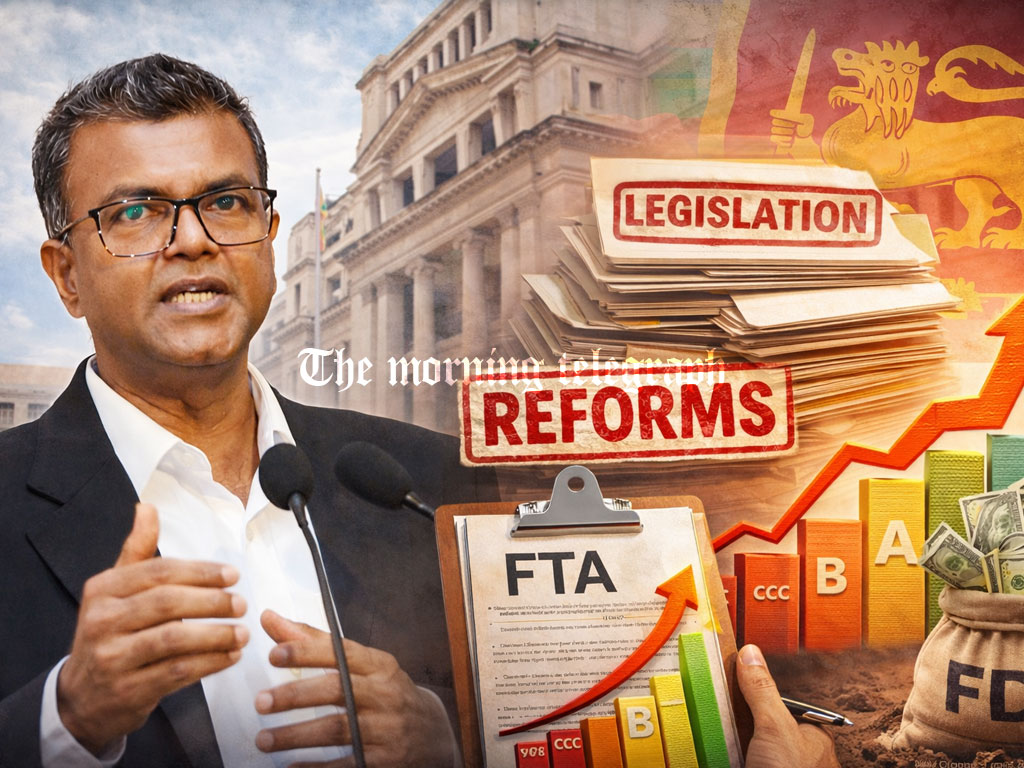
From sweeping SOE reforms to new trade deals and credit rating recovery, the Treasury signals an aggressive legislative overhaul aimed at restoring investor confidence, unlocking FDI, and stabilising Sri Lanka’s economic future.
Sri Lanka’s reform momentum is accelerating, with more than 20 new laws under review and several expected to be enacted within the year, Treasury Secretary Dr. Harshana Suriyapperuma revealed last week while outlining the 2026 Budget roadmap.

Legislative Overhaul Gains Pace
Addressing the Association of Professional Bankers Annual Convention, Dr. Suriyapperuma said the Government’s reform blueprint is clearly laid out in the 2026 Budget. The focus is on repealing outdated Acts and introducing modern legislation to improve the ease of doing business, strengthen governance, and attract foreign direct investment.
Among the most closely watched measures are the proposed State-Owned Enterprises Act, insolvency and restructuring legislation, and enhanced anti-corruption frameworks. These reforms align closely with recommendations in the International Monetary Fund’s 2023 Governance Diagnostic Assessment, which highlighted structural weaknesses in SOEs, energy, Customs, and Inland Revenue administration.
The SOE Act, aimed at improving accountability, efficiency, and decision-making speed, is expected to be finalised within weeks. Insolvency reforms have already received approval, creating a legal pathway for restructuring financially distressed companies.
Global Positioning and Trade Ambitions
Dr. Suriyapperuma emphasised Sri Lanka’s strategic geographic location as a unique advantage. The Government intends to unlock its maritime hub potential while ensuring macroeconomic sustainability.
Restoring sovereign credit ratings and improving access to international capital markets remain key objectives. Lower borrowing costs and improved investor sentiment are viewed as essential to rebuilding foreign exchange reserves and stabilising the currency.
The Government has also submitted its first application to pursue new Free Trade Agreements with selected countries and regions, signalling a renewed outward looking trade strategy.
Fiscal Discipline and Banking Support
The Treasury has settled Rs. 45 billion in outstanding obligations that had remained on bank balance sheets for years, helping reduce non-performing loans and strengthen the financial system. Dr. Suriyapperuma noted that medium-term growth is targeted at 7 percent.
Pro-banking measures under the 2026 Budget will take effect from April. A Rs. 95 million allocation is being channelled through banks to support small and medium enterprises. As of 31 January, Rs. 8 million had already been disbursed, alongside nearly Rs. 7 million in collateral-free loans extended to young and women entrepreneurs across districts.
Structural Reform Amid Global Uncertainty
The reform agenda unfolds against a backdrop of global volatility, geopolitical tensions, and environmental risks. Sri Lanka’s external position, including reserve buffers, leaves little room for policy missteps.
Dr. Suriyapperuma stressed that confidence remains the decisive factor in economic, political, and social stability. Zero tolerance for corruption and revenue-enhancing structural reforms have strengthened fiscal credibility.
Risk premiums on International Sovereign Bonds, as well as domestic Treasury Bills and Bonds, are declining, reflecting improved market confidence. The 2026 Budget was presented without additional borrowing despite fiscal pressures, which the Treasury describes as a sign of restored financial discipline.
Continuous engagement with investors, development partners, and the private sector will remain central. The objective is to create a stable, predictable environment where banks can expand lending, private enterprise can grow, and Sri Lanka can position itself as a credible destination for global capital.