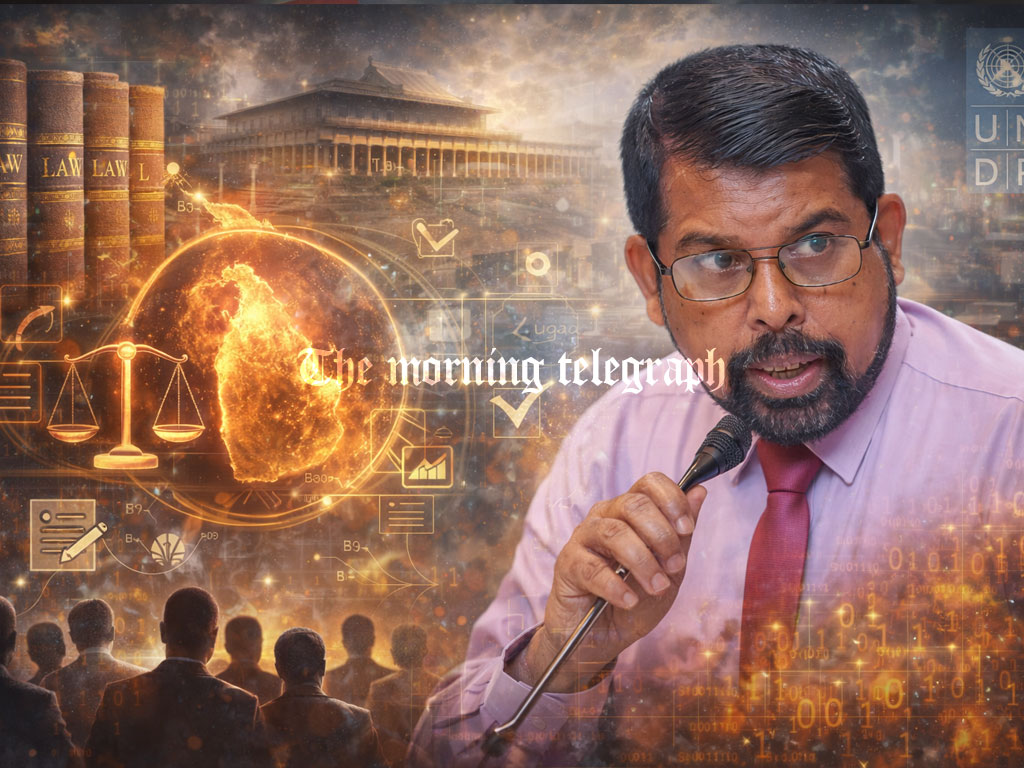
Sri Lanka signals a sweeping legal reform agenda aimed at modernizing colonial-era statutes, digitizing governance and restoring public trust in state institutions.
The government has formally announced plans to review and amend long standing laws across multiple sectors, in what is being described as a transformative legal reform programme. Professor Chandana Abayaratne, Minister of Public Administration, Provincial Councils and Local Government, confirmed that outdated statutes and ordinances will be revised and simplified to ensure more efficient public service delivery and greater accessibility for citizens.

The Minister made these remarks while addressing the inaugural session introducing legal reforms to public officials. The event marked the launch of a structured initiative to modernize Sri Lanka’s public administration legal framework in line with the digital era. The programme is being implemented with the full support of the United Nations Development Programme and was held at the Cinnamon Lakeside Hotel in Colombo under the Minister’s patronage.
The objective of the initiative is to update existing laws, rules and regulations governing Sri Lanka’s public administration system. The broader vision is to strengthen efficiency, enhance transparency, and rebuild public trust in the public service. In an era increasingly shaped by digital governance, e administration and institutional accountability, the reform process seeks to make government services simpler and more citizen centric.
Speaking further, the Minister emphasized that the Cabinet, chaired by the President, has granted approval for the reform process on two separate occasions through Cabinet Papers. Recommendations have already been issued to sub committees representing various ministries and thirteen different sectors to carry out the review and amendment work. This coordinated approach signals that the reform agenda is not symbolic but structurally embedded within government policy.
The Minister acknowledged that many of Sri Lanka’s laws date back to the British colonial period, and in some cases even reflect legal traditions that predate that era. While he noted that age alone does not justify repeal, he stressed the importance of evaluating whether those laws remain relevant in contemporary governance. Effective legal provisions should be retained, but regulations that no longer align with modern economic, social and technological realities must be adapted.
He further observed that Sri Lanka’s citizens, across communities including Sinhalese, Tamils and Muslims, made a decisive choice in 2024 to embark on a new national journey. That shift, he said, extended beyond politics and economics to include a broader cultural and administrative transformation. Legal reform, in this context, becomes a foundational pillar in strengthening democratic governance and national unity.
The Minister framed the current moment as a historic opportunity. Throughout global history, he noted, new legal traditions have often emerged during periods of collective renewal. He described the present era as one such turning point for Sri Lanka. The central question, he suggested, is how the country can build a future where younger generations are spared the hardships experienced in previous decades.
Creating that environment requires a comprehensive legal modernization strategy. By reforming outdated laws and aligning them with digital governance standards, the government aims to facilitate economic development, institutional efficiency and improved public service performance. The reform process is also expected to support anti corruption efforts and administrative clarity.
The Minister extended gratitude to the Special Representative of the United Nations Development Programme and her staff, the Minister of Justice, the Attorney General’s Department, and the Ministry of Justice for their collaboration. He also thanked officials from his own Ministry and participants representing various subject areas who attended the session.
Among those present were Secretary to the Ministry of Public Administration S. Aloka Bandara, Secretary to the Ministry of Justice and National Integration President’s Counsel Ayesha Jinasena, Deputy Resident Representative of the United Nations Development Programme Marina Ten, Policy Specialist and Head of the Integration Management Team Chandrika Karunaratne, Additional Secretary Dr. Roshini Dissanayake, Additional Solicitor General President’s Counsel Ravindra Pathiranage, Director General of the Department of Pensions Chaminda Hettiarachchi, Director of Legal Affairs at the Ministry of Finance A. K. D. D. D. Arandara, Divisional Secretaries and senior public officials from multiple government institutions.
As Sri Lanka embarks on this ambitious legal reform programme, the emphasis remains clear: modern laws, transparent governance and a public service that commands confidence in a rapidly evolving world.