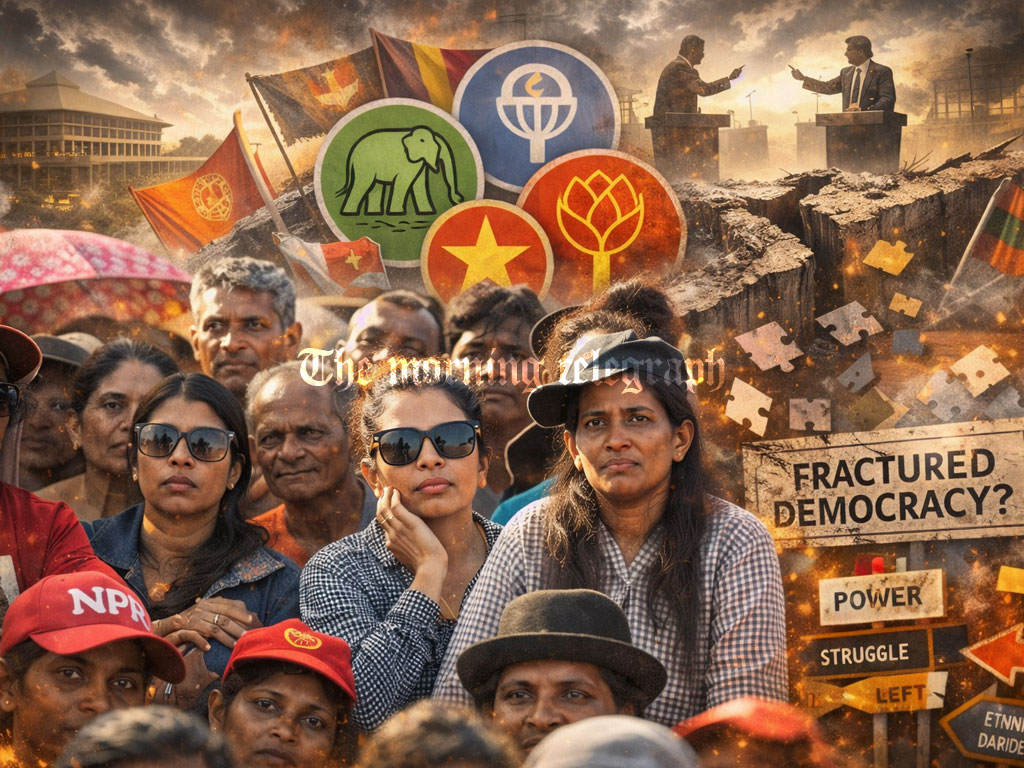
With 88 registered political parties and counting, Sri Lanka’s expanding party system raises urgent questions about democratic strength, voter clarity, and the true state of political accountability.
Sri Lanka’s political landscape is often described as vibrant and diverse, yet it is also marked by an astonishing proliferation of political parties. From the era of local monarchs to British colonial rule beginning on March 2, 1815, the island’s governance evolved through layers of external control and internal reform. Universal suffrage was introduced in 1931, a milestone in democratic representation, though Sri Lanka remained under the British Crown until adopting a republican constitution in 1972. Within this evolving constitutional framework, citizens gained the right to elect representatives, but a structured political party system did not formally take shape until 1935 with the formation of the Lanka Sama Samaja Party. That moment proved pivotal, producing leaders such as Dr. Colvin R. de Silva, Dr. N.M. Perera, Philip Gunawardena, Dr. S. Wickramasinghe, and Leslie Gunawardena, figures who shaped the island’s socialist and nationalist movements.

Over the decades, Sri Lanka’s political party system expanded at an unprecedented pace. As of 2026, the Election Commission lists 88 registered political parties, including five newly registered in 2025. These parties represent a broad spectrum of ideologies, ethnic identities, regional interests, and policy platforms. Some draw legitimacy from independence era struggles, while others are recent formations seeking space in a competitive electoral environment. Established entities such as the United National Party, Sri Lanka Freedom Party, Janatha Vimukthi Peramuna, and the Ceylon Workers’ Congress continue to dominate public discourse. Alongside them operate parties with distinct ethnic or issue based identities, including the Tamil Makkal Katchi, Eelam People’s Democratic Party, and the Frontline Socialist Party. Periodically, certain parties are removed from the official register, reflecting shifts in political relevance and organizational viability.
Yet the sheer number of registered parties does not necessarily translate into vibrant electoral competition. In most national elections, only a limited group actively contests seats. Many smaller parties appear to register for short term strategic purposes rather than sustained political engagement. Larger parties frequently absorb, align with, or co opt minor outfits to consolidate parliamentary strength. While multiparty democracy is theoretically designed to enhance voter choice and broaden representation, the Sri Lankan experience often reveals duplication, fragmentation, and diluted political accountability.
The historical evolution of party politics in Sri Lanka underscores an enduring tension between representation and fragmentation. Early political movements sought to mobilize citizens around coherent ideological visions and policy goals. The Lanka Sama Samaja Party, for instance, articulated working class and leftist aspirations grounded in social justice and national development. Over time, however, ideological clarity has diminished as parties multiplied. Today, numerous parties operate less as ideological platforms and more as vehicles for personal ambition, negotiation leverage, or electoral bargaining power. The result is a political ecosystem where proliferation may weaken democratic oversight rather than strengthen it.
Economic realities, ethnic identities, and regional grievances have further shaped the party system. Many smaller political parties emerge from localized concerns, caste affiliations, or minority interests. While such formations provide voice and representation to communities often marginalized in mainstream politics, they also intensify electoral fragmentation. Coalition governments and political alliances have become routine, with dominant parties integrating smaller groups to secure governing majorities. This pattern highlights a paradox within Sri Lanka’s political plurality. It functions both as an inclusive mechanism and as evidence of systemic weakness. The frequent merging and absorption of minor parties illustrate the tension between democratic ideals and pragmatic power consolidation.
Recent trends demonstrate continuity alongside change. In 2025, the Election Commission registered five new parties: the Socialist People’s Front, the People’s United Democratic Front, the Malaya Arasiyal Arangam, the Samathuthu Katchi, and the Vipulavadi Janatha Balaya. Although these additions expand formal political representation on paper, their tangible impact on governance remains uncertain. The steady cycle of registration, removal, rebranding, and merger reflects a political culture where legal recognition does not always correspond to sustained political engagement or policy influence.
Financial and administrative constraints also influence the survival of smaller parties. Many struggle to secure funding, maintain organizational infrastructure, or sustain visibility between election cycles. Their dependence on alliances with larger parties often results in marginalization or eventual absorption. Consequently, Sri Lanka presents a paradoxical democratic landscape. Voters appear to enjoy a wide range of registered options, yet effective decision making remains concentrated within a handful of dominant political actors.
Sri Lanka’s party system, shaped by colonial legacy, universal suffrage, and republican transition, embodies both historical continuity and contemporary strain. The proliferation of political parties raises a fundamental question about democratic health. Does the existence of dozens of registered entities genuinely enhance citizen participation and accountability, or does it create confusion and inefficiency?
Observers suggest that the current wave of party proliferation represents both opportunity and risk. Multiple parties can amplify diverse voices and minority representation. At the same time, repeated cycles of inactivity and absorption point to institutional fragility. Citizens may become disengaged when a system promises extensive choice but delivers limited practical alternatives. Ultimately, Sri Lanka’s expanding party register forces a deeper reflection on governance reform, political accountability, and whether numerical growth in parties equates to democratic strength or signals deeper structural stress.