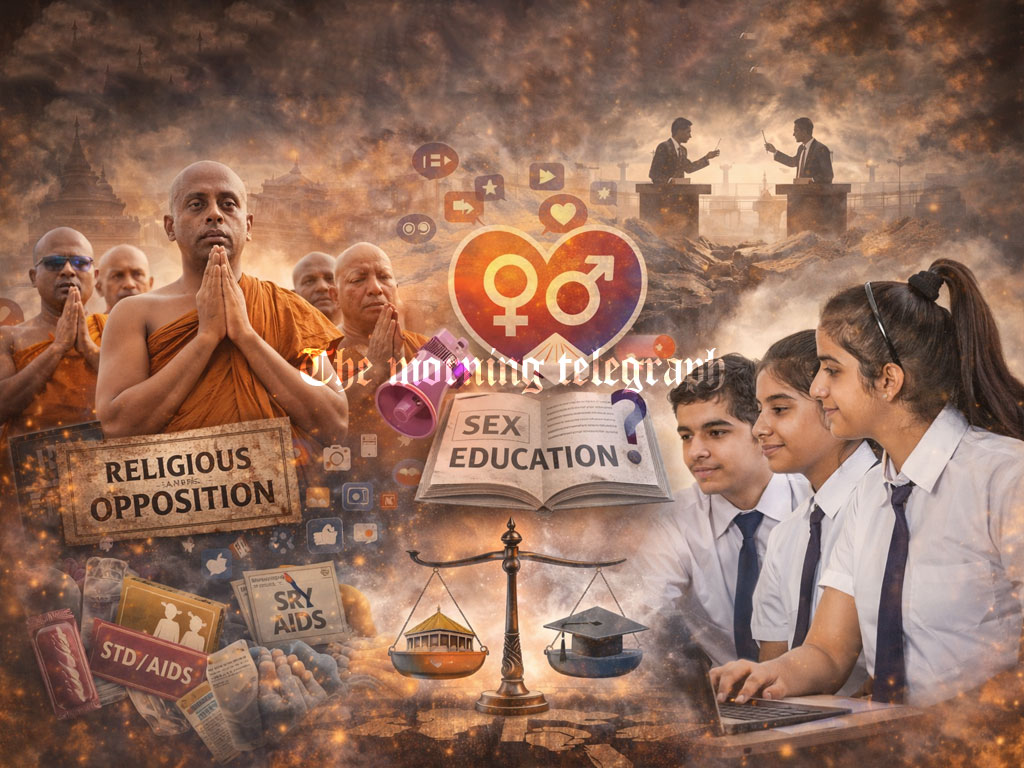
A renewed national debate has erupted over sex education in Sri Lanka, as religious objections collide with calls for life skills learning, public health awareness, and culturally sensitive reform in schools.
For decades, successive governments have hesitated to formally integrate sex education into the national school curriculum, often citing resistance from religious leaders. That long standing tension resurfaced after remarks made at the Sangha Conference in Colombo on February 20 by the Anunayake of the Kotte Sri Kalyani Samagri Dharma Maha Sangha Sabha, Professor Kotapitiye Rahula Thero. His statement that sex education is unnecessary for children reignited fierce debate across social media and public forums.

‘We do not need sex education’
“Recently, it was stated that we need to bring sex education to our country. Do the people of our country need sex education? I don’t think the people of our country need sex education. In our country at that time, people lived good married lives, raised ten children, lived very happily, and they kept their privacy and modesty as they wanted. What nonsense is this sex education? Do we need sex education? We don’t need sex education,” the Venerable Thera said.
Reflecting on what he described as past values, the Thera offered an example from early railway history in Sri Lanka.
“At that time, when the train was first introduced to Sri Lanka, people were lining up on both sides of the railway tracks to see this train. When this train came, mothers were watching on the side of the road to see how some part of this train engine worked. They say that they covered the face of their daughter with the cloth they were wearing. This is our sex education. The girls covered their faces with the cloth they were wearing. It was not a sexual story. But it was something unpleasant, adults know how the engine works. This is how sexuality is in our country. We are not going to talk about this sexuality. But now that we have introduced sexuality in a strange way, I think it is the same whether we introduce it to education again or not. Information about sexuality, which affects this cultural decline, has now been socialized in a social way,” said Professor Kotapitiye Rahula Thero.
Public Reaction and Social Media Debate
Once the sermon circulated widely, strong reactions emerged online. Supporters praised the defense of cultural values, while critics argued that moral panic should not override educational reform and adolescent health needs. The issue quickly became a focal point in the broader conversation about curriculum reform, youth protection, and public health policy.
‘Sex education is essential for life’
Former Chairperson of the National Education Commission, Padmini Ranaweera, stated that religion and sex education should not be conflated.
“I am not prepared to believe that religion is enough to build character, to teach someone how to live properly, and that is enough. When viewed in light of today’s needs, I believe that sex education is something that should be included in education. We should not look at it with the wrong eyes by calling it sex. At what age should that education be given? I fundamentally accept that sex education is an education necessary for life.”
Why structured sex education matters
She drew a practical analogy to nutrition education.
“If we do not learn about eating properly, we will develop a number of non communicable diseases by eating the wrong foods. We need to have an understanding of eating. Similarly, we need to have an understanding of choosing food. Such understanding is needed so that we do not go astray and that education is needed to do the right thing. Sex education is one of those things.”
Ranaweera emphasized that sex education is about informed decision making and personal responsibility.
“If a young girl becomes pregnant after reaching puberty due to ignorance, it is not a mistake that can be fixed. Where does it end? It is necessary to provide education to prevent that.”
Clarifying what sex education teaches
She stressed that comprehensive sex education is not instruction in sexual activity but awareness of the body and responsibility.
“Sex education should be, it is another part of your body. If you don’t understand it, you will do wrong things. Once you do wrong things, you will go to a place where you cannot turn back. Therefore, instead of destroying your life, make responsible decisions and face life responsibly. Responsible means, I know that I am responsible for it. Therefore, I am responsible. I will not go anywhere even if anyone tells me, I will not agree even if anyone suggests it. That awareness is essential.”
“If you think that providing sex education will destroy the country, I do not accept it. It will not happen,” she said.
Sex education within cultural context
Professor Premakumar de Silva from the Department of Sociology at the University of Colombo argued for a balanced approach rooted in cultural sensitivity.
“One group says that sex education is completely unnecessary because it is cultural. Those who say that sex education is necessary say that sex education should not be linked to culture and that it should be brought in necessarily. I say that both these ideas are important. A combination of both these ideas, that is, a cultural concern in some way, is very important to start providing sex education with an understanding of it.”
He noted that sexuality is a scientific reality and that ignorance can harm society.
“Sexuality is human nature. Buddhism and other religions also talk about understanding human nature. There are analyses of how something comes about. Religions also have those analyses. I think that is the education that should be given. This can also be brought into religious education. That is, how sexuality is understood religiously, how it is described within it. That is why I think that sex education is considered a taboo or something that we should not talk about publicly, that we should not bring it into our public space, that it is an issue that should be resolved in the private space, which I see as a statement made without a broad understanding of the issue.”
He further emphasized the importance of age appropriate sex education for both school and university students. As Sri Lanka navigates education reform, the debate highlights a central challenge: balancing tradition, science, culture, and youth well being in a rapidly changing society.