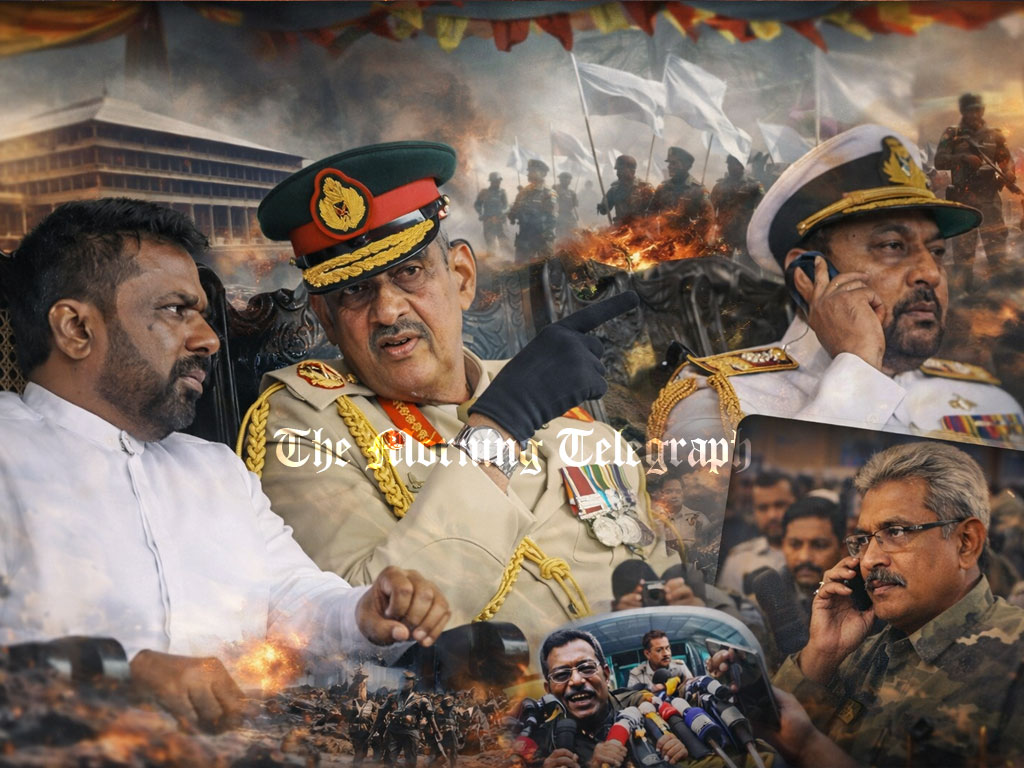
Seventeen years after the military defeat of the Liberation Tigers of Tamil Eelam, former Army Commander Sarath Fonseka has fundamentally altered his account of the final offensive, exonerating the Rajapaksas of war crimes he once attributed to them while raising explosive new questions about alleged backchannel negotiations that could have allowed Velupillai Prabhakaran to survive and potentially enter politics.
With Sri Lanka preparing to mark the seventeenth anniversary of the victory over separatist Tamil terrorism, the war-winning Army Chief who served from December 2005 to July 2009 has made startling revisions to his narrative concerning the final phase of the offensive that concluded on May 18, 2009. The armed forces declared ground operations complete that day after reclaiming the entire northern region, with LTTE leader Velupillai Prabhakaran, discovered hiding within secured territory, killed the following day. His body was recovered from the banks of the Nanthikadal lagoon, bringing a violent end to nearly three decades of civil conflict that had claimed tens of thousands of lives and displaced countless civilians .

As the war reached its inevitable conclusion, with the increasingly cornered Tigers taking refuge among helpless Tamil civilians, Fonseka departed for Beijing on May 11, returning to Colombo around midnight on May 17, 2009. In their final desperate attempt to facilitate Prabhakaran’s escape, the LTTE breached one flank of the 53 Division around 2.30 am on May 18. However, they failed to achieve their objective, and by noon the following day, those fanatical followers of the Tiger Supremo, trapped within military-controlled territory, died in confrontations with government forces .
During Fonseka’s absence, the celebrated 58 Division, formerly Task Force 1, commanded by then Major General Shavendra Silva, advanced approximately three and a half to four kilometres and positioned themselves appropriately alongside Major General Kamal Gunaratne’s 53 Division. The LTTE never had any realistic opportunity to save their leader by breaching the multiple lines held by frontline troops on the Vanni east front. Surrender to the Army appeared the only remaining option for the trapped Tiger fighters .
The Sinha Regiment veteran, who had repeatedly accused the Rajapaksas of war crimes and betraying the war effort by allegedly providing USD 2 million to the LTTE ahead of the 2005 presidential election in return for ordering a polls boycott that enabled Mahinda Rajapaksa’s victory, last week made noteworthy changes to his much disputed narrative. These revisions carry profound implications for understanding Sri Lanka’s military and political history, while simultaneously raising questions about the motivations behind such a dramatic shift in testimony .
The Revised Allegations: What Fonseka Now Claims
Fonseka’s revised account contains several dramatic assertions that deserve careful examination. He claimed the Rajapaksas wanted to sabotage the war effort beginning January 2008, alleging that during that month, Mahinda Rajapaksa, Defence Secretary Gotabaya Rajapaksa, and Navy Commander Wasantha Karannagoda proposed to the National Security Council that the Army should advance from Vavuniya to Mullaitivu on a straight line to rapidly conclude the war. They reportedly asserted that Fonseka’s strategy of fighting the enemy on multiple fronts caused unnecessary casualties, attempting to discourage the then Lieutenant General from his chosen military approach .
The former Army Chief produced purported video evidence to demonstrate decisive intervention by Defence Secretary Gotabaya Rajapaksa on the afternoon of May 17. This assertion centred on a telephone call received by Major General Shavendra Silva from Gotabaya Rajapaksa, captured on video by Swarnavahini journalist Shanaka de Silva, who now resides in the United States. De Silva had been among the few media representatives authorised by Army Headquarters and the Defence Ministry to accompany military leadership on the battlefield. Fonseka dramatically claimed that the videographer fled the country to escape death at the hands of the Rajapaksas, a statement reminiscent of former President Maithripala Sirisena’s assertion that he would be killed if the Rajapaksas won the 2015 presidential election against him .
The video allegedly captured Shavendra Silva disclosing three conditions laid down by the LTTE for surrender: their casualties should be evacuated to Colombo by road; they were ready to exchange six captured Army personnel for those in military custody; and the remainder were prepared to surrender. Subsequently, Fonseka received a call from Gotabaya Rajapaksa on a CDMA phone, with the Defence Secretary issuing specific instructions that if the LTTE was to surrender, it should be to the military and definitely not to the ICRC or any other third party. Gotabaya Rajapaksa, a former Commanding Officer of the 1st Battalion of the Gajaba Regiment, ordered that regardless of any new developments or talks with the international community, offensive action should not be halted. This declaration directly contradicted Fonseka’s previous claims that the Rajapaksas conspired to throw a lifeline to the LTTE .
In his latest statements, Fonseka declared that the Rajapaksa brothers, in consultation with the ICRC and Amnesty International, offered an opportunity for the LTTE leadership to surrender, whereas his order was to annihilate the organisation entirely. The overall plan was to eliminate all Tiger fighters, Fonseka asserted, alleging that the Rajapaksas initiated talks with the LTTE and other parties to save those trapped by ground forces in a 400 metre by 400 metre area by the night of May 16, among Tamil civilians being held as human shields .
Fonseka further claimed that if the LTTE had agreed to surrender to the Army, Mahinda Rajapaksa would have saved their lives, suggesting that in such a scenario, Velupillai Prabhakaran might have ended up as Chief Minister of the Northern Province. This extraordinary speculation about Prabhakaran potentially entering mainstream politics represents one of the most dramatic counterfactuals in Sri Lanka’s post-war discourse. Perhaps most shockingly, Fonseka declared that he never accused the 58 Division of executing prisoners of war in the so called white flag killings, but rather that the issue was created by media personnel embedded with military leadership. Fonseka stated that accusations regarding white flag killings never actually happened, claiming this narrative developed based on the Rajapaksas’ failed bid to save the lives of LTTE leaders .
The White Flag Allegations: A Sixteen-Year Controversy
Before examining the various assertions and allegations made by Fonseka, it is essential to remind readers of wartime US Defence Advisor in Colombo, Lieutenant Colonel Lawrence Smith’s June 2011 denial of white flag killings. The US State Department promptly declared that the officer had not spoken at the inaugural Colombo seminar on behalf of the United States. Smith’s declaration, made two years after the war ended and within months after the release of the Darusman report, dealt a massive blow to what many considered false war crimes allegations .
UN Secretary General Ban Ki-moon appointed a three member Panel of Experts in 2010, criticised by some as resembling a kangaroo court, consisting of Marzuki Darusman, Yasmin Sooka, and Steven Ratner to investigate war crimes accusations. Now Fonseka has effectively confirmed what Smith revealed at the defence seminar in response to a query posed by Major General retired Ashok Mehta of the IPKF to Shavendra Silva, who had been number two in Sri Lanka’s UN mission in New York at that time .
White flag allegations cannot be discussed in isolation from their political context. Fonseka originally made these claims as the common presidential candidate backed by the UNP, JVP, and TNA combine. That shocking declaration appeared in an interview with The Sunday Leader Editor Frederica Jansz, published on December 13, 2009 under the headline “Gota ordered them to be shot: General Sarath Fonseka.” The white flag story featured sensationally in a leaked confidential US Embassy cable during Patricia Butenis’ tenure as US Ambassador in Colombo. Butenis authored that cable at 1.50 pm on December 13, 2009, the same day the now defunct Sunday Leader exclusive appeared. Butenis had lunch with Fonseka in the company of then UNP Deputy Leader Karu Jayasuriya, according to the cable. Perhaps most significantly, Butenis noted that Fonseka’s advisors, namely the late Mangala Samaraweera, Anura Kumara Dissanayake, and Vijitha Herath, wanted him to retract part of the story attributed to him .
Frederica Jansz fiercely stood by her explosive story, reiterating its accuracy during the white flag hearing when this writer spoke with her. There appears little reason to suspect Jansz misinterpreted Fonseka’s responses to her queries. Subsequently, Fonseka repeated the white flag allegation at public rallies held in support of his candidature. Many eyebrows were raised at The Sunday Leader’s almost blind support for Fonseka, particularly against the backdrop of persistent allegations directed at the Army over Lasantha Wickrematunga’s killing in early January 2009 .
The Darusman report dealt extensively with the white flag killings, which became central to unsubstantiated Western accusations directed at the Sri Lankan military. Regardless of the political environment in which these accusations emerged, the issue received global attention for obvious reasons: the accuser was the war winning Army Commander who had defeated the LTTE. Yet Fonseka insisted, both during his meeting with Butenis and in recent public statements, that the Rajapaksas had worked behind his back with members of the international community .
In a dramatic February 2026 press conference, Fonseka released what he claimed was video evidence showing that LTTE members approached the military carrying white flags to surrender, and that Defence Secretary Gotabaya Rajapaksa allegedly ordered them to be killed . This latest release reignited controversy over the long-debated white flag incident, with Fonseka describing the material as significant evidence connected to longstanding allegations surrounding the deaths of several LTTE political figures, including Balasingham Nadesan and Seevaratnam Pulidevan, during the final phase of the conflict .
The white flag incident remains one of the most disputed and sensitive issues related to the end of Sri Lanka’s civil war. Successive governments and military officials have previously denied allegations of wrongdoing, while international human rights organizations have repeatedly called for independent investigations . Analysts suggest the renewed controversy could have significant political and legal implications as debate over accountability during the final phase of the war resurfaces once again.
Political Reactions: Namal Rajapaksa Welcomes the Shift
The political response to Fonseka’s revised narrative has been notably positive from the Rajapaksa camp. Sri Lanka Podujana Peramuna National Organizer and Parliamentarian Namal Rajapaksa welcomed Fonseka’s statement, describing it as a positive development that the former Army Commander had publicly said that former President Mahinda Rajapaksa is not a murderer .
Responding to questions from journalists regarding Fonseka’s recent statement, Namal Rajapaksa acknowledged that while Fonseka can be controversial, it was Mahinda Rajapaksa who, during the final stages of the war, made a public media statement calling on Velupillai Prabhakaran to lay down arms and surrender. He noted that calls for surrender to the military were not unusual in the context of war, but alleged that Fonseka had at different times made conflicting claims regarding orders given during the conflict .
Namal Rajapaksa emphasized that the military campaign was not directed against the Tamil community but specifically against the Liberation Tigers of Tamil Eelam. He reminded that thousands of war heroes sacrificed their lives to defeat terrorism and maintained that Mahinda Rajapaksa’s objective was to end the conflict with minimal loss of life and damage to property .
Expressing gratitude to Fonseka for what he described as clarifying that Mahinda Rajapaksa was not a bloodthirsty killer, as alleged by certain political groups and sections of the LTTE diaspora, Namal Rajapaksa further stated that the former President sought to be remembered as a leader who brought freedom to the country rather than one who caused destruction. He highlighted post-war infrastructure development projects, including highways and airports, as part of Mahinda Rajapaksa’s legacy, adding that his primary goal had been to secure peace and stability for the nation with the least possible loss of life .
This endorsement from the Rajapaksa family underscores the political significance of Fonseka’s reversal, transforming him from accuser to defender of the very individuals he once condemned on the international stage.
The International Context: Sanctions and Accountability
Fonseka’s latest declaration that the Rajapaksas wanted to save the LTTE leadership came close on the heels of British Deputy Prime Minister David Lammy’s brief visit to Sri Lanka. The United Kingdom, as leader of the Core Group on Sri Lanka at the Geneva based United Nations Human Rights Council, has spearheaded campaigns targeting Sri Lanka. Lammy was en route to New Delhi for the AI Impact Summit, having previously pushed for action against Sri Lanka during the UK general election. Taking punitive action against the Sri Lankan military had been a key campaign slogan meant to attract Tamil voters of Sri Lankan origin .
This campaign contributed to the declaration of sanctions in March 2025 against Admiral of the Fleet Wasantha Karannagoda, General retired Shavendra Silva, General retired Jagath Jayasuriya, and former LTTE commander Karuna, who had rebelled against Prabhakaran. Defending Shavendra Silva approximately a week after the UK sanctions were imposed, Fonseka declared the British action unfair .
But Fonseka’s recent declaration effectively cleared the Rajapaksas of war crimes, instead portraying them as traitors who allegedly sought to preserve LTTE leadership. This statement may undermine the continuous post war propaganda campaign aimed at demonising the Rajapaksas and top ground commanders. Canada, then part of the Western bloc that largely followed the US line, declared that Sri Lanka perpetrated genocide and sanctioned former Presidents Mahinda Rajapaksa and Gotabaya Rajapaksa. Other countries resorted to various actions, though such measures were not always formally announced. General retired Jagath Dias and Major General retired Chagie Gallage were among those targeted .
The international legal pressure on Sri Lankan officials continues unabated. In February 2026, Sri Lankan torture victims filed ten new claims for damages in a US court against wartime defence chief Gotabaya Rajapaksa, potentially complicating any political ambitions he might harbour. The plaintiffs alleged that Rajapaksa, from 2005 to 2015, commanded security forces who systematically abducted, tortured, raped, and extorted money from suspects. According to the South Africa-based International Truth and Justice Project and US law firm Hausfeld, victims were branded with hot metal rods, whipped with cables, and asphyxiated with plastic bags soaked in petrol .
The ten plaintiffs include three women, with eight being ethnic Tamil and two from Sri Lanka’s majority Sinhalese community. Six of them were repeatedly raped and sexually assaulted, the law firm and rights group alleged. A spokesman for Rajapaksa rejected the allegations, describing the lawsuits as mud-slinging propaganda aimed at tarnishing his image. Military spokesman Sumith Atapattu said the allegations against the security forces were totally fabricated .
Two cases were filed in the California court in April against Rajapaksa, one of them by the daughter of a murdered investigative journalist alleging extrajudicial killing. The ITJP noted that several security officials accused of abuse during the war remain in government positions, with executive director Yasmin Sooka observing that alleged perpetrators remaining in key investigative positions in the police force demonstrates why Sri Lankans have been unable to achieve justice inside the country .
Against the backdrop of Fonseka’s latest claims regarding accountability issues, the urgent need to review action taken against Sri Lanka cannot be delayed. Although the United States denied a visa when Fonseka was to accompany President Maithripala Sirisena to the UN in September 2016, he had not been formally accused of war crimes by Western powers, obviously because he served their interests, according to some observers. On the basis of unsubstantiated allegations that had not been subjected to proper judicial proceedings, Geneva initiated actions. The United States, Canada, and Britain acted on those accusations, with the US sanctioning General Shavendra Silva in February 2020 and Admiral Karannagoda in April 2023 .
The New Government’s Position
The current political landscape in Sri Lanka adds another layer of complexity to Fonseka’s revised narrative. The National People’s Power government, led by President Anura Kumara Dissanayake, faces its first major foreign policy challenge at the UN Human Rights Council, which will decide on the level of scrutiny of Sri Lanka, particularly focusing on accountability for human rights violations and the handling of the country’s economic and political crisis .
Since 2009, the international community led by the Western bloc has pressed Sri Lanka at the UN Human Rights Council to investigate and deal with the past, including questions about what happened in the final stages of the war, accountability, finding missing persons, return of land, and demilitarising the north and east. Resolution 51/1 of October 2022 extended and reinforced the capacity of the Office of the High Commissioner for Human Rights to collect and preserve evidence of gross human rights violations, aiming to advance accountability and support judicial proceedings in countries with laws permitting prosecution of war crimes .
This time, however, the situation differs fundamentally. For the first time since UNHRC resolutions on Sri Lanka appeared starting in 2009, Sri Lanka has a government in which none of its members can be accused of participating in excesses committed during the war. The members of the present government were not in positions of power where they could have made decisions regarding the deployment and use of force by security forces. The only time they held cabinet posts was in the period 2004 to 2005 when the Norwegian-facilitated ceasefire agreement operated and armed hostilities had temporarily ceased .
Instead of continuing the confrontational path taken by the two previous governments, an option for the new government would be to take the position that it needs time to study the provisions in the resolution and ascertain implementation possibilities. The ability of the new government to take forward the national reconciliation process that previous governments commenced but did not complete could add to its credibility .
The positive work done by civil society in Sri Lanka received special recognition at the ongoing 57th session of the UN Human Rights Council at a side event on Combating Intolerance, Hate Crimes and Islamophobia hosted by the United States delegation. Under its new leadership, Sri Lanka has the potential to be a positive story in a world increasingly troubled by the breakdown of international norms .
However, Namal Rajapaksa has criticized the current administration, alleging that President Dissanayake lacked the courage to acknowledge the military’s victory over the LTTE during his Independence Day address. Speaking in Parliament, the SLPP national organiser said that the President’s omission of the civil war victory deviates from international norms where leaders typically celebrate historic military achievements during national holidays. Rajapaksa noted that while the President praised the armed forces for recent disaster relief efforts during the Ditwah cyclone, he failed to mention the 2009 victory that ended the decades-long conflict .
Addressing potential sensitivities regarding the conflict, Rajapaksa defended the legacy of the war, asserting that celebrating the military’s success should not be conflated with ethnic prejudice, emphasizing that the war was fought against the LTTE, not the Tamil community .
The DNA Formation and Fonseka’s Political Journey
Having realized that he could not, under any circumstances, reach consensus with the UNP to pursue a political career within that party, Fonseka teamed up with the JVP, one of the parties in the coalition that backed his presidential bid in 2010. Fonseka’s current efforts to reach understanding with the JVP led NPP, where President Anura Kumara Dissanayake leads both registered political parties, should be examined against the backdrop of their 2010 alliance. Under Fonseka’s leadership, the JVP and several other groups contested under the symbol of the Democratic National Alliance, formed on November 22, 2009. However, the grouping pathetically failed to meet their own expectations. The results of the parliamentary polls conducted in April 2010 proved devastating and utterly demoralizing. Fonseka, who polled approximately 40 percent of the national vote at the January 2010 presidential election, ended up with just over 5 percent of the vote, with the DNA managing to secure only seven seats, including two on the National List. The DNA group consisted of Fonseka, former national cricket captain Arjuna Ranatunga, businessman Tiran Alles, and four JVP members, including Anura Kumara Dissanayake .
Having been arrested on February 8, 2010, soon after the presidential election, Fonseka found himself in prison. He was court martialled for committing military offences, convicted of corrupt military supply deals, and sentenced to three years imprisonment. Fonseka vacated his parliamentary seat on October 7, 2010. Following a failed legal battle to protect his MP status, Fonseka was replaced by DNA member Jayantha Ketagoda on March 8, 2011. However, President Mahinda Rajapaksa released Fonseka in May 2012 following heavy US pressure. The United States went so far as to warn then SLFP General Secretary Maithripala Sirisena that unless President Rajapaksa freed Fonseka, he would have to face consequences, a disclosure the then Health Minister Sirisena made when this writer met him at the Health Ministry, as advised by President Rajapaksa .
By then, Fonseka and the JVP had drifted apart, with both parties becoming politically irrelevant. Somawansa Amarasinha led the party when it decided to join the UNP led alliance that included the TNA and the SLMC. The controversial 2010 project had backing from the United States, as disclosed by leaked secret diplomatic cables during Patricia Butenis’ tenure as US Ambassador in Colombo. Despite arranging the JVP led coalition to end Rajapaksa rule, Butenis explained the crisis situation in a cable dated January 15, 2010, noting there were no examples of regimes undertaking wholesale investigations of their own troops or senior officials for war crimes while remaining in power. She observed that in Sri Lanka, this was further complicated by the fact that responsibility for many alleged crimes rested with the country’s senior civilian and military leadership, including President Rajapaksa and his brothers and opposition candidate General Fonseka .
Fonseka scored a significant victory when Election Commissioner Mahinda Deshapriya on April 1, 2013, recognized his Democratic Party, with the DNA registered as DP, approving the burning flame as its symbol. This marked the first instance of any service commander registering a political party. While Fonseka received the leadership, former Army officer Senaka de Silva, husband of Diana Gamage who later became an SJB MP before losing her National List seat over citizenship issues, functioned as Deputy Leader .
Wickremesinghe’s Intervention Rescues Fonseka
Fonseka’s DP suffered humiliating defeat at the August 2015 parliamentary polls. The outcome proved so disastrous that the DP was left without even a National List slot. Fonseka found himself back at square one. If not for UNP leader and Prime Minister Ranil Wickremesinghe, Fonseka might have been left completely isolated. Wickremesinghe accommodated Fonseka on the UNP National List, replacing M.K.D.S. Gunawardene, who had played a critical role in shifting influential party and electorate support to Maithripala Sirisena before his passing on January 19, 2016. Wickremesinghe and Fonseka signed an agreement at Temple Trees on February 3, 2016. Fonseka received appointment as National List MP on February 9, 2016, serving as Minister of Regional Development and subsequently as Minister of Wildlife and Sustainable Development until October 2018. Fonseka lost his ministry when President Sirisena controversially dismissed Wickremesinghe’s government to pave way for a new partnership with the Rajapaksas. The Supreme Court discarded that arrangement and restored the Yahapalana administration, but Sirisena, who had appointed Fonseka to the lifetime rank of Field Marshal in recognition of his contribution to defeating terrorism, refused to accommodate him in Wickremesinghe’s Cabinet. The President also excluded Wasantha Karannagoda and Roshan Goonetilleke, though he appointed them Admiral of the Fleet and Marshal of the Air Force respectively on September 19, 2019, following his failure to secure required backing for the November 2019 presidential election .
Wickremesinghe’s UNP repeatedly appealed on Fonseka’s behalf to Sirisena, but without success. At the 2020 general election, Fonseka switched allegiance to Sajith Premadasa and contested under the SJB’s telephone symbol, winning election from the Gampaha district. However, following a damaging dispute with Sajith Premadasa, he quit as SJB Chairman and at the last presidential election entered the fray as an independent candidate. Having secured merely 22,407 votes, Fonseka finished in distant ninth place. Obviously, Fonseka received no benefits from supporting the 2022 Aragalaya protests, and his defeat at the presidential election seems to have placed him in an extremely difficult political position .
Implications for Sri Lanka’s Historical Record
Fonseka relinquished party leadership in early 2024 ahead of the presidential election. Senaka de Silva succeeded as DP leader, while Dr. Arosha Fernando received appointment as Chairman. The DP has now aligned itself with the NPP, with the rest becoming history. This political realignment provides important context for understanding Fonseka’s revised narrative about the war’s final days .
The former Army Commander’s dramatic shift carries profound implications for how Sri Lanka remembers and understands the end of its decades long civil conflict. If Fonseka’s latest account gains acceptance, it fundamentally alters perceptions of the Rajapaksas’ role, transforming them from alleged war criminals to figures who supposedly sought to preserve LTTE leadership through negotiated surrender. This reinterpretation would have significant consequences for ongoing international pressure on Sri Lanka regarding accountability issues .
Fonseka’s revised narrative also raises questions about the reliability of his earlier accusations. The white flag killings allegation, which circulated globally and contributed to international sanctions against Sri Lankan military personnel, now stands implicitly contradicted by the man who originally made the claim. This development may strengthen arguments from those who have long maintained that allegations against the Sri Lankan military were politically motivated rather than factually based .
The timing of Fonseka’s revised account, coming nearly eighteen years after the war’s conclusion and following his political alignment with the NPP, suggests ongoing negotiations with political forces that now govern the country. His recent defence of Shavendra Silva against UK sanctions, combined with his clearing of the Rajapaksas from war crimes accusations, indicates a significant repositioning that may reflect both political calculations and perhaps genuine reconsideration of historical events .
For Sri Lanka navigating complex international relationships while managing domestic reconciliation processes, Fonseka’s revised narrative provides potential ammunition against ongoing external pressure. If the original accuser now effectively retracts core allegations, Western nations face difficult questions about the evidentiary basis for their sanctions and condemnations. However, the international community may respond by questioning Fonseka’s motivations and credibility rather than accepting his revised account at face value .
The video evidence Fonseka cites, featuring Shanaka de Silva’s footage of Shavendra Silva discussing LTTE surrender conditions and Gotabaya Rajapaksa’s instructions, may prove crucial in determining which version of events ultimately gains acceptance. Independent verification of this footage and its context will be essential for establishing historical truth. The fact that Shanaka de Silva now resides in the United States adds another layer of complexity to accessing and authenticating this evidence .
Fonseka’s political journey from war hero to presidential candidate to political prisoner to minister to independent candidate reflects the volatile nature of Sri Lankan politics and the personal costs of navigating post war power structures. His shifting narrative about the conflict’s end demonstrates how historical memory remains contested terrain, subject to ongoing negotiation based on contemporary political alignments and personal circumstances .
For the families of those who died in the final offensive, both military personnel and civilians caught in the conflict zone, Fonseka’s changing account may reopen painful questions about what actually occurred during those final days. The suggestion that alternative outcomes were possible, that LTTE leaders might have survived through negotiated surrender, introduces counterfactual possibilities that challenge the inevitability of the war’s bloody conclusion .
International observers and human rights organizations will likely scrutinize Fonseka’s revised account for its implications regarding accountability. If the original source of white flag allegations now disavows them, cases built on his testimony face fundamental challenges. However, documentary evidence, including diplomatic cables and contemporary reporting, may provide alternative sources that corroborate or contradict his changing narrative .
The Tamil Guardian, a publication representing Tamil perspectives, characterized Fonseka’s remarks as an apparent claim of responsibility for the execution of LTTE leaders and cadres, noting that survivor testimonies describe groups crossing towards Sri Lankan military positions carrying white flags and being taken into custody before later being killed or disappearing. Photographs and witness accounts have been used to support allegations that several of those who surrendered were executed in violation of international law .
Tamil organizations and international human rights groups have long called for an independent international investigation into the final phase of the armed conflict, with several UN reports acknowledging mass atrocities and serious violations of international law. Despite repeated calls for accountability, no senior military or political figures in Sri Lanka have been prosecuted .
History as a Contested Terrain
As Sri Lanka approaches the seventeenth anniversary of the war’s end, Fonseka’s revised account ensures that debates about the conflict’s final phase will continue. The political and historical implications of his statements will unfold over coming months and years, shaped by ongoing international engagement, domestic political developments, and perhaps the emergence of additional evidence from participants and observers of those final days .
The former Army Commander’s journey from accuser to defender of those he previously condemned illustrates the complexity of Sri Lanka’s post war landscape, where political alignments continually shift and historical narratives remain subject to revision based on contemporary circumstances. Whether Fonseka’s latest account represents genuine reconsideration, political calculation, or something else entirely, it has already succeeded in reopening questions many considered settled .
What remains undeniable is that the war’s end brought both victory and continuing controversy, with the human cost borne by all communities in Sri Lanka. The seventeen years since the defeat of the LTTE have seen the country navigate complex challenges of reconstruction, reconciliation, and accountability, with the full historical record still emerging through the competing testimonies of those who shaped and witnessed those pivotal events .
The competing narratives surrounding the white flag incident, the alleged negotiations with international intermediaries, and the ultimate fate of LTTE leadership reflect deeper questions about how Sri Lanka confronts its past while building its future. Fonseka’s dramatic reversal may ultimately contribute to a more nuanced understanding of those final days, or it may simply add another layer of complexity to an already contested historical record. Either way, his revised testimony ensures that the debate over Sri Lanka’s civil war endgame remains very much alive, with implications that extend far beyond the island’s shores