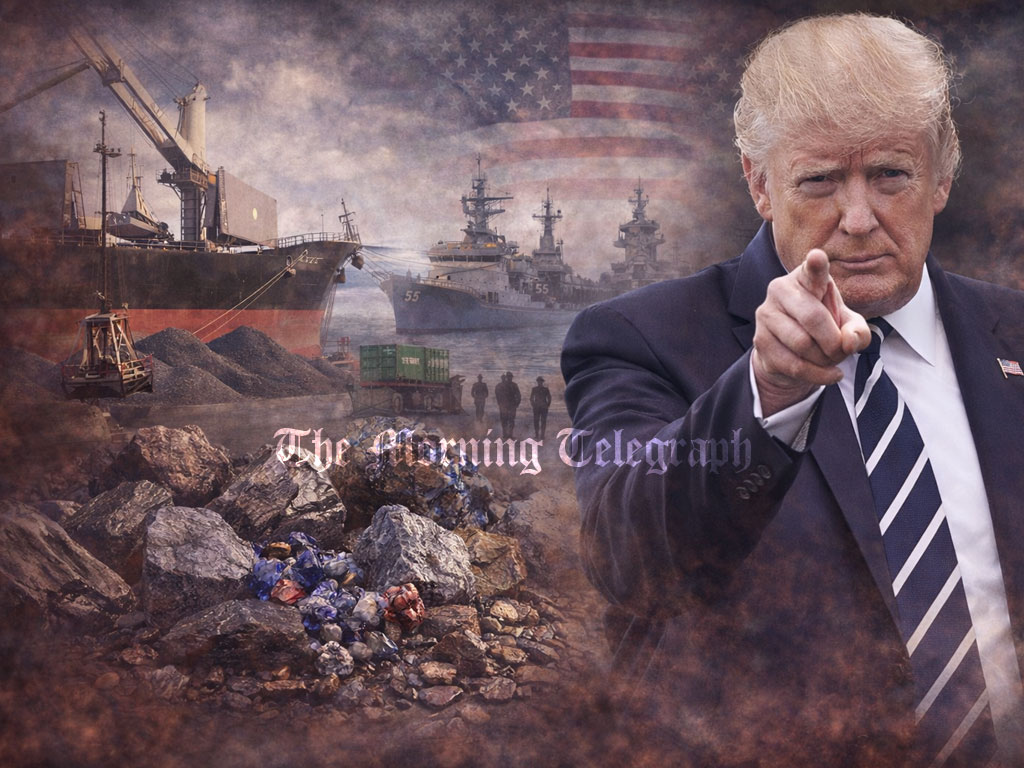
As Washington accelerates its global rare earth strategy, new diplomatic, military, and corporate moves suggest Sri Lanka’s high purity graphite could become a pivotal asset in the intensifying race for critical mineral dominance.
A fresh wave of diplomatic engagement and high level military visibility has ignited debate in Colombo over whether Sri Lanka is emerging as a strategic node in a widening geopolitical contest for critical minerals. At the heart of the discussion is a familiar policy direction long associated with Donald Trump, focused on reducing reliance on rival powers and securing alternative rare earth and critical mineral supply chains.

Recent meetings between a delegation linked to the Montana State Partnership Program and Sri Lanka’s Ambassador to Washington, Mahinda Samarasinghe, have drawn particular attention. The talks reportedly explored significant investment opportunities in Sri Lanka’s graphite sector. Once viewed as a niche mineral, graphite is now increasingly grouped alongside rare earth elements because of its central role in batteries, semiconductors, electric vehicles, and advanced defense technologies.
The delegation included Lieutenant Colonel Chris Cory and James Mooney, founder of Mooney Group LLC, accompanied by senior leadership and infrastructure specialists. Mooney Group is known for targeting minerals essential to next generation energy storage systems and military manufacturing platforms. Their interest in Sri Lanka’s graphite extraction signals more than routine commercial outreach. It reflects a strategic effort to link local production directly into U.S. and global supply chains that are being reconfigured under a broader critical minerals strategy.
Diplomatic sources indicate that discussions went beyond mining rights. The focus reportedly extended to technology transfer, environmental safeguards, and value added processing within Sri Lanka. This aligns with Washington’s friend shore approach, which seeks to build trusted supply networks among partners rather than depend on dominant global suppliers. Mooney Group’s earlier engagement in Central Asia is seen by analysts as part of a coordinated diversification strategy by U.S. aligned firms seeking resilient sourcing channels.
The commercial dialogue has coincided with a rare visit to Sri Lanka by Admiral Steve Koehler, Commander of the U.S. Pacific Fleet. As the largest naval command in the world, the Pacific Fleet oversees maritime routes across the Indo Pacific, including sea lanes vital to mineral transport and energy security. The timing has inevitably amplified scrutiny. While official statements describe the naval visit as routine cooperation, regional observers see the overlap of defense diplomacy and mineral engagement as consistent with previous patterns when Washington moves to secure strategic resources.
During his presidency, Donald Trump frequently invoked emergency powers to expand domestic rare earth production. He argued that reliance on foreign controlled supply chains threatened U.S. defense readiness and technological leadership. His administration prioritized access to graphite, lithium, cobalt, and rare earth elements used in fighter aircraft, missile systems, and electric vehicle batteries. Although he is no longer in office, the strategic logic underpinning those policies continues to influence U.S. national security planning.
Sri Lanka’s high purity vein graphite, found in only a handful of locations worldwide, has therefore acquired outsized geopolitical significance. Industry experts highlight its suitability for advanced battery anodes and defense grade applications. In a global market where supply chains are often concentrated in a few countries, Sri Lanka’s resource profile positions it as a potential alternative supplier in the evolving rare earth and critical minerals landscape.
Ambassador Samarasinghe has welcomed American interest, emphasizing Sri Lanka’s openness to foreign direct investment that promotes downstream industrial value rather than simple raw material export. He has framed potential collaboration as an opportunity to integrate Sri Lanka into the global critical minerals network, strengthening bilateral economic ties while boosting local industry and technology capacity.
Yet not all observers are convinced that the developments are purely economic. Some analysts caution that economic partnerships can gradually merge with strategic alignment, particularly as Indo Pacific competition intensifies. They argue that the convergence of military engagement, resource diplomacy, and private sector mining initiatives indicates that critical minerals are becoming a central arena of great power rivalry.
For Sri Lanka, the challenge will be balancing opportunity and sovereignty. The island’s graphite wealth offers the promise of investment, technology transfer, and industrial upgrading. At the same time, its location at the crossroads of major sea lanes and its growing relevance to U.S. mineral strategy ensure that economic decisions will be viewed through a broader geopolitical lens.
Whether this moment marks a new chapter in Sri Lanka U.S. relations or simply reflects shifting global supply chain priorities, one reality is clear. In the race for rare earth dominance and critical mineral security, Sri Lanka’s mineral wealth is no longer peripheral. It is now firmly in the spotlight of global strategic competition.