By Roshan Jayasinghe
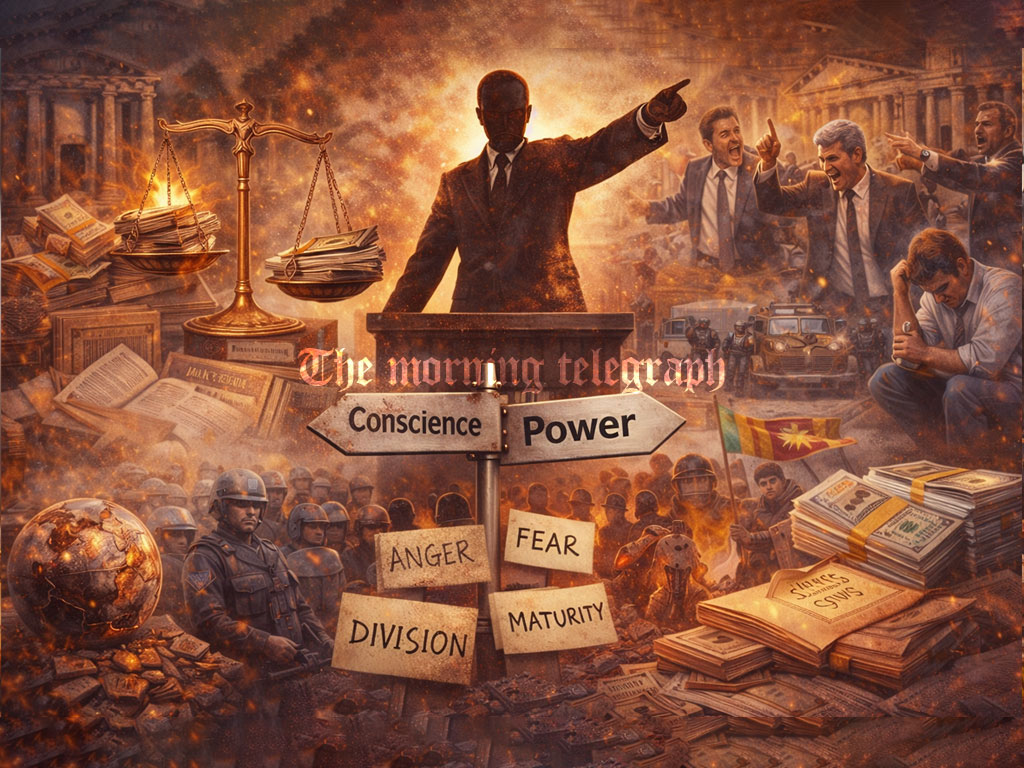
Civilizations do not fall because they lack power. They weaken when power grows faster than maturity. This is a reflection on what happens when authority outruns conscience, especially in a time when people are under strain.
I want to write this carefully, because it is so easy to make everything about one leader. I feel that pull too. When you are watching something that feels wrong, the mind naturally wants a single face to place it on.
But the truth is, leaders like this are not the whole story. They are the surface of something deeper. Something human. Something that repeats.
So this is not written to attack a person. It is written to name a pattern, and to see what it asks of us.

The pattern beneath the moment
There are times in history when power grows quickly, but the inner maturity needed to hold that power does not grow with it.
Every society builds systems to manage authority. Laws, courts, institutions, rules. These are supposed to slow impulse down, spread power out, and protect people from the extremes of a single will.
But systems can only do so much if character is missing.
Power itself is not the problem. A society needs authority. Without it, things fall apart. The problem begins when authority starts moving without restraint, when quick decisions are valued more than careful thinking, when dominance becomes mistaken for leadership, and when certainty becomes more important than truth.
This pattern is not new. It has shown up in many forms, in many places. It shows up whenever human beings confuse force with strength.
In uncertain times, people want a voice that sounds sure. When life feels unstable, when people feel tired, divided, stretched, the human mind reaches for certainty. Certainty feels like safety.
But certainty without reflection hardens. It becomes rigidity. And rigidity, when you attach power to it, becomes control.
Control without humility starts to treat difference as a threat. Then threat becomes the excuse for force.
This is how it begins.
Cruelty rarely arrives with a clear announcement. It slips in through tone. Through mockery. Through the slow lowering of standards. What would have once been unacceptable becomes normal. People adjust. They do not always agree. They just get used to it.
And that is one of the quiet dangers. Not only what happens in institutions, but what happens in the mind.
When distortion becomes common, when exaggeration becomes routine, when truth starts feeling flexible, when loyalty starts replacing principle, shared reality weakens. Once shared reality weakens, unity becomes almost impossible.
And there is another thing. Power does not only act. Power teaches. It teaches what is acceptable. It teaches what strength looks like. It teaches what we are willing to tolerate. When speech loses discipline, society absorbs that loss.
This is not only local anymore. In a connected world, leadership affects everyone. Climate, economics, alliances, even the emotional tone between nations. The world listens, even when we pretend it does not.
Where the real work lives
So the deeper question is not only who holds power. The deeper question is whether our maturity is keeping pace with the power we have created.
Technology has expanded reach. Authority moves faster than it used to. Influence travels instantly. But have we grown inwardly at the same pace? Have we strengthened restraint, humility, and the ability to talk to one another without turning each difference into a war?
Or have we allowed fear, grievance, and exhaustion to take the steering wheel?
We also have to be honest about the economic reality people are living in. People are struggling. The cost of living keeps rising. Jobs feel uncertain. Housing feels like it is slipping away. Many families feel pressure every day.
When survival feels unstable, the mind narrows. That is human. In that state, money begins to feel like the only measure. Wealth begins to feel like safety. And then anything else, compassion, dignity, long term responsibility, can start to feel secondary.
Climate can feel like a distant topic when your rent is due. Unity can feel like a luxury when your nervous system is in survival. These are not moral failures. They are human reactions.
And this is why certain leaders become appealing.
A person who speaks directly to economic fear, who promises quick fixes, who says he is the solution, can feel like relief. Especially when he speaks with certainty. Especially when he claims only he can fix it.
If that certainty is built on exaggeration or repeated untruth, it can still work, because fear compresses judgment. It does not mean people are stupid. It means they are under strain.
But this is where we need to pause, because a society cannot trade moral grounding for financial promises and expect to stay healthy.
Economic strength without conscience is imbalance.
A nation cannot measure success only in currency. It must measure it in character, in dignity, in how it treats the vulnerable, and in how it protects truth.
If we reduce leadership to who promises financial dominance, we make room for leaders who speak loudly and confidently even when they lack depth or restraint. Exhaustion makes dominance attractive. Division makes certainty comforting. Anger makes force feel justified. But none of this creates stability.
Leadership at its highest is stewardship. It protects even people who disagree. It understands that power is responsibility, not possession.
When maturity guides authority, power steadies a nation. When maturity is missing, power magnifies whatever is already there. Humility expands. Grievance expands. Insecurity expands. Office does not create character. It reveals it.
This is why the real work is not only electoral. It is civilizational.
We have to look at what kind of leadership we reward, what kind of tone we accept, and what kind of behavior we normalize. Power ends up reflecting the standards of the people who sustain it.
Clarity and the direction of humanity
Each individual has a responsibility here. Not to argue endlessly, and not to become partisan, but to become clear.
Clear about the direction humanity must take.
Clear about what belongs on the side of dignity, truth, restraint, and care.
There is a duality in human behavior that we recognize instantly. We can feel it without needing a theory.
Cruelty and dignity.
Ignorance and wisdom.
Division and unity.
Vengeance and restraint.
When clarity weakens, we become vulnerable to leaders who present division as protection and hostility as strength. A leader who claims to protect one group by demonizing another shrinks a nation. A leader who depends on enemies to appear strong is dependent on conflict.
And a society that rewards that behavior should ask itself what standards have been lowered.
My frustration is real. I do not deny it. But frustration alone does not create wisdom. If anger replaces clarity, we risk repeating the very pattern we say we oppose.
The deeper task is steadiness.
To stay clear.
To stay principled.
To remember what strength looks like.
Strength is not loud. It does not humiliate. It does not need enemies. Strength carries restraint.
We live in an era of immense power. The question is whether humanity will mature into it.
For now, I am not only looking at one leader. I am looking at us. And I am asking whether our maturity is expanding as quickly as our authority.
Author’s Note
This reflection is not written in defense of any party, and not written to condemn any individual. It is written because I see a pattern that repeats wherever power grows faster than conscience.
Power is a mirror. It reflects the inner state of those who hold it, and those who sustain it.
The future of any democracy depends less on personalities and more on the standards we refuse to lower.
For now, I remain observant, and I choose the side of dignity.
About the Author
Roshan Jayasinghe is a writer and observer of human systems. His work explores the gap between man made constructs and lived humanity, with a focus on how economics, trade and everyday choices intersect with questions of fairness, responsibility and inner alignment. Through essays for publications in The Morning Telegraph, he aims to remind readers that they are not passengers in a fixed machine, but active custodians of a shared world.