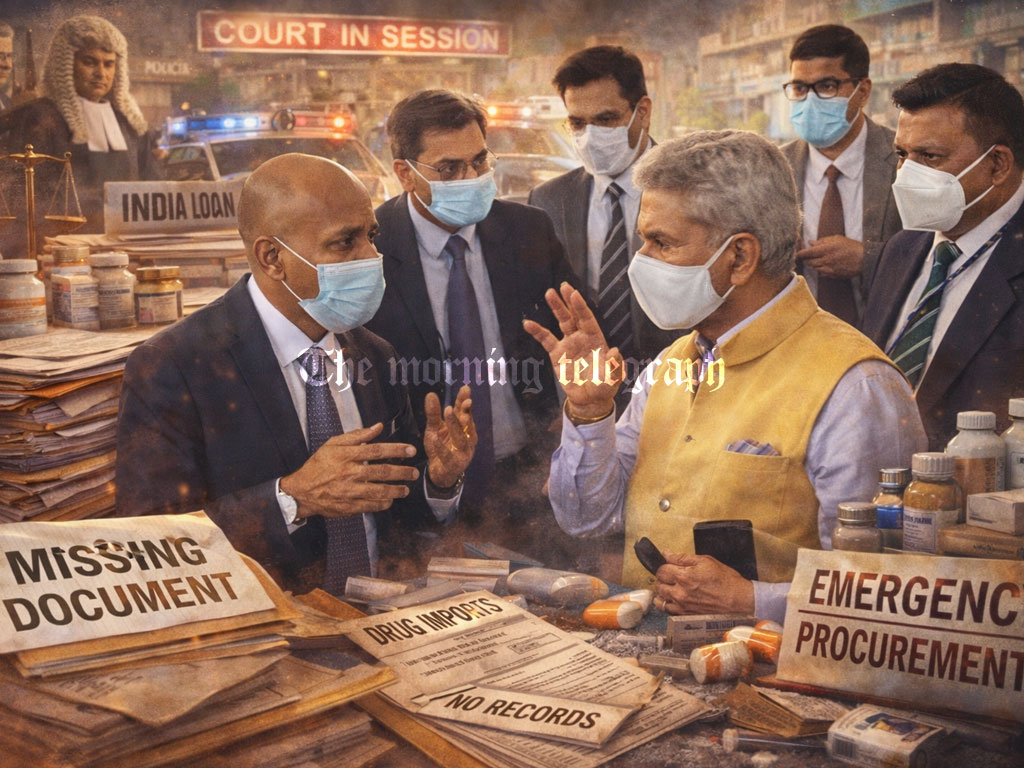
A missing 2022 India loan agreement, disputed drug imports, and emergency procurement decisions collide in a high stakes courtroom battle that raises urgent questions about transparency, accountability, and regulatory oversight during Sri Lanka’s economic crisis.
At the Colombo Permanent Three Judge High Court, proceedings took a dramatic turn when Attorney at Law Harendra Banagala, appearing for the first defendant Hewage Sudath Janaka Fernando, informed the bench that no public institution in Sri Lanka appears to hold a copy of the 2022 Indian loan assistance agreement. The agreement, signed at the height of Sri Lanka’s economic crisis to secure urgently needed medicines and food supplies, has now become a focal point in a broader debate over government transparency and public accountability.

According to submissions made in court, the agreement was sought under the Right to Information Act. However, the Right to Information Commission responded that it could not confirm whether any public authority had custody or control of the document. Banagala told court that Ms. Lasanthi Wimalasurendra, Administrative Officer of the Commission, conveyed this position in writing on September 19, 2025, following a formal request dated September 10. He urged the court to direct the Commission to produce the agreement, arguing its relevance to the case. The presiding judge declined, noting that it remains the responsibility of the defense to obtain the evidence it intends to rely upon.
The courtroom focus then shifted sharply to the importation and safety of pharmaceutical products during the crisis period. Banagala questioned a witness about media reports highlighting complications linked to 63 imported drugs in 2023, including itching, stomach pain, and other adverse side effects. The exchange underscored concerns surrounding drug regulation, emergency procurement, and oversight within the pharmaceutical sector. The witness responded that statements attributed to officials, including former Drug Regulatory Authority Chairman Ravindra Manoj Gamage, reflected personal opinions if not formally endorsed by the Board of Directors.
Banagala pressed further, raising the issue of whether personal views should appear on official platforms and suggesting that senior public officials have a duty to uphold transparency and institutional integrity. The witness maintained that there was no legal provision governing such publication. Objections were raised by the National Security General to certain lines of questioning, adding another layer of tension to already intense proceedings.
The defense also inquired about a reported court order requiring pharmaceutical companies to bear inspection costs during drug imports. The presiding judge intervened to clarify whether such an order existed, instructing the witness to respond directly to the specific question posed. Attention then turned to the Human Immunoglobulin vaccine controversy, widely reported in local media amid allegations of forged import certificates and possible complications. The witness confirmed having been informed by the then CEO of the Drug Regulatory Authority but could not recall detailed information about specific adverse outcomes.
Further scrutiny extended to the financial dimension of the Indian loan agreement. Banagala asked which Finance Minister negotiated the deal. The witness said he could not specify, citing the involvement of multiple ministries during the turbulent crisis period. The court also examined document 158, described as a proposal by eighth defendant Keheliya Rambukwella to import medicines under emergency procurement provisions. The witness acknowledged that on December 29, 2023, the Secretary to the Ministry of Health announced ministerial approval to prioritize certain medicines, effectively bypassing standard registration requirements under Section 109 of the Medicines Regulation Act.
Questions were also raised about the venue of a board meeting held on March 27, 2023, at a luxury hotel in Colombo rather than the official Chairman’s office. The witness stated that board meetings are typically conducted in the Chairman’s room and that the hotel expenses were reportedly borne by board members themselves, though clear documentation was lacking. The bench further explored cabinet approval related to obtaining medicines from an Indian company that had previously been blacklisted by the Drug Regulatory Authority. The witness noted that the CEO informed members of certificate issuance 14 days after the event.
The court adjourned proceedings until February 27 and ordered summonses for Senior Professor Priyadarshani Galappaththi of the Colombo Medical Faculty and Senior Professor Amila Wanathunga of the University of Sri Jayewardenepura to testify on behalf of the complainant. As hearings continue, the case stands as a test of institutional transparency, regulatory accountability, and governance standards during one of Sri Lanka’s most severe economic crises.