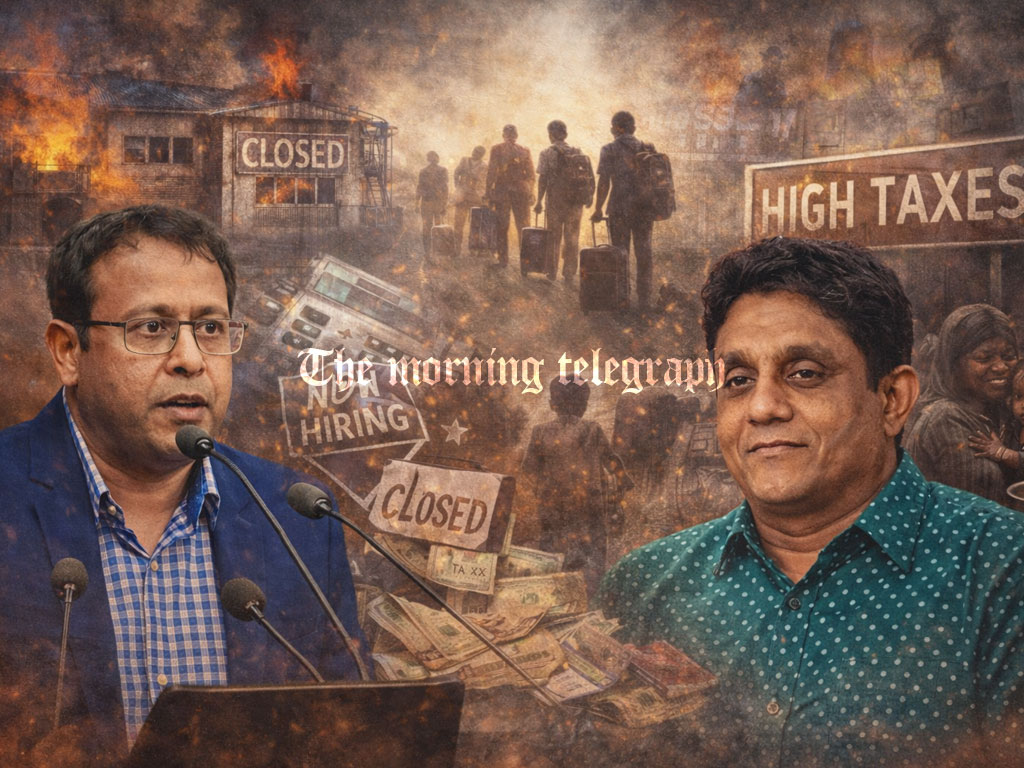
A leading academic warns that unemployment, poverty, industrial collapse, and mass emigration are accelerating under crushing taxes and policy missteps, raising urgent questions about whether Sri Lanka’s growth narrative is masking a deepening labor market crisis.
Elaborating on his remarks, he stated:
“Economist Dudley Seers has long examined the relationship between poverty, inequality, and unemployment in the context of economic growth. He argued that when an economy expands, poverty levels should decline, income disparities should narrow, and meaningful steps should be taken to resolve unemployment. This economic framework proposed by Dudley Seers is recognized by Opposition Leader and Samagi Jana Balawegaya leader Sajith Premadasa.”

He further cited findings from a government labor force participation survey conducted in 2024. According to the data, the national labor force participation rate has fallen to 47 percent, down from 54 percent in 2017, marking a 6.7 percent decline. Of Sri Lanka’s 16.8 million working age population, only around 8 million are actively engaged in the labor force. The overall unemployment rate stands at 4.4 percent, with male unemployment at 3 percent and female unemployment significantly higher at 7.1 percent. Only 30 percent of working age women participate formally in employment, meaning seven out of ten women remain outside the workforce. Unemployment appears higher among those with advanced educational qualifications. Among youth aged 20 to 24, unemployment has reached 20.7 percent, indicating that one in five young people is jobless. At present, approximately 150,000 young men and women are seeking employment.
The International Labour Organization has noted that official figures may not fully reflect the severity of the labor market situation, as many individuals have voluntarily exited the workforce.
Migration figures also reflect mounting pressures. In 2022 and 2023, approximately 515,000 people migrated abroad, and in 2024 an additional 300,000 left the country. Drawing on Dudley Seers’ model, Professor Perera pointed out that economic growth periods have sometimes coincided with increasing unemployment. Poverty levels have doubled compared to 2017–2018, with an estimated 25 to 30 percent of the population now living below the poverty line. He stressed that immediate government intervention is necessary to tackle unemployment, poverty, and widening inequality.
Historically, Sri Lankan governments have introduced major development initiatives to address similar challenges. Between 1948 and 1960, projects such as the Gal Oya scheme sought to reduce unemployment and inequality. From 1977 to 1990, large irrigation programs and free trade zones were launched. During 1989 to 1993, the late Ranasinghe Premadasa implemented public works programs and the 200 factories initiative aimed at poverty alleviation and formal employment expansion. However, these models are currently under strain, an issue highlighted by Opposition Leader Sajith Premadasa.
At present, Sri Lanka imposes an 18 percent VAT, a 30 percent corporate tax, and a maximum income tax rate of 36 percent. Human Rights Watch has criticized the 2025 tax framework as harmful. High corporate taxation, he argued, has curtailed job creation. Large and medium scale industries are closing, with industrial employment declining by 15.1 percent in 2023 and around 30 small and medium enterprises shutting down. The departure of skilled professionals further compounds the crisis.
Export oriented service sectors are also under pressure, and the government’s 2025 target of earning 3 billion dollars has not been achieved. Many young people are seeking employment overseas due to limited domestic opportunities. Professor Perera suggested that initiatives such as India’s MGNREGA rural employment program and Germany’s vocational training systems should inform policy discussions on youth employment and skills development.
He called on the government to reform taxation, safeguard national employment, introduce emergency youth programs, curb professional migration, reduce income taxes, and address industrial job losses. Sajith Premadasa has emphasized that labor market disruptions persist and that decisive policy action based on accurate data is essential for sustainable long term growth.
Finally, he referred to alleged coal procurement mismanagement, which he claimed resulted in losses of approximately LKR 8 billion. Additional costs stem from supplementary coal purchases and technical failures at facilities such as the Lak Vijaya power plant. While a committee has been appointed to calculate direct losses, indirect financial and environmental damages remain unquantified. The Samagi Jana Balawegaya has urged the inclusion of economists from Ruhuna University to conduct a comprehensive assessment covering environmental impact, electricity procurement, supply continuity, production expenses, and transportation costs. Without broader expertise, he argued, an accurate evaluation of total losses will not be possible.