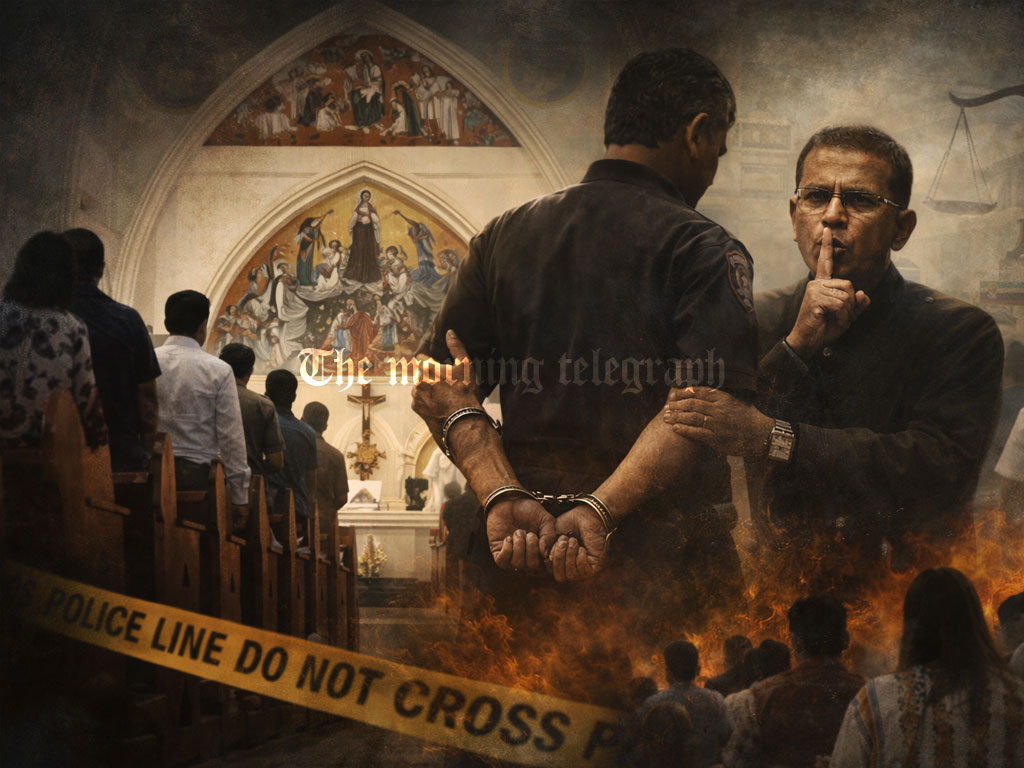
A deepening controversy over the detention of Major General Suresh Sallay has ignited a wider debate about moral authority, selective outrage, and whether Sri Lanka’s Catholic Church can still claim the ethical high ground it once defended so fiercely.
There are rare moments in public life when an institution that claims moral authority is forced into a defining test. It must choose between consistency and convenience, between principle and proximity to power. The detention of Major General Suresh Sallay has become one such moment for the Catholic Church in Sri Lanka. What might have remained a legal controversy has evolved into a broader moral debate about credibility, justice, and institutional integrity. At its core lies a troubling question: can a Church that once condemned arbitrary detention remain silent when the same legal tools are used today?

For decades, the Church positioned itself as a steadfast critic of the Prevention of Terrorism Act. It described the PTA as draconian, arbitrary, and incompatible with the rule of law. Clergy and lay leaders organized public demonstrations, forums, and campaigns warning that a law allowing prolonged detention, limiting access to counsel, and granting expansive executive discretion invited abuse. This stance was framed not as partisan activism but as moral duty. The message was clear and principled: an unjust law does not become just because the target changes. Human rights, due process, and legal safeguards were presented as universal values that must apply to every citizen equally.
Today, that long held moral clarity appears blurred. When the same law was invoked to detain a former intelligence chief whose mother is reportedly Roman Catholic, the tone shifted noticeably. Fr. Cyril Gamini Fernando urged citizens not to question the detention, not to engage in commentary, and not to interfere with investigations. In a society deeply aware of the dangers of unchecked power, that appeal has been interpreted by many as a call for silence rather than restraint. Critics argue that public scrutiny is not interference but a democratic safeguard. When questioning is discouraged, suspicion naturally deepens.
The manner of the arrest has amplified unease. Reports indicate that Major General Sallay was taken into custody while traveling to work, and for several hours there was little official explanation. A subsequent police briefing offered limited clarity, leaving gaps that fueled speculation. Into that uncertainty emerged reports of an alleged telephone recording from a previous administration, suggesting readiness to present allegations at the highest political level. Whether such claims are substantiated or not, the mere perception of political proximity raises concerns about investigative independence and transparency. In fragile democracies, perception often shapes public trust as powerfully as proven fact.
Further complexity arises from prior statements made by a colleague of Fr. Cyril Gamini Fernando calling for the execution of former SIS Director Nilantha Jayawardena. There was no completed legal process or judicial determination at that time. The absence of institutional rebuke now appears significant to observers. Added to this is the existence of a pending defamation case filed by Sallay against Fr. Cyril Gamini Fernando. Reports that court appearances were avoided have added to perceptions of inconsistency. When silence is urged in the present while severe language was tolerated in the past, the Church’s moral authority becomes a subject of scrutiny.
This debate is not about declaring guilt or innocence. Courts, evidence, and legal procedures must determine those matters. The deeper issue concerns consistency in moral witness. Can an institution condemn arbitrary power in one era and appear to accept its use in another? Principles that fluctuate with circumstance risk losing their moral weight. A Church that once demanded accountability from the state must confront whether it now appears reluctant to apply the same standard universally.
Law is meant to restrain power, not to serve preferred outcomes. A statute that enables extended detention without trial does not become benign because it is applied to a controversial figure. Selective endorsement of extraordinary legal powers sets a precedent that can erode civil liberties over time. Sri Lanka’s recent history is marked by public demands for governance reform, transparency, and accountability. When voices that once championed these ideals adopt a quieter tone, citizens naturally ask whether moral conviction has given way to strategic caution.
Public scrutiny is a constitutional safeguard, not a threat. Democracies depend on open discussion, investigative journalism, and civil society engagement. Encouraging citizens to refrain from questioning legal action may be interpreted as discouraging civic responsibility. Transparency strengthens institutions by subjecting them to public examination. Silence, by contrast, invites doubt. In an era where trust in political and religious institutions is already fragile, consistency becomes not merely desirable but essential.
The theological dimension sharpens the dilemma. Christian teaching emphasizes alignment between word and deed. Ethical witness demands coherence. When selective outrage replaces principle, credibility weakens. The Church that once condemned the PTA now faces questions about why its response appears muted. The same leaders who demanded justice and human rights protections in past controversies now counsel restraint. This contrast has created tension among the faithful, many of whom seek clarity rather than ambiguity from their spiritual leaders.
None of this suggests that investigations into national tragedies should be obstructed. On the contrary, impartial and independent inquiries are vital to justice. However, independence is reinforced by transparency and equal application of the law. Extraordinary powers require careful scrutiny. Institutions that once drew moral authority from challenging state excess risk diminishing that authority if they appear selective in their advocacy.
Sri Lanka’s broader context adds weight to the moment. The nation continues to navigate economic recovery, political polarization, and lingering distrust from previous crises. In such an environment, institutions that command moral respect carry significant influence. When they are perceived as inconsistent, public disillusionment deepens. The controversy surrounding the detention of Major General Suresh Sallay is therefore more than a legal episode. It reflects a larger struggle over accountability, rule of law, and the ethical responsibility of religious leadership.
A nation cannot sustain a morality that shifts according to circumstance. When principles are suspended for expediency, the law ceases to restrain power and instead risks becoming an instrument of it. Critics argue that what is unfolding is not merely selective morality but institutional inconsistency cloaked in ecclesiastical language. The resulting discontent within the Catholic Church is no longer theoretical. It is visible in public discourse, tangible in civic debate, and significant in its implications for both religious integrity and democratic accountability.
At its highest calling, religious leadership stands above politics, not beside it. It defends principles regardless of who is affected. If moral authority is to endure, it must be anchored in consistency, transparency, and courage. Sri Lanka’s public now watches closely, not only to see how the legal process unfolds, but to discern whether the Church will reaffirm the universal values it once proclaimed so confidently. The future credibility of that moral voice may depend on the answer.