Ballistic missiles slam into US bases in the Gulf as Washington and Tel Aviv unleash sweeping airstrikes on Iran, igniting a region-wide war with nuclear stakes and global consequences.
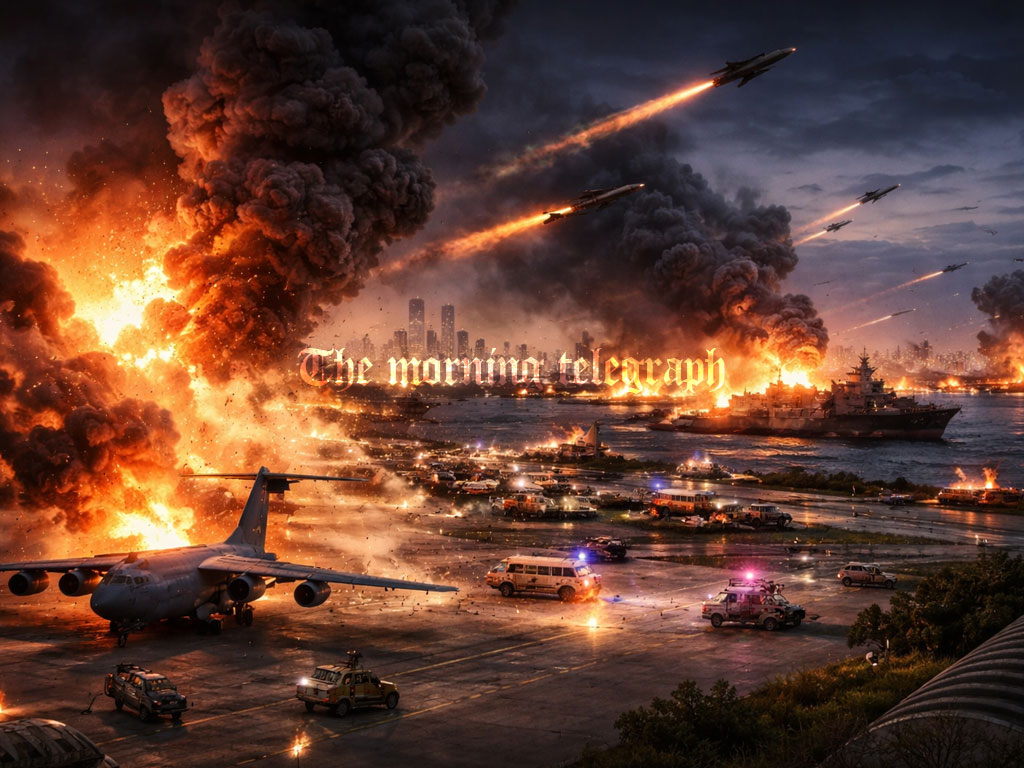
International media report that massive explosions have rocked areas near key American military bases in Kuwait, Bahrain and Abu Dhabi, marking a dramatic expansion of the conflict between Iran, the United States and Israel. According to regional security sources, Iran has launched ballistic missiles toward Al Udeid Air Base in Qatar, the largest US air base in the Middle East, as well as Al Salem Air Base in Kuwait, Al Dhafra Air Base in the United Arab Emirates and the US Fifth Fleet headquarters in Bahrain. Some installations are reported to have been directly hit, while unofficial accounts describe additional large explosions in parts of Saudi Arabia.

The escalation comes as Israel and the United States intensify coordinated missile and air strikes on Iranian territory. Strategic targets have reportedly included high-level government facilities, with claims that even the Iranian presidential compound was struck. Officials in Washington and Tel Aviv say several critical objectives have been achieved in what is being described as a decisive military campaign.
US President Donald Trump confirmed that he ordered a major military operation against Iran, framing it as essential to protect the American people, US forces and allied nations from what he called escalating threats posed by the Iranian regime. He argued that more than four decades of hostility, proxy warfare and alleged state sponsorship of terrorism can no longer be tolerated.
In his address, Trump accused Iran of destabilizing the Middle East by funding and training militant groups in Lebanon, Yemen, Syria and Iraq. He reiterated claims that Tehran was linked to the October 7 Hamas attack on Israel that resulted in the deaths of 46 Americans. Emphasizing a zero tolerance nuclear policy, he stated that the United States will never allow Iran to obtain nuclear weapons.
The president referenced Operation Midnight Hammer, conducted last June, which he said destroyed key Iranian nuclear facilities in Fordow, Natanz and Isfahan. However, he asserted that intelligence indicated renewed efforts to rebuild nuclear capabilities and expand long-range missile systems. This latest phase of military action, he said, aims to eliminate those capabilities entirely.
Trump issued a stern warning to the Iranian Revolutionary Guard Corps and the country’s armed forces, urging them to lay down their weapons immediately. He said surrender would bring immunity, but continued resistance would result in devastating consequences. Addressing Iranian civilians, he advised them to remain indoors during the operations and suggested they seize what he described as a historic opportunity to reclaim control of their nation. While acknowledging the risk of American casualties, he called the campaign a necessary mission for global security and future generations.
Israeli Defense Minister Israel Katz characterized the offensive as a pre-emptive strike designed to neutralize imminent threats from Iran. Iranian media reported powerful explosions in Tehran, Isfahan, Qom, Karaj and Kermanshah, with foreign correspondents describing smoke-filled skies and widespread panic. President Trump vowed that Iran’s missile industry would be dismantled through sustained operations.
The Israeli Defense Forces confirmed that Iran responded with missile launches toward Israeli territory. Warning sirens sounded across Israel, and civilians were directed to shelters as part of emergency protocols. Reports also indicated that several major Iranian state news websites were taken offline following what officials described as a coordinated cyber attack targeting communication infrastructure.
Israeli Prime Minister Benjamin Netanyahu named the operation Lion’s Roar and declared that its objective is to remove what he called an existential nuclear threat. In a recorded message, Trump again called on the Iranian people to challenge their leadership, promising strong American backing.
The current escalation follows a twelve-day conflict last June that significantly weakened Iranian air defenses and heightened regional instability. Both Iran and Israel have now closed their airspace to civilian flights, reflecting the intensity of the hostilities.
Military analysts describe the unfolding situation as a full-scale regional war. Joint operations referred to as Operation Epic Fury and Operation Roaring Lion have reportedly struck more than thirty targets across Iran. These include key government sites such as the Iranian president’s residence, the office of the supreme leader, the intelligence ministry and the defense ministry. Sensitive military installations in Parchin and ballistic missile infrastructure in western Iran have also been targeted. Reuters reported that Supreme Leader Ayatollah Ali Khamenei has been moved to a secure location.
Trump stated that the strikes are aimed at eliminating global threats stemming from Iran’s long-range missile and nuclear programs. He repeated his warning that Iran must disarm or face overwhelming force. Netanyahu similarly described the campaign as essential to neutralize a direct threat to Israel’s survival.
In response, Iran, Hezbollah and Houthi forces launched missile barrages toward Tel Aviv. Iranian officials characterized the retaliation as only the beginning of a fierce counteroffensive. With Israel declaring a nationwide state of emergency and airspace closures spreading across the region, the conflict has triggered panic in parts of Iran. Reports describe long lines at gas stations and residents in major cities, including Tehran, attempting to evacuate amid fears of prolonged warfare.
The widening confrontation now encompasses missile exchanges, cyber warfare, strategic airstrikes and naval deployments across the Gulf. Energy markets are closely monitoring the situation as tensions near critical shipping lanes intensify. What began as targeted strikes has evolved into a high-stakes geopolitical crisis that threatens to reshape the balance of power in the Middle East and beyond.