A warning from the Church pulpit about exploiting religion has reopened deep national wounds about accountability, post-Easter finances, and the uneasy marriage of faith and politics in Sri Lanka.
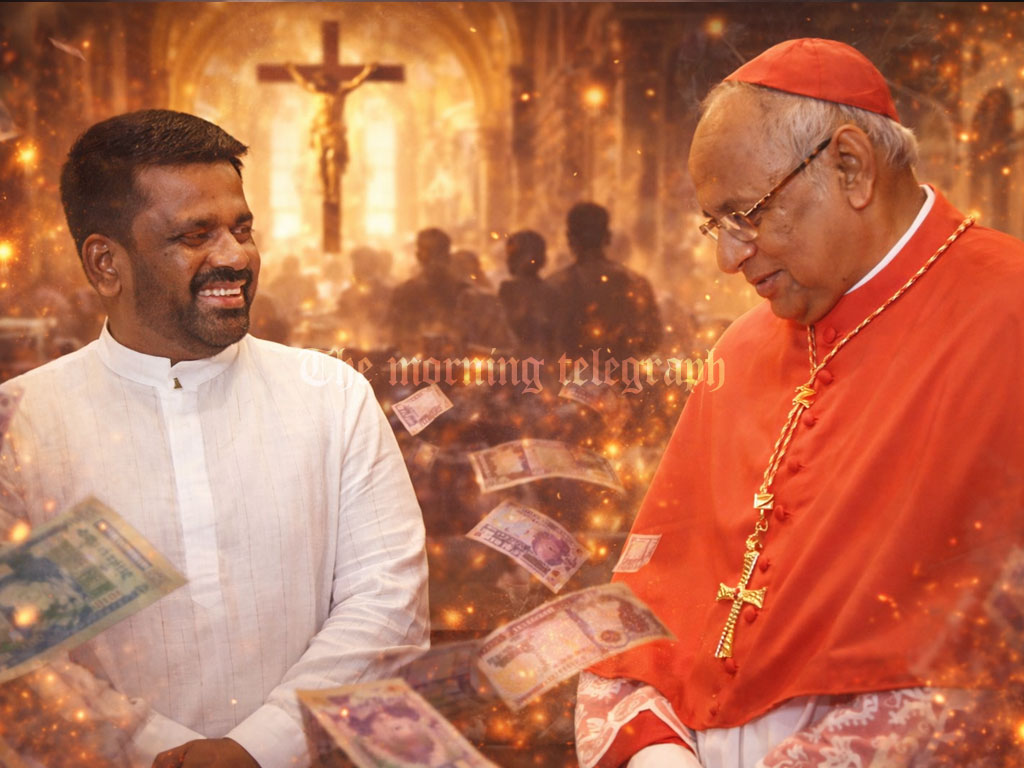
A recent remark by Cardinal Malcolm Ranjith has once again placed the Catholic Church at the center of public debate. Speaking at a ceremony at St. Joseph’s Church in Nillanduwa, the Archbishop of Colombo urged believers not to use religion as a tool for personal benefit. He reminded the faithful that prayer must be accompanied by practical action, encouraging medical treatment and responsible decision making rather than blind dependence on miracles. On the surface, it sounded like a familiar pastoral message about faith and reason working together.

Yet the context in which these words were delivered has made them far more significant. In Negombo and beyond, many listeners interpreted the statement through the lens of Sri Lanka’s turbulent recent history. Since the 2019 Easter Sunday attacks, the Catholic Church has played a prominent and sometimes controversial role in national conversations about justice, state accountability, and political responsibility. The Cardinal has emerged as one of the most outspoken religious voices in the country, positioning the Church as a moral authority and defender of victims.
Supporters describe this as courageous and prophetic leadership, arguing that the Church stepped into a vacuum when political institutions faltered. They believe the Cardinal has consistently demanded truth and transparency in the aftermath of tragedy. Critics, however, view the situation differently. They suggest that the line between spiritual guidance and political engagement has often blurred, creating an uneasy fusion of altar and podium. For them, sermons about personal integrity ring differently when the institution itself is perceived as deeply embedded in political discourse.
Adding to the public unease are persistent questions about financial transparency. Allegations surfaced months after the Easter attacks that Church institutions received substantial humanitarian aid, reportedly close to one billion Sri Lankan rupees, from local Islamic organizations in the immediate aftermath. These claims were raised at a press conference by several victims from Negombo and gained traction in public discussions. While Church representatives have addressed funding issues in various statements, a detailed and publicly accessible financial breakdown has not been released.
In a country already grappling with trust deficits and economic instability, the absence of comprehensive disclosure fuels suspicion. Transparency, accountability, and ethical leadership have become powerful keywords in Sri Lanka’s political and social landscape. When religious institutions call for moral discipline among the faithful, the public often expects equal rigor in institutional governance. The lack of clarity surrounding post-attack financial flows has therefore amplified scrutiny rather than silenced it.
This tension has produced a familiar paradox. Sri Lanka remains a society where moral authority carries immense cultural weight, yet skepticism toward institutions runs deep. For many Catholics, the Cardinal’s warning against using religion for personal agendas was a sincere attempt to refocus the faithful on spiritual authenticity. For others, it reopened unresolved questions about money, memory, and moral consistency.
In the end, the debate is less about a single sermon and more about credibility. In post-attack Sri Lanka, faith and finance intersect in ways that demand transparency as much as devotion. The challenge for the Church is not only to preach integrity but to embody it in a climate where public trust must be earned, not assumed.