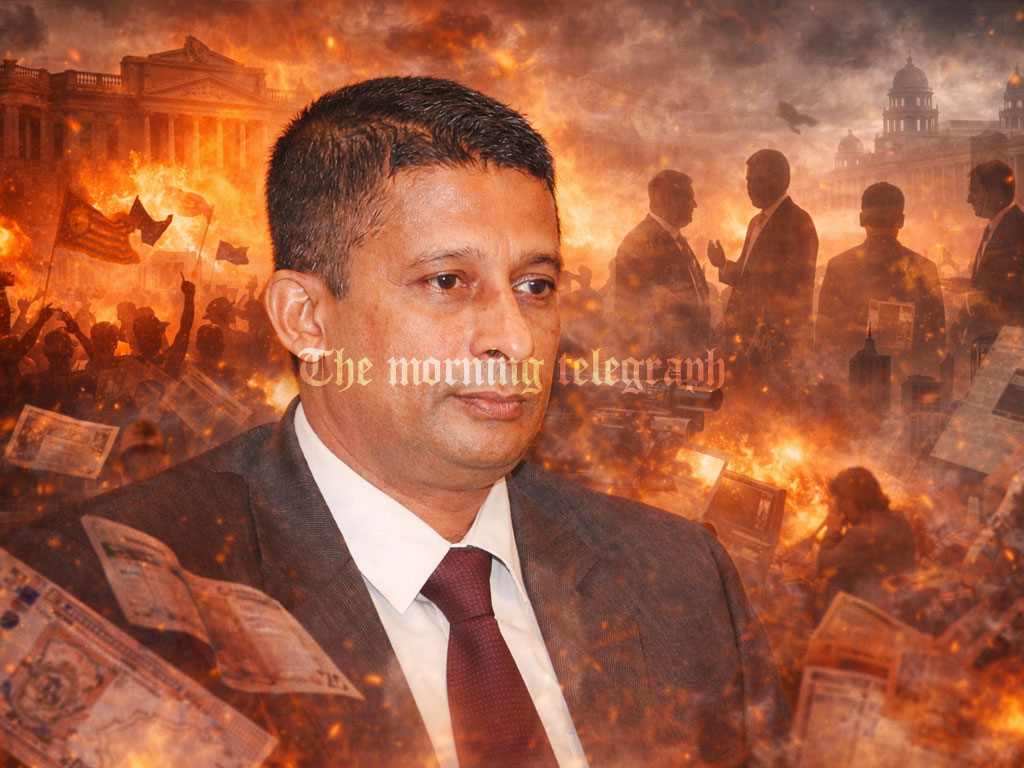
From military intelligence briefings to Easter Sunday controversies, Suresh Sale’s shadow has loomed over successive Sri Lankan governments, exposing how power, fear, and political survival intersect at the highest levels.
The name Suresh Sale first surged into national consciousness in 2016 during the Yahapalana administration of Maithripala Sirisena and Ranil Wickremesinghe. At the time, he was serving as Director of Military Intelligence, a position originally secured under Gotabaya Rajapaksa when he was Defence Secretary. Even after Mahinda Rajapaksa’s 2015 defeat and Gotabaya’s exit from office, Sale remained firmly in place. President Sirisena did not remove him, a decision that would later trigger intense political turbulence.

Soon after assuming office, Sirisena received a quiet visit from Gotabaya Rajapaksa at his official residence. This occurred while the new government was pursuing investigations into Gotabaya over the Avant Garde controversy and the MiG aircraft deal. As arrest preparations intensified, Gotabaya secured a court order preventing his detention. Sirisena then publicly praised the judiciary’s independence. When Gotabaya and several senior military officers were later summoned to court, Sirisena sharply criticised the Bribery Commission and the Financial Crimes Investigation Division. He argued that war heroes should not be humiliated in courtrooms, framing the proceedings as an insult to the nation.
That speech marked a dramatic political pivot. Figures once portrayed as controversial actors from the Rajapaksa era were suddenly recast as national defenders. The United National Party and its civil society allies were caught off guard. The Sirisena Ranil partnership began to fracture, and the Rajapaksas regained moral and political momentum.
Within Ranil Wickremesinghe’s circle, the suspicion quickly took root that Sirisena’s shift was influenced by intelligence briefings from Suresh Sale. Reports allegedly warned that summoning Gotabaya and senior commanders could provoke unrest within the armed forces and destabilize the government. Fearing a security backlash, Sirisena appeared to distance himself from his own administration. The UNP believed Sale was acting in alignment with Rajapaksa interests and privately pressed Sirisena to remove him.
Public pressure soon mounted. Civil society groups such as Purawesi Balaya and prominent activists demanded Sale’s dismissal, accusing him of conspiring to undermine the government. Then minister Rajitha Senaratne publicly alleged that Sale was attempting to incite instability in Jaffna. Despite the chorus of criticism, Sirisena initially defended Sale, insisting his intelligence assessments were credible.
Eventually, under sustained pressure from the UNP, civil society, and the Janatha Vimukthi Peramuna led by Anura Kumara Dissanayake, Sirisena relented. The JVP warned that shielding Gotabaya would create future dangers. Senior JVP figures reportedly met Sirisena and argued that he was being manipulated through intelligence channels. Sale was asked to step down. In hindsight, many analysts view this episode as the first major crack in the Yahapalana coalition.
As predicted by critics, Gotabaya Rajapaksa later rose to the presidency. Upon assuming office, he appointed Sale as head of the State Intelligence Service. The cycle of controversy resumed, this time centered on the 2019 Easter Sunday attacks. Opposition figures including Harin Fernando and Manusha Nanayakkara alleged that the true mastermind was protected within the system. References to a mysterious message containing the word Sonic fueled speculation that a senior security official was involved. Public anger intensified, and the Catholic Church amplified demands for accountability.
The Easter attacks became a defining political fault line. As protests under the Aragalaya movement forced Gotabaya from office, Ranil Wickremesinghe returned as President. Ironically, neither he nor his administration pursued action against Sale. The same political camp that once demanded his removal now defended him against Easter related accusations. The shift illustrated how intelligence officials can outlast governments and reshape alliances.
When Anura Kumara Dissanayake won the presidency with strong backing from segments of the Catholic community, he pledged to remove Sale and uncover the truth behind the Easter tragedy. Yet the process unfolded cautiously. Sale’s removal took time, and his arrest followed only after prolonged deliberation. The delay raised questions about the complexities of intelligence networks and political risk.
Across successive administrations, Suresh Sale has functioned less as a mere official and more as a lightning rod for broader struggles over power, accountability, and national security. His career reflects the delicate balance between intelligence gathering and political influence. In Sri Lanka’s volatile landscape, intelligence assessments can sway presidents, fracture coalitions, and redefine narratives overnight.
Whether viewed as a professional officer executing his mandate or as a political force operating within shadowy corridors of influence, Sale’s trajectory underscores a central truth about modern governance. Intelligence is never neutral in times of crisis. It shapes perceptions, amplifies fears, and can alter the course of political history.
The question that lingers is not simply about one man’s influence, but about the structural power of security institutions in a democracy still healing from conflict and trauma. In Sri Lanka, the intersection of intelligence, political survival, and public trust remains fraught. And as governments rise and fall, the figure at the center of this long running saga continues to symbolize how fragile that balance can be.