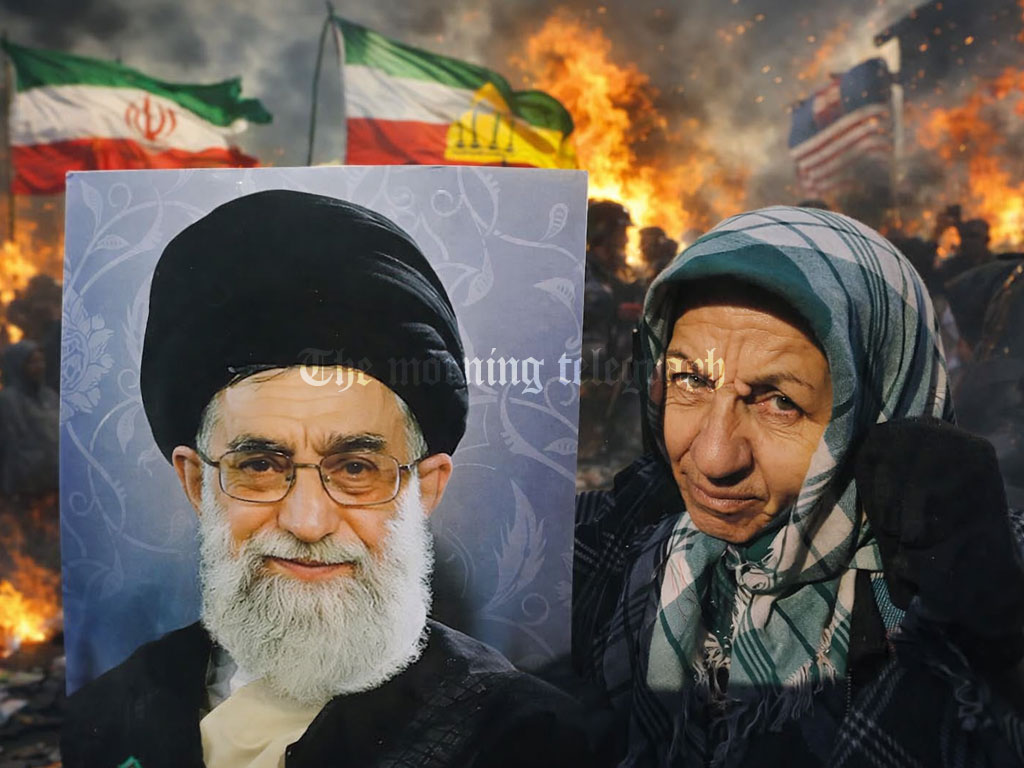
For thirty-seven years, he was the invisible hand guiding every aspect of Iranian life. From the battlefields of the Iran-Iraq War to the bloody crackdowns on the “Woman, Life, Freedom” movement, Ayatollah Ali Khamenei survived coups, assassinations, and economic collapse. But in the winter of 2026, the survival strategies that kept him in power for decades finally failed him. When the American and Israeli missiles stopped falling, the Supreme Leader was gone and with him, the very soul of the Islamic Republic.
The announcement came as a thunderbolt across a sleeping world. President Donald Trump, standing beside Israeli Prime Minister Benjamin Netanyahu, confirmed what military briefings had already whispered through Washington: the opening salvo of joint US-Israeli airstrikes had achieved its primary objective. Ayatollah Ali Khamenei, the 86-year-old Supreme Leader of Iran, was dead.

Iranian state television, usually the regime’s most reliable propaganda instrument, delivered the confirmation with visible hesitation. The anchor’s voice cracked as she read the prepared statement. For three decades, Khamenei had been the constant presence in every Iranian home, his portrait hanging in government offices, his speeches broadcast on every channel. Now, his sudden violent death left a void that nothing in the constitution or the regime’s history had prepared anyone to fill.
His hardline authoritarian vision had shaped Iranian existence since 1989, when he first assumed the mantle of leadership following the death of Ruhollah Khomeini. As head of state and commander-in-chief of all armed forces, including the elite Revolutionary Guard Corps, his powers were constitutionally absolute. There was no aspect of Iranian life, from the morality police enforcing hijab laws to the nuclear negotiations with world powers, that escaped his ultimate authority.
His death under such circumstances promised an uncertain and potentially explosive future, not just for Iran’s eighty-five million people, but for the entire Middle East region already teetering on multiple fault lines.
Religious Upbringing and Revolutionary Birth
Ali Khamenei entered the world in 1939 in Mashhad, Iran’s second-largest city and home to the shrine of Imam Reza, the eighth Shia saint. His father was a cleric of modest means but deep piety, belonging to the Shia sect that forms Iran’s religious majority. The young Khamenei would later romanticize his “poor but pious” childhood, describing meals that consisted of nothing more than bread and raisins, a narrative of humble origins that served his political persona well in later years.
His religious education began in Mashhad’s traditional seminary system before taking him briefly to Najaf, Iraq, the holiest city for Shia Muslims worldwide. He completed his studies in Qom, Iran’s preeminent religious center, where he came under the influence of several clerics who would shape his thinking. Among them was Ruhollah Khomeini, then a rising opposition figure whose lectures on Islamic government planted seeds that would take decades to fully bloom.
The young Khamenei became increasingly involved with underground circles critical of Shah Mohammad Reza Pahlavi, whose Western-backed rule grew more autocratic and detached from religious traditions as the years passed. This activism carried significant risk. The Shah’s security apparatus, the notorious SAVAK, arrested him on six separate occasions. He endured torture in their dungeons, experiences that forged his revolutionary commitment but also left him with a deep, permanent suspicion of state security services—an irony not lost on those who watched him later build one of the most extensive security states in the Middle East.
When the 1979 Islamic Revolution finally swept the Shah from power, Khamenei emerged from the shadows. He had not been among Khomeini’s innermost circle during the revolutionary buildup, but he possessed something perhaps more valuable: administrative competence combined with unquestioning loyalty. In the chaotic aftermath of the Shah’s departure, such men were rare and precious.
His rise was meteoric. He joined the Revolutionary Council, the body directing the revolution’s transition into government. His first official position was Deputy Minister of Defense, a critical role in a country whose military had just collapsed. That same year, Khomeini appointed him to lead Friday prayers in Tehran, a position of immense visibility and influence that he would hold indefinitely. His sermons, broadcast nationwide, introduced his stern visage and revolutionary rhetoric to millions of Iranians who had never heard of him before the revolution.
Khamenei co-founded the Islamic Republican Party, the political vehicle that would consolidate revolutionary power by eliminating rivals and establishing ideological uniformity. The party’s headquarters became a target for the regime’s enemies. In June 1981, a bomb hidden in the building detonated with horrific force. Khamenei survived, but his right arm was permanently paralyzed, and his lungs took months to recover from the blast’s effects. He carried those injuries for the rest of his life, physical reminders of the violence that accompanied the revolution’s consolidation.
Later that same year, he became a candidate for the presidency. The council that vetted candidates remained firmly under Khomeini’s control, ensuring that only acceptable figures reached the ballot. Khamenei won with an astonishing 97 percent of the vote, though independent observers would note that revolutionary elections rarely produced competitive outcomes. His inaugural address set the tone for his presidency, denouncing “deviation, liberalism, and the American-influenced left” as existential threats to the Islamic project.
The Iran-Iraq War Forges a Leader
The war began months before his election, when Iraqi President Saddam Hussein launched an invasion aimed at exploiting revolutionary chaos and seizing territory along the disputed border. Saddam feared, with some justification, that Iran’s Shia revolutionary fervor might infect his own restive Shia population and undermine his secular Ba’athist regime.
Khamenei spent significant time on the front lines during the war’s early phases, before and after assuming the presidency. The eight-year conflict would eventually claim hundreds of thousands of lives on both sides, employing tactics that shocked the world. Iraq used chemical weapons against Iranian villages near the border, killing civilians with mustard gas and nerve agents. Missile attacks struck cities as far distant as Tehran, bringing the war home to millions of Iranians who never saw a battlefield.
The conflict profoundly shaped Khamenei’s worldview. It deepened his already considerable distrust of the United States, which had systematically supported Saddam with intelligence, diplomatic backing, and even direct naval involvement in the Persian Gulf. When American warships destroyed Iranian oil platforms and civilian airliners, the message was unmistakable: the United States would align with any power, no matter how brutal, to contain the Islamic Revolution. This lesson never left Khamenei and would guide his strategic thinking for the remainder of his life.
Ascending to the Throne
When Ayatollah Khomeini finally died in June 1989, the regime faced an unprecedented crisis. The revolution’s founder, the source of its legitimacy and authority, was gone. The Assembly of Experts, a body of clerics theoretically empowered to select and supervise the Supreme Leader, moved quickly to name Khamenei as successor.
The choice surprised many and troubled some. Khamenei lacked the religious credentials that Khomeini had possessed. He held only the rank of Hojjatoleslam, a middle-tier clerical designation, while the constitution seemed to require the higher rank of Ayatollah. He had none of Khomeini’s charisma, none of his reputation for piety and learning, none of his revolutionary mystique.
Khamenei acknowledged these limitations in his first speech after assuming office. “I am a person with many mistakes and shortcomings, a mere clerical student,” he told the nation. “However, all responsibility lies with me, and I will use all my abilities and all my faith in Almighty God to be able to shoulder this grave responsibility.”
The humility was strategic. Khamenei understood that he could not command the same reverence as his predecessor. He would need to build power through other means. He moved cautiously at first, consolidating support among the clerical establishment while simultaneously building alternative power centers that would owe their loyalty directly to him.
Over years and decades, he constructed an elaborate network of loyalists throughout the state apparatus. The judiciary answered to his appointees. Key media outlets followed his guidance. The elite Revolutionary Guard Corps received his protection and patronage, evolving from a revolutionary militia into a economic empire and security juggernaut with interests intertwined with the Leader’s survival. Intelligence agencies purged independents and elevated those whose careers depended on Khamenei’s favor.
Western analysts who studied his rule noted that his power rested on a coalition of “hardline clerics and newly wealthy revolutionary guards.” These groups had no interest in reform or opening that might threaten their privileges. They provided Khaminei with a sturdy base of support that no challenge could easily shake.
State media carefully cultivated his image, portraying him as a simple man living modestly in Tehran with his wife, children, and grandchildren. The narrative of humble piety served to distinguish him from the corrupt monarchs of the Persian Gulf and justify his continued rule through economic hardships that might otherwise have fueled more sustained opposition.
Crushing Dissent
Throughout his long reign, Khamenei demonstrated consistent willingness to employ violence against any challenge to his authority. Student protests in 1999 drew a brutal response when security forces stormed dormitories, beating and arresting young people who had dared to demand greater freedom.
A decade later, the Green Movement erupted following the disputed 2009 presidential election. Millions of Iranians took to the streets, wearing green and chanting “Where is my vote?” The protests represented the most serious domestic challenge to the regime’s legitimacy since the revolution’s early years. Khamenei’s response was characteristically ruthless. Security forces fired on crowds, used pepper spray and batons against peaceful marchers, and filled prisons with activists, journalists, and opposition figures. The green wave receded, driven back by blood and fear.
When fuel price increases sparked street protests in 2019, the government simply cut off internet access across the entire country. For days, Iran vanished from the digital world while security forces hunted protesters in the streets. Amnesty International later documented cases of security forces shooting protesters from rooftops, killing dozens if not hundreds. The international community condemned the crackdown, but Khamenei remained unmoved, secure in the knowledge that no outside power would intervene to stop him.
Women protesting mandatory hijab faced particularly harsh treatment. Those who removed their scarves in public risked arrest, torture, and solitary confinement. A human rights lawyer who defended such women received a 38-year prison sentence and 148 lashes, a punishment designed to terrorize others into silence.
The greatest challenge came in 2022, when 22-year-old Mahsa Amini died in police custody after morality officers arrested her for allegedly wearing her hijab improperly. The Kurdish woman’s death ignited protests across Iran, with women at the forefront burning their headscarves and chanting “Woman, Life, Freedom.” The slogan spread globally, sparking solidarity demonstrations from Los Angeles to London.
The US-based Iran Human Rights Activists News Agency documented more than 400 deaths during the protests that followed. Security forces fired live ammunition at crowds, arrested thousands, and executed at least four protesters after sham trials designed to terrorize others into submission. The regime survived, but the protests revealed deep cracks in its foundation that would only widen in subsequent years.
By the winter of 2025-2026, economic collapse had driven thousands back into the streets. The rial had lost virtually all value. Unemployment among young people exceeded fifty percent. Basic goods remained unaffordable for millions of families. Protests erupted in multiple cities simultaneously, spreading faster than security forces could contain them.
Khamenei acknowledged that thousands had died in the crackdown, though he blamed the violence on foreign enemies. “Those linked to Israel and the United States caused enormous damage and killed thousands,” he declared in a speech from Tehran. They had created chaos, he insisted, committing “crimes and grave insults” against the Iranian nation.
Independent monitors painted a different picture. The Iranian Human Rights Activists News Agency reported that government forces had employed “lethal force” against protesters. More than 7,000 people had died, according to their documentation, most of them unarmed civilians. Over 200 of the dead belonged to “military and government forces,” suggesting the scale of confrontation had approached something like civil conflict.
The COVID Vaccine Controversy
The pandemic provided another window into Khamenei’s governing style and its sometimes tragic consequences. A 2022 investigation by Persian news services estimated that 300,000 Iranians had died from COVID-19, more than double the official death toll at that time. The discrepancy reflected systemic failures in testing, reporting, and healthcare provision.
Khamenei, without presenting evidence, advanced conspiracy theories about the virus’s origins. “It is said that part of this virus was created specifically for Iran using the genetic knowledge of Iranians,” he told the nation. The claim had no scientific basis but resonated with deep Iranian suspicions of foreign interference.
Acting on these suspicions, he banned imports of American and British vaccines even as global distribution efforts began. Iranian officials watched neighboring countries secure supplies while their own population remained vulnerable. Later reports would indicate that Khamenei himself received one of several Iranian-made vaccines, though production remained too limited to protect the broader population.
Confrontation with America
The hostage crisis that defined the revolution’s early months established anti-Americanism as the Islamic Republic’s founding principle. When university students loyal to Khomeini seized the US Embassy in Tehran, taking diplomats and staff hostage for 444 days, they cemented hostility toward the United States as official state policy. Khamenei inherited this legacy and made it his own.
Following the September 11 attacks, President George W. Bush designated Iran as part of an “axis of evil,” along with Iraq and North Korea. The designation confirmed Khamenei’s warnings about American hostility and provided rhetorical cover for continued confrontation.
Iran’s support for Lebanese Hezbollah, the Shiite militant group engaged in semi-permanent conflict with Israel, exemplified Khamenei’s strategy of projecting power through proxies. Hezbollah received Iranian weapons, training, and funding, enabling it to challenge Israel without exposing Iran to direct retaliation.
Yet for all his anti-American rhetoric, Khamenei proved cautious about direct confrontation. He criticized the United States constantly but avoided actions that might trigger open war. His strategy aimed at containing American influence, not inviting American military power to overwhelm his forces.
The Nuclear Question
Khamenei’s position on nuclear weapons evolved over time but maintained consistent elements. He declared that nuclear weapons were un-Islamic, issuing a fatwa against their development in 2003. This religious ruling provided diplomatic cover while Iran pursued nuclear technology that brought it ever closer to weapons capability.
Israel and Western powers remained unconvinced by Iranian assurances. During Mahmoud Ahmadinejad’s presidency, when Iran accelerated its nuclear program and missile development, suspicion grew that the regime sought nuclear weapons under cover of civilian energy production. International sanctions tightened, strangling the Iranian economy and deepening the hardship ordinary Iranians endured.
The 2015 nuclear agreement represented a significant diplomatic achievement. Iran, the United States, Britain, France, China, Russia, and Germany agreed to limit uranium enrichment in exchange for sanctions relief. President Barack Obama, who championed the deal, insisted it was “working” to prevent nuclear proliferation.
Donald Trump thought otherwise. During his first presidential term, he withdrew the United States from the agreement, denouncing it as a “massive fabrication” that pretended “a murderous regime seeks only a peaceful nuclear energy program.” European signatories expressed regret at the American decision, but could not salvage the deal without Washington’s participation.
Tensions escalated further when Trump ordered the killing of General Qassem Soleimani, commander of the Revolutionary Guards’ Quds Force and one of Iran’s most powerful figures. Khamenei vowed revenge and deepened Iran’s relationships with Russia and China, seeking counterweights to American pressure.
By 2025, the situation had deteriorated beyond diplomatic solution. Israel launched military strikes against Iranian nuclear facilities, targeting scientists and military installations in residential areas. Iran retaliated with missile attacks on Israeli territory. The United States joined Israel in responding, and Khamenei appeared increasingly cornered, his vows of resistance sounding hollow as Iranian defenses proved inadequate.
The Final Strike
On February 28, 2026, the United States and Israel launched joint airstrikes against Iranian targets. Trump justified the attack with the same formulation he had used for years: Iran “can never have a nuclear weapon.” Netanyahu added that the strikes aimed to eliminate an “existential threat” posed by the Islamic Republic.
Several Gulf states found themselves targeted in the exchange of fire that followed. Israel reported Iranian retaliation, though details remained confused in the fog of war. What became clear within hours was that the strikes had achieved something none of their predecessors had managed: the death of the Supreme Leader himself.
Khamenei’s decades-long grip on Iranian politics had finally been broken. He had wielded tight, often brutal control over every lever of power, positioning himself above political factions while ensuring that no dissent grew beyond his control. Life in Iran was governed by rules he set, enforced by security forces he commanded, limited by red lines he drew.
Only a handful of people in all of Iran possessed any power to say what changes could be made, and all of them owed their positions to his favor. Now he was gone, removed by foreign violence in a way that his constitution never anticipated and his regime never prepared for.
The future stretched ahead, uncertain and terrifying. The shadow had been lifted, but the darkness remained.
SOURCE :- BBC SINHALA