A humanitarian rescue mission after a US torpedo strike on an Iranian warship has dragged Sri Lanka into the heart of the Middle East conflict, forcing Colombo to navigate treacherous waters between superpowers while facing pressure from China, India, and domestic political turmoil.
The telephone rang at Sri Lanka’s Foreign Ministry at 5:08 on a Wednesday morning. On the other end of the line was news that would plunge this Indian Ocean island nation into the centre of an escalating war between the United States and Iran. A naval vessel was sinking approximately 19 nautical miles south of the Sri Lankan coast, and more than 180 sailors were fighting for their lives in the churning waters.

Within hours, Sri Lankan naval and air forces were scrambling rescue missions, fishing boats were being requisitioned, and hospital staff in Galle were preparing for an influx of casualties. What initially appeared to be a straightforward maritime emergency would soon transform into one of the most complex geopolitical dilemmas this country has faced in decades.
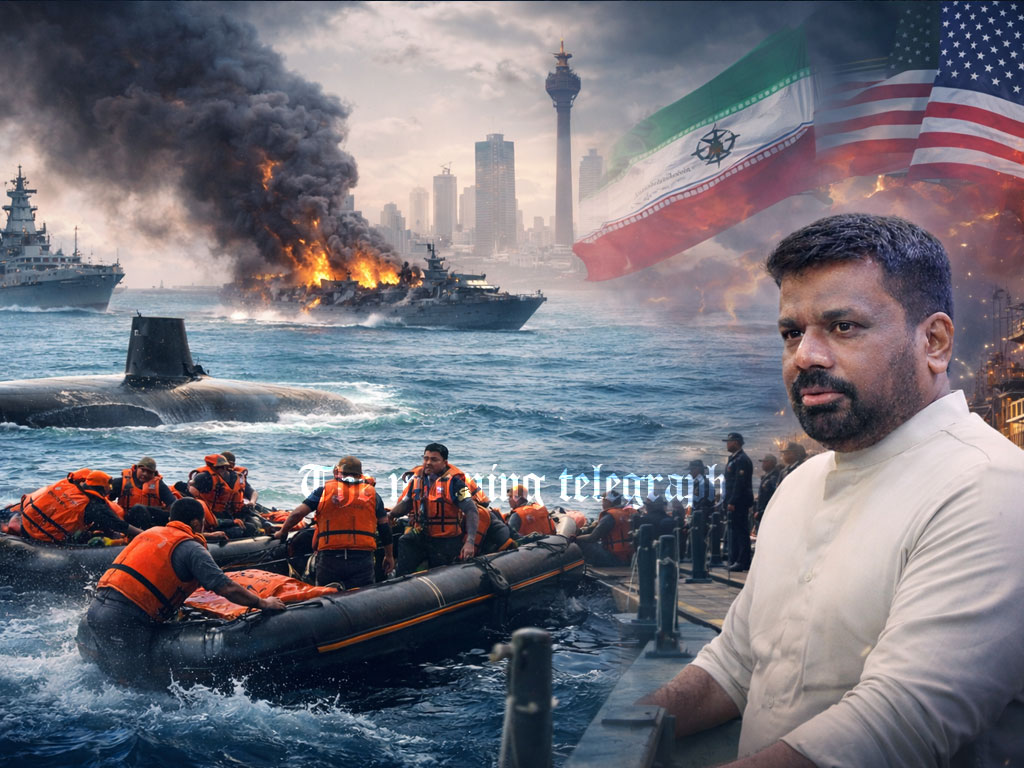
The vessel in distress was the IRIS Dena, an Iranian naval ship returning from a security conference in Visakhapatnam, India, where it had travelled at the formal invitation of the Indian government. But this was no accident. International media, followed quickly by local reporters, began circulating claims that an American submarine had targeted the Iranian vessel with torpedoes. The United States Department of Defense, through Secretary Pete Hegseth, would later confirm what many had suspected: the first torpedo strike since the Second World War had just occurred in the Indian Ocean, and an Iranian warship lay at the bottom of the sea.
When Sri Lankan rescue teams arrived at the coordinates, they found no ship. What they discovered instead were the bodies of more than 80 Iranian sailors floating in the waters, their lives extinguished in a confrontation that had nothing to do with this country but was now very much on its doorstep.
When the Torpedoes Hit
The sinking of the IRIS Dena represents a significant escalation in the conflict between Washington and Tehran. According to reports reaching Colombo, the vessel had been participating in naval exercises and a security conference hosted by India, bringing together warships from multiple nations. Three Iranian vessels had actually made the journey from Iran to India, though initial reports had suggested only two ships were involved in the regional deployment.
As the IRIS Dena made its way back through Sri Lanka’s Exclusive Economic Zone, an American submarine lurking beneath the waves launched its torpedoes. The attack was swift and devastating. By the time distress signals reached Sri Lankan authorities, the ship was already doomed.
The timing could hardly have been more sensitive. Only days earlier, President Anura Kumara Dissanayake had attended an artificial intelligence summit in New Delhi, where he held discussions with Sergio Gor, the United States Assistant Secretary of State for South and Central Asian Affairs. Simultaneously, Admiral Steve Koehler, commander of the United States Pacific Fleet, made an unexpected visit to Colombo for talks with senior Sri Lankan officials. The proximity of these diplomatic engagements to the subsequent military action has inevitably fuelled speculation about whether Washington was laying groundwork for its regional operations.
India found itself uncomfortably implicated in the controversy, given that the Iranian vessels had sailed from an Indian port. New Delhi issued an immediate and forceful denial that any Indian territory had been used in launching attacks against Iran, but the damage to its carefully maintained neutrality was already done.
The Navy’s Denial That Crumbled
When Sri Lankan naval officials first addressed the media, they were emphatic. The sinking was not a confirmed attack, they insisted. By the time Sri Lankan forces reached the location, the vessel had already disappeared beneath the waves. Journalists pressing for confirmation of American involvement were met with cautious deflection.
Hours later, those denials looked painfully premature. Secretary Hegseth’s confirmation from Washington that an American submarine had indeed targeted the Iranian vessel forced a rapid reassessment within Sri Lankan government circles. The country now had to grapple with the reality that an act of war had occurred in waters it claimed as its exclusive economic zone, and its initial response had been based on incomplete information.
The situation grew more complicated when a second Iranian vessel, also returning from the Indian conference, halted within Sri Lanka’s Exclusive Economic Zone and requested permission to enter the Port of Colombo. More than 200 sailors were aboard, and their commanders were acutely aware that they too could become targets following the destruction of their sister ship.
A Standoff at Sea
Sri Lanka’s National Security Council convened urgently under President Dissanayake’s chairmanship. The initial decision was straightforward: treat this as a humanitarian emergency. The plan called for bringing only the sailors ashore using special naval boats, bypassing normal immigration and customs procedures. The vessel itself would remain at sea, and Sri Lanka would accept no responsibility for it.
Tehran had other ideas.
Through both the Iranian ship’s commanders and the embassy in Colombo, Iranian authorities transmitted an unambiguous message. No sailor would abandon their vessel. If Sri Lanka wanted to assist the crew, it would have to allow the ship to enter a Sri Lankan port. The sailors would not leave their vessel behind under any circumstances.
Former minister Wimal Weerawansa added fuel to an already blazing fire when he warned publicly that allowing an Iranian warship close to Sri Lanka’s coast could invite another American torpedo strike. If such an attack occurred within Sri Lankan waters, the consequences would be catastrophic. Notably, no government official moved to challenge Weerawansa’s assessment.
Despite this warning, Sri Lanka proceeded with its original plan on Wednesday afternoon. Naval vessels including the SLNS Nandimithra sailed from Colombo Harbour toward the Iranian ship anchored 19 nautical miles away. Their mission was straightforward: bring back 208 personnel comprising officers, senior sailors, sailors and cadets.
The operation began smoothly enough. Sri Lankan naval personnel started transferring Iranian crew members onto their vessels. Then, abruptly, everything stopped.
A message from Tehran reached the Iranian ship, instructing sailors already boarding Sri Lankan vessels to return immediately. Unless the ship itself was guaranteed entry to Colombo Harbour, no Iranian personnel would leave. The sailors who had already begun their journey to Sri Lanka turned back, climbing onto their own decks as Sri Lankan officers watched in confusion.
The naval vessels, including the Nandimithra, returned to Colombo Harbour carrying no survivors. The mission had failed completely.
The Compromise That Satisfied No One
With the standoff continuing, Iranian diplomats reopened urgent discussions with Sri Lanka’s Foreign Ministry. Foreign Minister Vijitha Herath briefed President Dissanayake on the developments, and consultations were initiated with several Middle Eastern countries, including both Iran and Saudi Arabia.
Another emergency security council meeting followed. According to information reaching political circles through unofficial channels, Iranian officials participated directly in these discussions. There were indications, though not officially confirmed, that American representatives may have been informally consulted as well.
After lengthy deliberations examining international conventions, maritime law and Sri Lanka’s legal obligations, the government reached a compromise. Both the Iranian sailors and their vessel would be permitted to enter Sri Lankan waters. However, a significant condition was imposed. Only the crew would come ashore at Colombo. The vessel itself would be directed toward the Port of Trincomalee rather than entering Colombo Harbour.
The decision reflected Sri Lankan authorities’ awareness of the security risks involved in bringing an Iranian warship directly into the capital. Even then, according to sources familiar with the discussions, the plan called for keeping the vessel anchored off the coast near Trincomalee rather than docking inside the harbour.
The Hunduwe Firestorm That Engulfed the President
While these delicate negotiations proceeded, President Dissanayake addressed Parliament to brief lawmakers on the escalating Middle Eastern crisis. His speech covered the various risks Sri Lanka might face from the conflict and outlined the government’s diplomatic approach.
Then came the phrase that would overshadow everything else.
“Are these even countries?” the President remarked at one point. “These are ‘Hunduwe’.”
Social media exploded. The term, which carries derogatory connotations in Sinhala, went viral within hours. Critics accused the President of insulting sovereign nations and displaying diplomatic immaturity. Supporters argued the remark had been taken out of context and that the President was expressing frustration with great power politics rather than mocking any specific country.
Beyond the linguistic controversy, however, lay a more substantive political observation. Opposition figures and political commentators noted a striking shift in the governing party’s posture toward the United States. In previous years, when America carried out military actions in Palestine, Gaza, Iraq, Venezuela or Cuba, leaders of the Janatha Vimukthi Peramuna including figures now holding senior government positions had led protests outside the United States Embassy in Colombo. They had condemned American imperialism in passionate speeches and demanded that Sri Lanka maintain its nonaligned credentials.
This time, there was no such condemnation. Neither the President nor senior ruling party members directly denounced the American attack on Iran. Dissanayake limited himself to a general statement that no country has the right to wage war in a manner violating another state’s sovereignty, a formulation that avoided assigning blame to any specific party.
Opposition Takes the Lead on Condemnation
Opposition Leader Sajith Premadasa adopted a markedly different approach. In his parliamentary address, he strongly condemned the American strikes on Iran while also criticizing Tehran’s retaliatory attacks on other Middle Eastern countries. Both sides, he argued, had contributed to the escalation of violence.
Premadasa convened a meeting of opposition party leaders and MPs at his parliamentary office, a discussion lasting nearly an hour that focused on the Middle Eastern crisis and its implications for Sri Lanka. Participants agreed the opposition should adopt a balanced position, condemning American strikes on Iran while also criticizing Iranian attacks on other regional states. They further argued that the unilateral assault on Iran violated several provisions of the United Nations Charter, given Iran’s status as a sovereign nation.
The opposition decided to appoint an expert committee to study the crisis and prepare a detailed report on its implications. Premadasa subsequently voiced these concerns in Parliament and later visited the Iranian Embassy in Colombo to express condolences to the families of those killed in the attacks. He became the first Sri Lankan party leader to meet the Iranian ambassador after the strikes.
Plans were made to stage a protest outside the United States Embassy in Colombo. In a remarkable development, the Iranian ambassador himself appeared at the protest alongside former MP Mujibur Rahman, a scene that would have been unthinkable just weeks earlier.
Two Weeks of Contradictions
Only fourteen days before the torpedoes struck, Sri Lanka had expressed warm diplomatic sentiments toward Iran during celebrations marking the anniversary of the Islamic Republic. The event, organized by the Iranian Embassy, took place at the ITC Ratnadipa Hotel at Galle Face and drew senior government officials, opposition figures, military commanders and other dignitaries.
Representing the Sri Lankan government was Health Minister Nalinda Jayatissa. The Iranian ambassador delivered a strongly worded speech condemning United States policies toward Iran and warning against possible military actions targeting his country. His remarks were widely interpreted as provocative and critical of Washington.
All eyes turned to Minister Jayatissa. Would he align with Iran’s position or attempt to strike a diplomatic balance?
In his speech delivered in English, Jayatissa chose to warmly thank Iran for its longstanding support to Sri Lanka. He highlighted the Uma Oya multipurpose development project, funded by Iran, noting its significant contribution to strengthening Sri Lanka’s irrigation sector. He acknowledged Iran’s role as a supplier of fertilizer and as an important buyer of Sri Lankan tea, emphasizing the economic benefits these relationships bring.
The minister’s remarks amounted to a clear expression of gratitude toward Iran, with no suggestion that Sri Lanka intended to curtail economic ties with Tehran despite mounting pressure from the United States. These diplomatic signals, analysts believe, did not go unnoticed in Washington.
Some observers now warn this could complicate ongoing tariff negotiations between Sri Lanka and the United States. Should Colombo maintain a firm position in those discussions, Sri Lanka’s export sector could face serious challenges in the American market.
Economic Shockwaves Reach Colombo
The escalating conflict is already producing economic ripple effects reaching Sri Lankan shores. Mediterranean Shipping Company, one of the world’s largest shipping firms, has announced a war risk surcharge on cargo transported from the Indian subcontinent including Sri Lanka, India, Pakistan and Bangladesh to Africa and island nations in the Indian Ocean.
The surcharge, effective from March 5, is intended to offset security risks and attacks on maritime routes in the region. The company announced an additional charge of five hundred dollars for standard twenty foot containers and one thousand dollars for refrigerated containers, with even higher fees planned for shipments from the Gulf to Africa.
Shipping insurers are raising premiums for vessels operating in the region while some companies are limiting coverage altogether. For Sri Lanka, a country heavily dependent on maritime trade, these developments could result in higher import and export costs, increased freight charges and rising insurance expenses. The economic recovery the government has been working toward could face significant headwinds from a conflict thousands of miles away.
China Demands Answers
The situation has grown even more complicated following reports that an American submarine carried out an attack on an Iranian vessel within Sri Lanka’s Exclusive Economic Zone. China has reportedly decided to question the Sri Lankan government over the matter.
Beijing’s argument is straightforward. If an American submarine can enter Sri Lanka’s maritime zone and launch military operations, on what basis are Chinese research vessels denied access to Sri Lankan waters?
This dispute has deeper roots extending back several years. In the past, multiple Chinese research vessels were permitted to conduct activities in Sri Lankan waters. However, strong objections from India led the previous government under Ranil Wickremesinghe to impose a one year ban on such visits. China interpreted that decision as a serious affront to its national prestige and subsequently withheld economic support despite Sri Lanka’s deep financial crisis.
When President Dissanayake visited Beijing during his first official trip as head of state, he reportedly gave verbal assurances that the issue would be resolved and that relevant procedures would be revised. Nearly a year later, those assurances remain unfulfilled.
As a result, China has slowed down several development projects in Sri Lanka and could adopt a tougher stance on debt restructuring negotiations. If Beijing concludes that Sri Lanka is allowing Iranian and American naval activities near its waters while continuing to block Chinese research vessels, the consequences for Colombo could be severe.
The Chinese position reflects a broader concern about equitable treatment. Beijing sees no reason why its vessels should be excluded from waters where American submarines can conduct military operations. For Sri Lanka, balancing these competing demands while maintaining relationships with both superpowers presents an almost impossible diplomatic challenge.
The Anti-Corruption Card
Amid these external pressures, the government appears to be falling back on its most reliable domestic political strategy: the campaign to arrest corrupt figures from previous administrations. Since coming to power, the administration has launched several nationwide initiatives aimed at addressing the country’s deep seated problems. Despite these efforts, the dominant sentiment lingering in the public mind seems simpler: whatever the government does, at least they are catching the thieves who ruled before.
However, over recent months, momentum behind this anti corruption drive appears to have slowed for various reasons. According to information reaching political circles, a special internal discussion was recently held within the government following the sudden emergence of fuel queues across the country, a development that occurred within hours of tensions escalating in the Middle East.
During that discussion, many participants reportedly warned that the crisis could trigger additional economic and social challenges for the government in the near future. In that context, it was suggested that the anti corruption drive should be intensified to maintain public confidence in the administration.
Sources indicate that a highly confidential meeting involving five or six senior figures was convened last week to review progress on ongoing investigations. The discussions reportedly focused at length on the status of several high profile probes. Following the meeting, steps were allegedly taken to summon certain individuals for further discussions. Although it remains unclear whether that meeting eventually took place, news of the invitation itself quickly leaked, even reaching a prominent opposition figure.
Since meetings of this nature are rarely convened, many believe the information must have been leaked by someone directly involved in organizing it. Some insiders suggest the meeting may have been called by influential figures seeking to issue firm instructions against attempts by certain parties to delay or derail ongoing investigations.
The Troublemaker and the Astrologer
Meanwhile, a particular opposition MP widely regarded as something of a political troublemaker has reportedly become a persistent headache for the President. Sources say the MP frequently telephones the President attempting to offer unsolicited advice. The President himself has reportedly told close associates that these calls have become something of an irritation.
Last Wednesday, when the President arrived in Parliament, the same MP allegedly followed him around the premises, setting aside all hesitation in an effort to corner him into conversation. According to insiders, this is not the first time the outspoken politician has behaved this way. In the past, he had similarly attempted to offer advice to former presidents, often from the opposition benches.
After addressing Parliament, the President proceeded to the parliamentary dining hall with several MPs. Not long afterward, the same opposition strategist walked in and seated himself at the very table where the President was sitting. At that table were former Finance Minister Ravi Karunanayake and opposition MP Dayasiri Jayasekara. During the conversation, Karunanayane briefed the President on possible economic and geopolitical risks Sri Lanka might face as a result of the Middle East conflict. Observers noted that the President listened attentively and engaged in a detailed exchange of views with him. Several matters raised during the discussion were reportedly acted upon immediately.
However, while the President appeared receptive to Karunanayake’s observations, the economic theories put forward by the self styled expert at the table did not receive much attention. Insiders suggest this may be because the MP in question tends to dwell more on theoretical arguments than on the practical realities facing the country.
Another curious development has been unfolding within the United National Party. A crafty political operator holding a senior position in the party has reportedly been making phone calls to friends and allies not to discuss policy or strategy, but to share an astrological prediction. Ironically, this comes shortly after the party proudly announced that it had digitised its operations.
According to those who received the calls, the UNP figure predicted based on astrological calculations that the present government would collapse before the end of the year, paving the way for Ranil Wickremesinghe to return to the presidency. Many who heard this prediction reportedly burst out laughing. Their reaction was simple: the same party that boasted about becoming a modern digital political organisation now appears to be clinging to horoscopes for its political hopes.
Strategic Crossroads
Sri Lanka now finds itself navigating a dangerously complex geopolitical environment. Caught between the United States, Iran, India and China while simultaneously grappling with economic recovery and IMF commitments, the island nation faces a delicate balancing act.
The decisions made in the coming months could shape not only Sri Lanka’s foreign policy trajectory but also its economic survival in an increasingly polarized world. The government’s handling of the Iranian rescue operation, its response to the American attack within its maritime zone, and its management of relationships with China and India will determine whether this country emerges from the crisis with its sovereignty intact or finds itself crushed between contending great powers.
The humanitarian imperative that drove Sri Lanka to rescue Iranian sailors was morally clear. The geopolitical calculations surrounding that rescue are anything but. As one senior diplomat reportedly remarked during the emergency security council meetings, sometimes the most dangerous waters are not those with torpedoes beneath the surface, but those where the currents of international politics threaten to pull a small nation under.
For now, Sri Lanka has survived the immediate crisis. The Iranian sailors are safe, the second vessel has been accommodated without incident, and open conflict has been avoided within Sri Lankan territory. But the submarine that launched those torpedoes is still somewhere beneath the Indian Ocean, the war between America and Iran shows no signs of abating, and the research vessels China wants to send are waiting for permission to sail.
The telephone at the Foreign Ministry will ring again. The only question is what news the next call will bring.