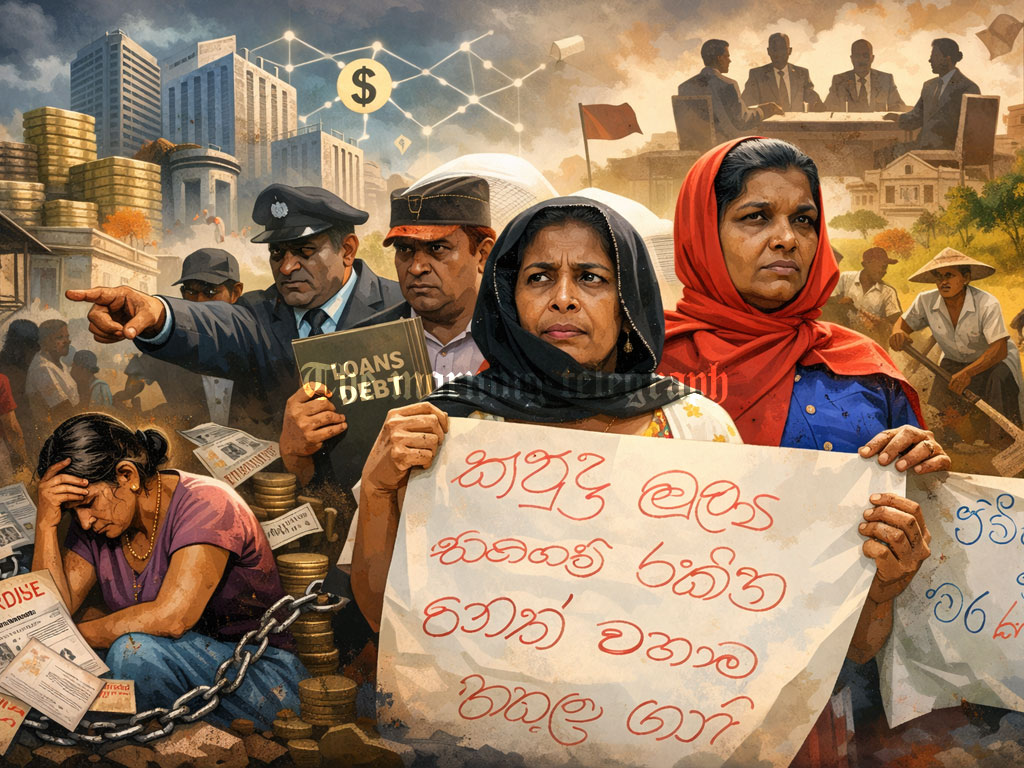
Grassroots activists warn that Sri Lanka’s new Microfinance and Credit Regulatory Authority law could deepen the rural debt crisis, burden women borrowers and weaken community credit systems instead of delivering the relief the government promised.
The passage of Sri Lanka’s Microfinance and Credit Regulatory Authority Bill in Parliament on March 4 has triggered strong criticism from grassroots movements and civil society organizations.
While the government has presented the new legislation as a major step toward regulating the country’s largely unregulated microfinance and money lending sector, critics argue that the law fails to address the realities faced by borrowers trapped in high interest microfinance debt. Activists say the policy risks strengthening financial institutions while leaving vulnerable communities, particularly rural women, with little meaningful protection.

Organizations such as Justice Collective warn that the legislation was shaped by international financial conditions rather than the everyday experiences of indebted families. According to the group, the bill does not adequately address the issue of credit justice and ignores the structural factors that have driven thousands of low income households into long term debt cycles.
The Microfinance and Credit Regulatory Authority Bill was formally approved by Sri Lanka’s Parliament on March 4.
According to Deputy Minister of Finance and Planning Dr. Anil Jayantha, the law aims to establish a regulatory authority responsible for licensing and supervising microfinance and lending institutions. The intention, he says, is to prevent borrower exploitation and ensure financial stability within the lending sector.
However, Justice Collective has expressed deep disappointment over what it sees as a contradiction between the government’s election promises and the policies now being enacted. During the 2024 election campaign, the administration pledged to reduce the heavy burden placed on women by predatory microfinance loans that charge extremely high interest rates.
Activists now argue that the new law does not deliver the promised relief. Instead, they claim it risks reinforcing the existing debt trap that already affects many rural women borrowers across Sri Lanka.
Community advocates also point out that the legislation does not require meaningful representation of women borrowers on the newly proposed regulatory authority. Without direct participation from women who experience the consequences of microfinance debt, critics question whether the authority can properly understand the economic realities faced by borrowers.
Promise of Change
Millions of struggling families supported the National People’s Power alliance in the hope of systemic change in Sri Lanka’s economic and financial policies.
However, activists argue that the legislative process behind the new bill did not adequately involve affected communities. They say many members of Parliament failed to consult community credit providers operating within their constituencies before approving the law.
Predatory lending continues to operate in both formal financial institutions and informal lending networks. Critics say the legislation does not clearly identify or prohibit abusive recovery methods and aggressive loan collection practices.
Advocacy groups also claim the law shifts attention away from the failure of financial regulators to control licensed finance companies. Some lawmakers, they allege, are linked to major financial institutions that profit from high interest lending to poor borrowers.
At the same time, activists warn that the new regulatory framework could unintentionally marginalize community based financial systems. Local credit networks such as death benefit societies, farmers’ groups and women’s savings collectives have long provided safer borrowing alternatives for low income households.
Structural Reform Concerns
Critics argue that the bill reflects broader structural reforms encouraged by international financial institutions rather than policies designed primarily to protect borrowers.
Similar reforms have been promoted through financial programs supported by the Asian Development Bank, including the 2016 Microfinance Act and subsequent economic reform agendas.
Activists note that recommendations made by Sri Lanka’s Supreme Court in 2024 and proposals put forward by affected communities were not incorporated into the 2026 law.
Reform Pathways
Advocates say meaningful financial reform should focus on expanding access to affordable credit through state banks and public lending programs.
They argue that subsidized loans and better financial support for women farmers, small scale producers and micro entrepreneurs could help create stable livelihoods while reducing dependence on high interest private lenders.
Supporters of community finance believe that strengthening social protection, fair wages and inclusive economic policies will be essential if Sri Lanka hopes to break the cycle of rural indebtedness.