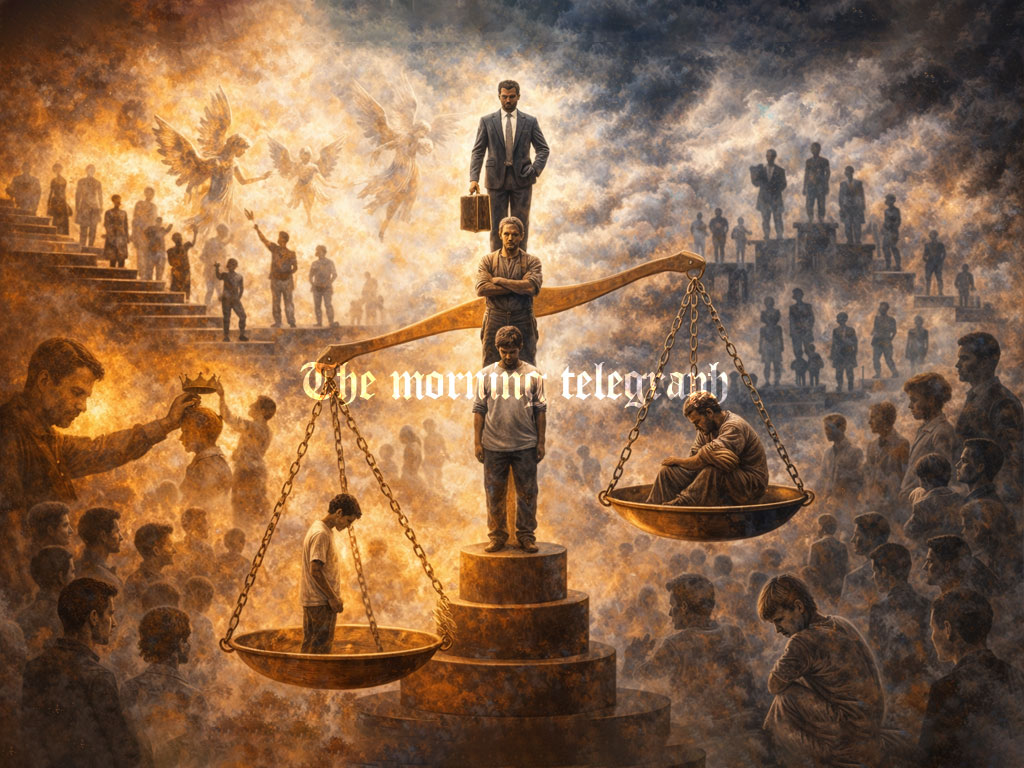
On the human habit of assigning greater and lesser worth, and the correction we still refuse to make
By Roshan Jayasinghe
Author’s Note:
This reflection was written not to deny difference in human life, but to question the habit of turning difference into greater and lesser human worth. We live in a world that educates the mind in many directions, yet often leaves untouched one of the oldest distortions shaping human behaviour. This piece is an invitation to look at that construct more honestly, and to consider whether one of humanity’s deepest corrections still lies in something we have long treated as normal.
There is something human beings do so easily that most of the time we hardly stop to question it.

We measure one another.
Not in height, weight, distance, or age, but in worth. We place one person above another, and another below. We attach importance to title, class, education, money, appearance, race, influence, occupation, status, and even the way a person speaks or carries themselves. Much of human society has been quietly arranged around these rankings. From early on, we begin to understand who is meant to be admired, who is meant to be obeyed, who is meant to be noticed, and who can be passed by without much regard.
What is perhaps most unsettling is not only that this happens, but that it is accepted so readily. It has become so ordinary that many no longer see it as a made way of living at all. It appears to them as reality itself.
Yet no child enters the world with this measure already formed. No infant arrives believing one life stands higher than another. These are not truths we are born knowing. They are arrangements we are introduced to. We absorb them slowly through family, school, religion, culture, and the behaviour of those around us. We learn where approval is given. We learn what society praises. We learn what kind of person receives attention, dignity, privilege, or authority, and what kind does not. In time, these lessons settle so deeply that what was taught begins to feel natural.
This may be one of the most quietly damaging things human beings have done to one another.
Difference itself is not the problem. Difference is part of life. No two people are the same, nor were they ever meant to be. One may be more gifted in language, another in numbers, another in patience, another in physical strength, another in care, another in vision, another in courage under pressure. Human variety is not a flaw in life. It is part of its richness. It is what allows people to support one another, complement one another, and contribute in different ways.
What happened next was not innocent. Difference was no longer simply seen. It was organised into higher and lower, and from there, human worth itself became entangled in the measure.
That is where the distortion begins.
To see that one person knows something another does not is simple enough. To see that one person has practiced a craft longer, developed a skill more deeply, or taken on greater responsibility is also plain observation. Yet the human mind so often moves from observation into a more dangerous conclusion. It begins to treat those differences as though they reveal the value of the person themselves. Not what they do, not what they have learned, not what circumstances placed around them, but who they are in essence.
From that error, much of our human mess has followed.
The one seen as superior is often encouraged to protect that position. The one seen as lesser often carries an unseen wound, whether they resist it or quietly submit to it. Entire systems then grow around this false arrangement. Schools reward it. Social circles repeat it. Politics manipulates it. Economies deepen it. Culture dresses it up in admiration and aspiration. Even ordinary conversation keeps it alive without ever naming it.
So much human behaviour begins to make more sense when seen through this lens. Pride, shame, envy, exclusion, domination, performance, insecurity, resentment, the endless need to prove oneself, and the fear of being seen as insignificant. Much of what passes as ambition is not always the love of creation or contribution. Often it is the fear of being nobody in a world that has confused worth with position.
This, to me, may be one of the deepest fractures in human life.
We have confused function with value. A person may hold greater responsibility in a certain setting. A surgeon and a student are not doing the same work. A pilot and a passenger are not carrying the same task in a moment of flight. A teacher may know more of a subject than the child being taught. Such distinctions exist. Life requires roles, and at times structure. But role is not the same as human worth. Responsibility is not superiority. Skill is not superiority. Wealth is not superiority. Fame is not superiority. Public recognition is not superiority. None of these things raise the substance of one life above another.
Yet human society continues to behave as though they do.
This begins very early because the human mind is sensitive to belonging. From childhood, we read signs of approval and rejection. We notice where respect is given and where it is withheld. We are shaped by comparison long before we understand what comparison is doing to us. To belong feels safe. To be excluded can feel like a threat to survival. In such a condition, status becomes powerful. It begins to look like protection. To some, superiority offers temporary relief from inner insecurity. To others, inferiority becomes a story they have heard so often they begin to mistake it for truth.
This is how false structures survive. Not only through force, but through repetition. Not only through cruelty, but through normalisation. People begin living by an arrangement without remembering that it was made.
And what is made can also be questioned.
It is worth asking whether this whole way of seeing has been one of humanity’s greatest errors. Not because it is the only source of conflict, but because it quietly enters almost everything. Once one person is inwardly accepted as more human than another, even subtly, fairness begins to weaken. Compassion becomes selective. Dignity becomes conditional. Relationship becomes contaminated by hidden comparison. From there, disorder spreads into homes, schools, communities, nations, and history itself.
It may even be that much of our violence begins long before a weapon is ever raised. It begins in the mind that has already agreed that one life matters more.
And yet if one looks at life itself, it does not seem to speak in this language as insistently as human society does. Birth does not arrive wearing status. Hunger does not ask for rank before it is felt. Grief does not spare the educated. Illness does not bow to title. Death does not preserve social standing. The body returns without ceremony. The earth receives all without consulting their position among the living.
Life seems to remind us, again and again, that we are not as separate in worth as we have trained ourselves to believe.
So why do we continue?
Partly because the ego is comforted by distinction. To feel above another can temporarily cover over one’s own uncertainty. To be associated with success, power, exclusivity, prestige, or refinement can give a fragile self something to hold. In the same way, many who are placed below begin carrying pain that does not belong to their being, but to the story society has imposed upon them. The tragedy is that both are trapped. Superiority imprisons the one above just as inferiority burdens the one below. One must defend the image. The other must struggle beneath it.
Neither is truly free.
A reset, then, may not begin by pretending all people are identical. They are not. Human beings differ in temperament, ability, maturity, experience, and responsibility. But none of that requires the reduction of another person’s worth. That is the distinction that matters. We may differ in expression, but not in the basic dignity of being here at all.
This is one of the things we have failed to teach clearly enough.
That another person’s gift does not make them more human than you.
That another person’s struggle does not make them less.
That wealth may change comfort, but not essence.
That education may refine understanding, but not basic worth.
That no title, however grand, alters the underlying fact of being a living human being among other living human beings.
One also cannot ignore the way older constructs continue to be carried forward through religion, gender, race, and inherited identity, then placed quietly into the early shaping of a child as though they were part of reality itself. If such distortions can be preserved so faithfully across generations, it is worth asking why a truer understanding of humankind struggles to find the same acceptance. For all the intelligence we attribute to ourselves, and for all the refinement of the human form and mind, it is remarkable how easily we still submit to false assumptions once they have been repeated long enough and wrapped in familiarity.
If this were understood more deeply, much of human striving might begin to soften. Not excellence, but the need to build identity through elevation. Not contribution, but the hunger to stand above. Not discipline, but the use of achievement as a means of separating oneself from others.
To reset this would require more than policy, though policy matters. More than reform, though reform has its place. It would require a correction in perception. A more honest inward seeing. A refusal to unconsciously worship status. A refusal to mistake polish for depth, power for wisdom, wealth for greatness, or visibility for value.
It may also require that we look more carefully at our own daily lives. Who do we instinctively respect more? Who do we overlook? In whose presence do we become smaller? Around whom do we perform importance? Which forms of social praise still influence our judgment of human worth? These are not distant questions. They live quietly within ordinary human behaviour.
And perhaps that is where change must begin too. Not in grand declarations alone, but in the way one human being learns to meet another without immediately placing them on an inner scale.
That may be harder than it sounds, because comparison has become almost automatic in modern life. But that does not make it true. It only means it has been practiced often.
The fact that something is common does not make it wise.
The fact that something has lasted does not make it right.
The fact that whole civilizations have arranged themselves around hierarchy does not mean hierarchy expresses the deepest truth about human life.
It may simply mean we repeated a mistake until it began to look like order.
Perhaps the trouble began the moment we no longer saw difference as part of life, but as a reason to assign greater and lesser value to those living it.
From there, much followed. The proud and the ashamed. The elevated and the dismissed. The ones taught to speak with confidence, and the ones taught to doubt their own place in the room. Over time, the measure became so ordinary that few stopped to ask whether it was true at all.
Yet life itself does not seem to insist upon it. We are born without title. We suffer without status. We leave without possession. Whatever we gather in between may shape our experience, but it does not alter the deeper fact that each of us arrives here as life, and departs as life, however decorated the journey may have been.
To remember this may be one of the quiet corrections still available to us.
Not to erase distinction, but to stop turning distinction into value.
Not to deny excellence, but to stop worshipping it as higher being.
Not to flatten humanity, but to release it from the unnecessary burden of inner ranking.
What is difficult to understand is not that human beings once fell into such a pattern, but that we continue to educate around almost everything except this. We train children in subject after subject until repetition becomes mastery. We ask them to remember facts, pass examinations, and fit into systems, yet we give far less attention to one of the deepest distortions shaping human behaviour itself. We do not seem to teach, with the same seriousness, how easily the mind turns difference into superiority and inferiority, and how much suffering follows when it does.
If this is one of the roots of so much human disorder, then surely it deserves more than occasional moral language or polite agreement. It deserves recognition as a foundational human correction. Not as theory, but as practice. Not as sentiment, but as conduct. Not as another ideal to admire, but as something to be lived, taught, and reflected in the way we build homes, schools, communities, and cultures.
Perhaps then we may begin meeting one another with greater honesty.
And perhaps from that, a less wounded world could slowly emerge.
It is worth asking, quietly and honestly, why we have worked so hard to educate the human mind, yet so little to correct one of its most damaging habits.