A sudden wave of Iranian attacks across key Gulf states exposes deep intelligence warnings, rising oil shocks, and a fast escalating regional war with global economic consequences.
Iran has intensified its military campaign by launching fresh attacks on the United Arab Emirates, targeting critical infrastructure and signaling a dangerous expansion of the ongoing conflict. The strikes, which directly impact United States Gulf allies, come despite earlier claims by former President Donald Trump that such escalation was unexpected, even as intelligence sources indicate prior warnings had been issued.

Diplomatic sources across the Gulf and wider Middle East suggest that Iran targeting Gulf Arab states was widely anticipated if the United States or Israel engaged Tehran militarily. This assessment, shared among regional and Western governments, highlights the predictable nature of the escalation now unfolding in what has become a prolonged and volatile conflict.
Now entering its third week, the United States and Israeli military campaign against Iran has resulted in at least 2,000 deaths, with no clear resolution in sight. The Strait of Hormuz remains effectively restricted, as Washington struggles to rally international support to secure the vital shipping route. The disruption has pushed global energy prices higher, raising serious concerns about inflation and economic instability.
Military exchanges continue without pause. Iran has demonstrated its continued strike capability by launching overnight missile attacks on Israel, indicating that despite sustained bombardment, its long range military capacity remains intact. In response, Israel has intensified operations, targeting what it describes as Iranian regime infrastructure in Tehran, along with Hezbollah linked sites in Beirut, while preparing for an extended campaign.
Reports from Israeli media suggest that Iran’s senior security figure Ali Larijani may have been targeted in a recent strike, though there has been no official confirmation regarding his condition. Both Iranian authorities and the Israeli military have remained silent on the matter, adding to the uncertainty surrounding the conflict’s leadership dynamics.
The conflict has also spread into Iraq, where rockets and drones targeted the United States embassy in Baghdad in what officials describe as one of the most intense attacks since hostilities began. While no casualties have been reported, the incident underscores the widening regional footprint of the war.
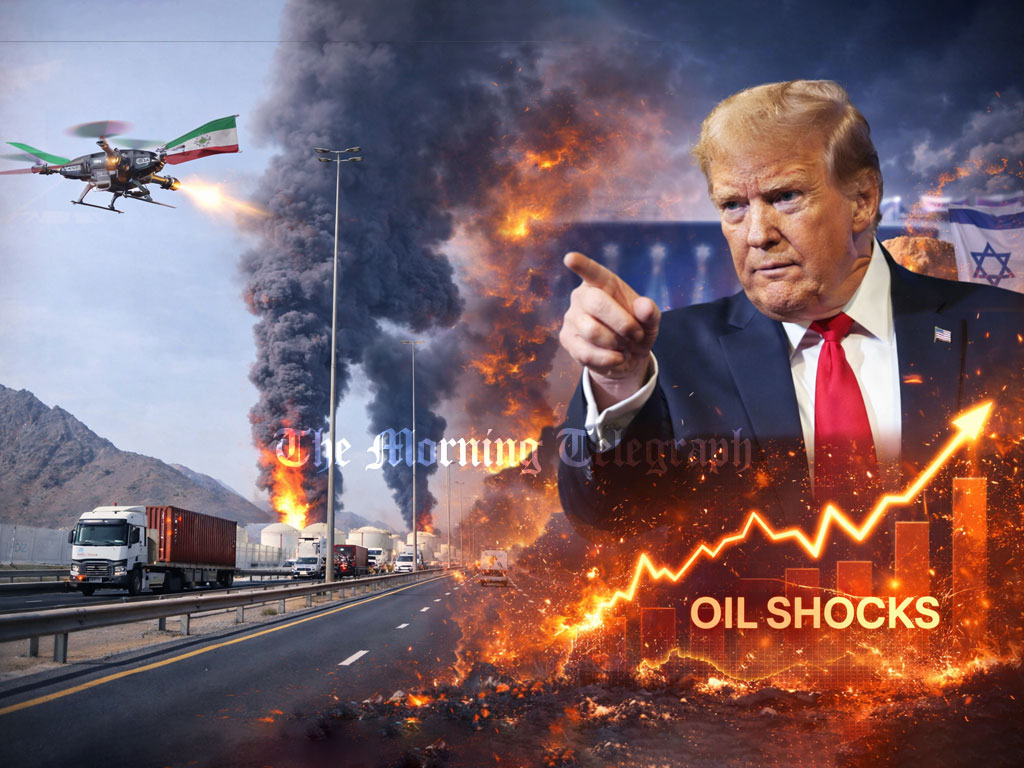
In the United Arab Emirates, the impact has been immediate and severe. Airspace closures were enforced following missile threats, while a drone strike hit a key oil facility in Fujairah for a second consecutive day. Debris from intercepted missiles caused casualties in Abu Dhabi, while fires broke out at major energy infrastructure sites, raising alarm over the vulnerability of global oil supply chains.
These developments threaten to disrupt the UAE’s ability to export crude oil, potentially cutting off a significant supply route and deepening the global energy crisis. With nearly 20 percent of the world’s oil passing through the Strait of Hormuz, the stakes for international markets remain extremely high.
Despite expressing surprise, Trump had reportedly been briefed that military action against Iran could trigger retaliatory strikes against United States allied nations in the Gulf. Intelligence assessments also warned that Tehran would likely attempt to close the Strait of Hormuz, a move that has now materialized in part.
International support for reopening the waterway remains limited. Several major allies, including Germany, Spain, Italy, Japan, and Australia, have declined to commit naval resources, citing legal and strategic constraints. Concerns have also been raised about the effectiveness of naval escorts in guaranteeing safe passage through increasingly contested waters.
Meanwhile, Iran continues to rely on its drone capabilities, which have proven both cost effective and disruptive. Iranian leadership has dismissed claims of weakening military strength, asserting that its operational precision and experience have improved despite ongoing attacks.
The economic consequences are already visible. Oil prices have surged, reversing earlier declines, while financial markets react to the growing risk of stagflation, where rising costs coincide with slowing economic growth. Central banks are beginning to respond, with interest rate adjustments aimed at containing inflationary pressures triggered by the conflict.
As the war expands beyond its initial scope, the intersection of military escalation, energy security, and global economic stability is becoming increasingly evident. What began as a regional confrontation is now reshaping geopolitical alignments and testing the resilience of global markets in real time.