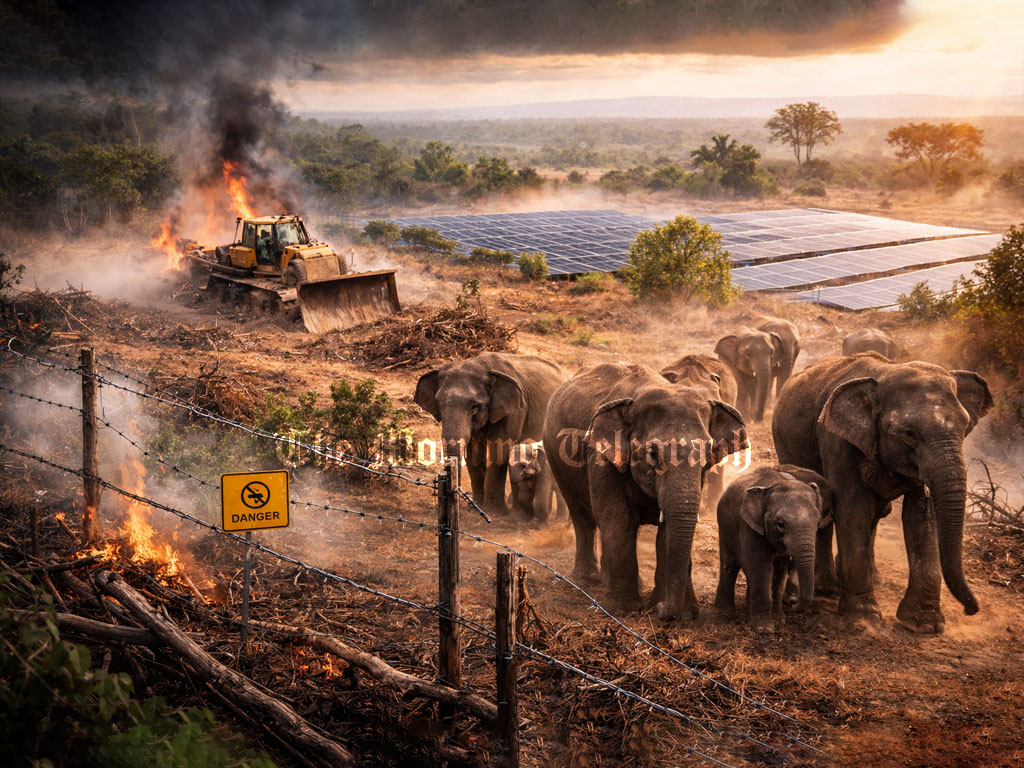
In a disturbing turn of events that raises serious questions about environmental governance, nearly 1,000 acres of protected elephant habitat in Hambantota has been systematically cleared by 17 companies for solar power projects, allegedly through bribery, illegal land clearing, and manipulation of court orders while government authorities remain silent.
The Land and Agriculture Reform Movement, through its spokesperson Sajeewa Chamikara, has exposed a massive environmental violation unfolding along the border of the Hambantota Wild Elephant Management Reserve. What makes this situation particularly alarming is the scale of destruction and the alleged involvement of prominent individuals, former cricketers, and business entities in what appears to be a coordinated assault on protected forest lands under the guise of renewable energy development.
Seventeen companies have reportedly initiated illegal construction of large-scale solar power facilities by clearing approximately 1,000 acres of forest cover in the Seenukkugala, Orukengala, and Kapapuwewa areas. These locations serve as critical elephant habitats bordering the Hambantota Wild Elephant Management Reserve, making this destruction particularly devastating for wildlife conservation efforts in the region.
The project breakdown reveals five companies developing a 50-megawatt facility while twelve companies collaborate on a 150-megawatt project. The environmental damage already inflicted includes complete forest clearing using heavy machinery, deliberate burning of vegetation, and installation of electric fences that now surround what was once thriving elephant territory.

The Companies Behind the 50-Megawatt Project
The 50-megawatt solar venture involves Dudu International Pvt Ltd, Nidhanya International Pvt Ltd, Tanu International Pvt Ltd, Tannish International Pvt Ltd, and Orion Solar Pvt Ltd. According to the allegations, the physical clearing operations for these companies fall under the supervision of Nadun Krishan Andaraweera, a resident of Ambalantota. Under his direction, heavy machinery has reportedly bulldozed and burned extensive forest areas that previously provided shelter and sustenance for wild elephants.
The methods described suggest a systematic approach to land clearing that shows complete disregard for environmental protection laws. Using dozers to remove vegetation followed by burning represents not just habitat destruction but also contributes significantly to carbon emissions, creating an ironic contradiction for projects claiming to promote clean energy.
The Bribery Allegations and Key Individuals
Perhaps the most troubling aspect of this entire situation involves allegations of corruption. The five companies reportedly paid Rs. 14 million as a bribe specifically to construct an electric fence spanning approximately 12 kilometers within the Hambantota Elephant Management Reserve. This payment allegedly secured support from government institutions to proceed with illegal forest clearing and solar project construction.
Praveen Peiris, identified as a director of Dudu International Private Limited, allegedly coordinated these activities on behalf of the five companies. Dudu International is owned by former Air Force Commander Oliver Ranasinghe, adding a layer of political and military establishment connections to the controversy.
The web of connections extends further into Sri Lanka’s celebrity and business circles. Peiris also serves as a director of Sino Lanka Power Gen Pvt Ltd, a company involved in solar power ventures. The other directors of this company include two of Sri Lanka’s most celebrated former cricketers, Mahela Jayawardena and Kumar Sangakkara. While their direct involvement in the alleged illegal activities remains unspecified, their association with companies operating in this space draws them into the broader controversy surrounding these projects.
The allegations suggest that these companies and individuals are collaborating to obtain project approvals and land leases from the Mahaweli Authority through irregular channels, bypassing established legal procedures while destroying elephant habitats in the process.
The 150-Megawatt Project Consortium
The larger 150-megawatt solar initiative, promoted as a $150 million investment, involves twelve companies: Geneco Pvt Ltd, Electrolyte Pvt Ltd, Photon Valley Pvt Ltd, Solargen Pvt Ltd, Stallion Energy Solar Pvt Ltd, Elephant Power International Pvt Ltd, Madunagala Agrico Pvt Ltd, Leisure Creation Pvt Ltd, Talna Solar Pvt Ltd, Circle Line Pvt Ltd, and Greenline Solar Pvt Ltd.
Erandu Niroshana Ihalavanni, owner of Madunagala Farm, reportedly oversees operations for this consortium. His alleged activities include constructing electric fences without proper authorization around 500 acres of forest land bordering the Hambantota Wild Elephant Management Reserve. The clearing operations allegedly continue day and night, using dozers and fire to remove forest cover.
Beyond the environmental destruction, Ihalavanni faces serious allegations of intimidating officials and activists. Reports indicate he employs gangs to threaten individuals attempting to inspect the illegally cleared land, blocks public roads to prevent access by outside groups, and has engaged with local temple priests to discourage community opposition to the projects.
The Leadership Structure
Charana Kumaranatunga reportedly appointed Ihalavanni for these purposes, serving as the head of the Hambantota 150 MW Solar PV Project Group of Companies. Kumaranatunga holds the position of Managing Director at Renventure Pvt Ltd, a strategic consulting firm established in 2021 that provides integrated business solutions.
Bandula Withanarachchi serves as chairman of Renventure Pvt Ltd. The twelve-company solar project operates as the Southern Nexus Solar Project under Southern Nexus Pvt Ltd, with Withanarachchi providing leadership. This organizational structure reveals a coordinated business approach to what activists describe as systematic environmental destruction.
Withanarachchi’s involvement in renewable energy extends beyond this particular project. He previously led efforts to implement Project Apollo, a 110 MW solar park representing an $82 million investment in 2024, developed in partnership with Southern Nexus and HD Ceylon Energy Pvt Ltd. This experience positions him as a significant player in Sri Lanka’s solar energy sector, making his alleged involvement in irregular practices particularly concerning for industry governance.
The Court of Appeal Controversy
A critical development in this saga involves legal proceedings before the Court of Appeal. Withanarachchi, in his capacity as Chairman of The Rainventures and Director of Southern Nexus, together with Charana Kumaranatunga as Managing Director of Rainventures, challenged what they described as poor coordination between government agencies and the suspension of land leases by the Mahaweli Authority.
The Court of Appeal delivered its judgment on June 12, 2025, ordering the Mahaweli Authority to release the lands to these companies without delay. Based on this court order, the twelve companies are currently clearing 500 acres of forest land. However, activists raise serious concerns about how this judgment was obtained.
The allegation suggests that Withanarachchi misled the court by concealing opportunities for objections from the Mahaweli Authority. Furthermore, the companies involved reportedly lack experience in constructing solar power plants, raising questions about their genuine intentions and capabilities. This pattern of inexperienced companies obtaining land for major energy projects through court orders warrants thorough investigation by relevant authorities.
Legal Requirements for Environmental Impact Assessment
The National Environmental Act establishes clear requirements for projects of this nature. Section 23B mandates that prior approval must be obtained based on a comprehensive Environmental Impact Assessment process before implementation. Gazette Notification No. 772/22 dated June 24, 1993, specifies that written approval must be obtained before using forests exceeding one hectare for non-forest purposes, opening areas exceeding 50 hectares, or constructing power plant projects exceeding 50 megawatts.
Both solar projects described in the allegations exceed these thresholds significantly. The 50-megawatt project meets the power generation threshold requiring EIA approval, while the 150-megawatt project far exceeds it. The forest clearing of approximately 1,000 acres represents land use changes on a scale that unquestionably requires comprehensive environmental review.
Section 23AA of the National Environment Act establishes penalties for violations, including fines up to Rs. 15,000 or imprisonment up to two years or both upon conviction before a Magistrate’s Court. While these penalties may seem modest relative to the scale of alleged violations, they represent the legal consequences available under current legislation.
Archaeological Protection Violations
Beyond environmental concerns, the projects allegedly violate archaeological protection laws. The Antiquities Ordinance No. 09 of 1940, as amended, together with Project Procedures Regulations No. 01 of 2000 published through Gazette Notification No. 1152/14 dated October 4, 2000, requires archaeological damage assessments and approval before implementing development projects involving land clearing exceeding two hectares or forest clearing exceeding one hectare.
The scale of clearing described in these allegations far exceeds these thresholds, suggesting multiple layers of legal violation. Any development project of this magnitude in a region with potential archaeological significance should undergo proper assessment to protect cultural heritage resources that may exist beneath the surface.
Human-Elephant Conflict Intensifies
The environmental destruction has already triggered severe consequences for local communities. Approximately 5,365 farming families settled in the Mayurapura division under the Mahaweli development project now face intensified human-elephant conflict. Areas including Gonnoruwa, Meegahajadura, Thanamalwila, and Galwewa report elephants invading villages in unprecedented numbers following the destruction of their natural habitat.
This conflict produces tragic outcomes on both sides. Elephants face death or injury as they venture into human settlements seeking food and shelter. Meanwhile, local residents suffer attacks resulting in fatalities and permanent disabilities. Some farming families have already abandoned their lands, unable to sustain agricultural livelihoods while defending against elephant incursions.
The social and economic implications extend beyond individual families to affect entire communities. Abandoned farmlands reduce agricultural production, disrupt local economies, and create demographic shifts as families relocate to safer areas. This pattern of displacement represents a hidden cost of poorly planned development projects.
Proposed Additional Land Allocations
The situation may worsen as the Mahaweli Authority reportedly prepares to allocate additional lands for solar development. According to the allegations, approximately 500 acres and 600 acres of land designated for the Hambantota Wild Elephant Management Reserve and upland farming colonies in Wewegama and Usgala areas under the Sooriyawewa Divisional Secretariat may soon be provided for new solar power plants.
Environmental activists call for immediate intervention to halt this process before further damage occurs. The cumulative impact of allocating protected wildlife habitat for industrial development threatens to permanently alter the ecological balance of the region and eliminate critical elephant corridors that have existed for centuries.
The Irony of Destroying Forests for Green Energy
The expansion of solar energy aims to control carbon dioxide emissions contributing to climate change. However, the Hambantota projects achieve the opposite effect by destroying forests that naturally absorb and store carbon. Forests serve as essential carbon sinks, and their removal through clearing and burning releases stored carbon while eliminating future absorption capacity.
The arid zone location of these projects adds another dimension of environmental concern. Forests in dry zones play crucial roles in maintaining local rainfall patterns and supporting agricultural systems. Their destruction risks disrupting rain cycles, potentially triggering broader climate impacts that affect farming communities and natural ecosystems throughout the region.
This situation highlights a fundamental contradiction in current approaches to renewable energy development. When solar projects destroy forests and displace wildlife, they undermine the environmental benefits that sustainable energy should provide. True sustainability requires holistic thinking that considers ecosystem impacts alongside energy generation goals.
The Need for Proper Site Selection
The underlying problem extends beyond these particular projects to encompass broader questions about how Sri Lanka selects sites for renewable energy development. Abandoned quarries, degraded lands, and previously developed sites offer alternatives that would avoid destroying forests and wildlife habitats.
Solar panels installed on buildings and residential roofs throughout the country could generate substantial electricity without requiring any additional land clearing. Combining distributed rooftop generation with battery storage systems would enhance energy sovereignty while avoiding environmental damage.
The Sustainable Energy Authority and Ceylon Electricity Board should prioritize these approaches rather than facilitating large solar parks on forest lands. Proper feasibility studies and environmental impact assessments must precede any land allocation for energy projects, ensuring that development proceeds only when genuine benefits outweigh environmental costs.
Institutional Failures and Government Silence
The most troubling aspect of this situation involves the apparent failure of regulatory institutions. The Central Environmental Authority, Department of Wildlife Conservation, and Mahaweli Authority bear responsibility for enforcing environmental laws and protecting public lands. Yet according to the allegations, these bodies have either participated in or permitted violations to proceed.
Government silence on these issues raises questions about political will to enforce environmental protections when development interests conflict with conservation. The involvement of well-connected individuals and companies may create pressures that override normal regulatory processes, resulting in unequal application of the law.
Conclusion and Recommendations
The Hambantota solar projects represent a critical test of Sri Lanka’s commitment to both renewable energy development and environmental protection. Neither goal should be sacrificed for the other. Properly planned solar energy can contribute to climate goals while respecting ecological limits.
Immediate intervention by the Central Environmental Authority and Department of Wildlife Conservation is essential to halt further illegal clearing and investigate alleged violations. Projects already underway should face suspension pending thorough environmental review and verification that all legal requirements have been satisfied.
Moving forward, Sri Lanka must develop transparent processes for selecting renewable energy sites based on objective criteria that prioritize already degraded lands over forests and wildlife habitats. Public participation in project approval decisions would help ensure that community concerns receive proper consideration before development proceeds.
The involvement of prominent individuals in these projects should not shield them from scrutiny or accountability. If laws have been violated, those responsible must face appropriate consequences regardless of their status or connections. Equal application of environmental protections is essential for maintaining public trust in regulatory systems.
Ultimately, the Hambantota situation demonstrates that renewable energy development without proper safeguards can cause environmental harm that outweighs its benefits. Learning from these mistakes and establishing stronger protections will be essential as Sri Lanka pursues its clean energy future while preserving the natural heritage that makes the country unique.