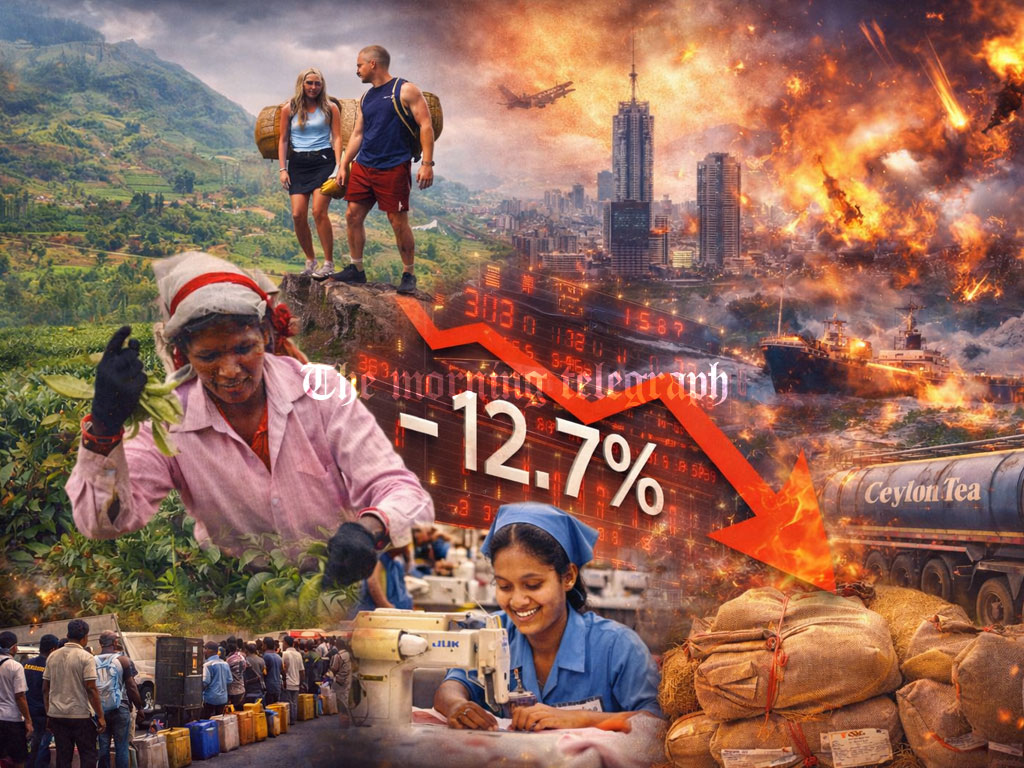
From fuel queues to shattered export orders, Sri Lanka’s economy is feeling the heat of the Iran war more acutely than almost any other nation, with billions in market value wiped out in just two weeks.
When the United States and Israel launched their bombing campaign against Iran on February 28, Sri Lanka’s booming stock market was among the first casualties. The bourse has since plunged 12.7 percent through March 20, erasing a staggering 1.07 trillion rupees in market capitalization over just 14 trading days. On the first trading day following the attack, March 3, the index tumbled more than 5 percent, triggering a temporary trading halt.

Investors are now caught between local anxieties and external shocks. At home, the return of fuel queues and fears of a renewed power crisis have rattled sentiment. Externally, uncertainty over whether the Gulf conflict will escalate further has kept buyers on edge. Analysts note that Sri Lanka’s market reaction has been unusually severe compared to regional peers. Raynal Wickremeratne, Head of Strategy at Softlogic Stockbrokers, pointed out that while most countries saw declines between 4 and 7 percent, Sri Lanka’s drop approached 14 percent. He attributed this to visible reminders of past crises, with motorists forming long queues at petrol stations as soon as they left their offices.
The return of fuel queues triggered a collective memory of the 2022 economic collapse, when crippling shortages led to widespread unrest. Investors fear a repeat scenario where power cuts, cooking gas shortages, and institutional closures precede a broader economic slowdown. Compounding these worries, the conflict has disrupted transit hubs such as Dubai and Doha, placing Sri Lanka’s tourism sector in jeopardy during what should be its peak season.
Tourist arrivals have already shown troubling signs, falling 19.4 percent in the first 18 days of March. Daily average arrivals dropped from approximately 10,000 in February to just 6,000 in March. Listed tourism stocks have taken a direct hit. Between February 27 and March 17, Ceylon Hotels Corp fell 29.7 percent, Palm Garden Hotel dropped 24.7 percent, and Aitken Spence Hotel Holdings declined 23.8 percent. Market heavyweight John Keells Holdings, which has significant exposure to the tourism industry, slipped 3.74 percent during the same period. Industry reports noted that Jetwing Resorts experienced an occupancy decline of 5 to 10 percent, while Heritance Ahungalla saw notable cancellations among long-stay European bookings.
Navin Ratnayake, Head of Research at John Keells Stockbrokers, warned that Sri Lanka’s tourism model remains vulnerable due to its heavy reliance on Middle Eastern transit hubs. He suggested that to meet the ambitious target of over 3 million arrivals, the industry must pivot toward direct Asian connectivity rather than depending on the traditional hub-and-spoke model through the Gulf.
Sri Lanka’s export sector, particularly tea, has also suffered significant damage. Gulf nations are the largest buyers of Ceylon Tea, with Iraq alone accounting for 23.3 percent of purchases in 2025. In the first week after the attack, weekly tea auction prices fell 4.3 percent while volumes declined 13.2 percent. Shipping costs have become prohibitive, with exporters facing severe delays. The Tea Exporters Association estimated weekly revenue losses between US$10 million and US$15 million. Listed tea stocks reflected the distress, with Namunukula Plantations plunging 30.6 percent and Agalawatte Plantations falling 22 percent between February 27 and March 17. Industry players reported that while tea processing continued, packed cargo was piling up in warehouses because vessels were unable to berth. Freight charges have spiked significantly, particularly impacting high-value low-grown tea varieties favored by Middle Eastern and Russian markets.
The apparel sector has not been spared either. Listed firms such as TJL have been forced to reroute shipments to Europe and the United States via the Cape of Good Hope to avoid the Red Sea. TJL shares plummeted 20.6 percent on the first trading day after the bombing. While buyers currently absorb the additional freight costs, exporters face rising expenses for raw materials like yarn and fabric imported from China and India. Hayleys PLC, which has significant logistics and export interests, saw its share price fall 6.4 percent on the first trading day after the conflict escalated, while its subsidiary Hayleys Fabrics dropped 17.2 percent.
Amid the widespread declines, a few sectors have emerged as unexpected beneficiaries. Analysts noted that Colombo Port terminals such as South Asia Gateway Terminals and West Container Terminal could see increased throughput as cargo originally destined for Middle Eastern ports is rerouted or offloaded in Sri Lanka. John Keells Holdings, which holds stakes in both terminals, has seen relative resilience in its share price. Bunkering operations have also gained from the surge in global oil prices. With Brent crude climbing 49.62 percent since the conflict began to reach $109.2 per barrel, operators with existing inventory are enjoying improved margins. John Keells Holdings’ bunkering business, operating on a cost-plus model, is considered particularly well insulated.
In the agribusiness sector, Sunshine Holdings PLC has benefited from a 12 percent rise in global palm oil prices since the war began, helping offset losses from its tea operations through brands such as Watawala Tea and Zesta. Meanwhile, the renewable energy sector has become more attractive as the cost of thermal electricity generation rises in tandem with global oil prices.