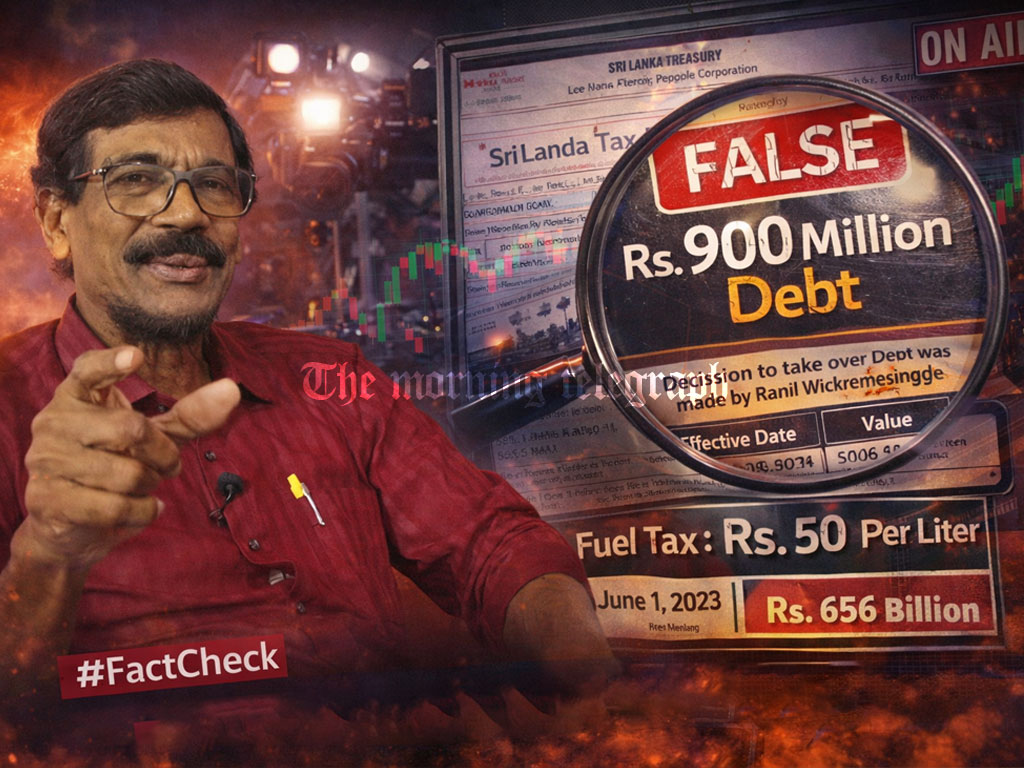
In a heated television exchange, a journalist dismantled the National People’s Power Party General Secretary’s assertion about who truly took over the Ceylon Petroleum Corporation’s massive debt, revealing the uncomfortable truth with official dates and data.
A tense moment unfolded on a private television channel yesterday when Tilvin Silva, General Secretary of the National People’s Power Party, found himself fact-checked live on air over his claims regarding the Ceylon Petroleum Corporation’s staggering debt burden.
During the political program, Silva asserted that the Oil Corporation had accumulated a debt of Rs. 900 million due to continuous losses incurred during the regimes of former Presidents Ranil Wickremesinghe and Mahinda Rajapaksa. He further claimed that upon the current government taking office, the Treasury assumed this debt, with taxes levied on fuel now being channeled to settle what he described as a legacy of previous administrations.

“We took over the huge debt of the Oil Corporation to the Treasury,” Silva stated, arguing that fuel taxes are not directed toward government expenses but rather toward clearing the massive financial burden inherited from past regimes.
However, the journalist hosting the program immediately interjected with a pointed correction. The decision to transfer the Oil Corporation’s debt to the Treasury, the journalist revealed, was actually implemented during former President Ranil Wickremesinghe’s tenure, beginning on June 1, 2023. A specific tax of Rs. 50 per liter of fuel was introduced at that time, with the target year for full repayment set at 2029.
When confronted with this timeline, Silva attempted to pivot. “That decision must have been made. But now it has been taken over,” he responded.
The journalist pressed further, presenting data showing that when the National People’s Power government assumed power in 2024, the remaining debt to be settled stood at Rs. 656 billion, not a newly initiated takeover as Silva had suggested.
Silva then offered a defensive clarification. “Time will tell. No matter what, now that money has been taken over by the treasury. No matter whose time it was taken over, now the treasury is earning this money. That is why this tax is being levied.”
The exchange highlighted the sensitivity surrounding the Oil Corporation’s financial legacy, with the journalist’s real-time fact-checking underscoring the challenges political figures face when revisiting complex fiscal decisions made by previous governments. The moment served as a rare instance of live accountability, leaving Silva to navigate an uncomfortable narrative twist on national television.