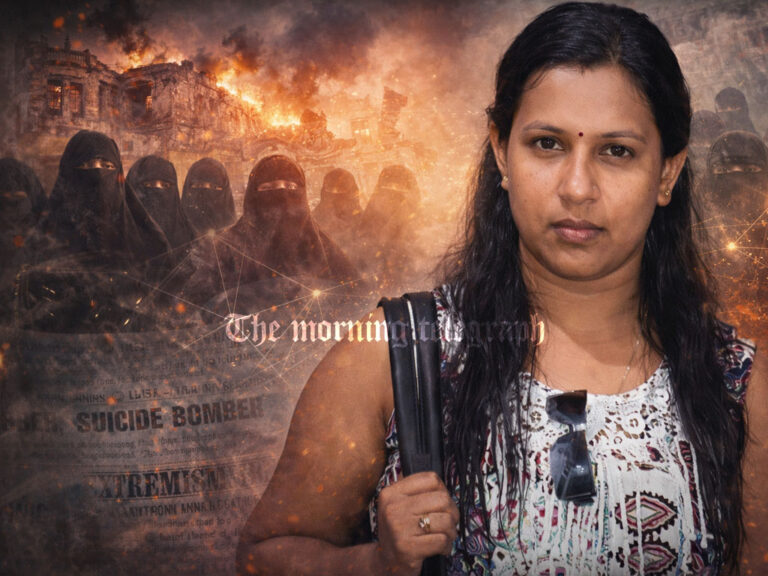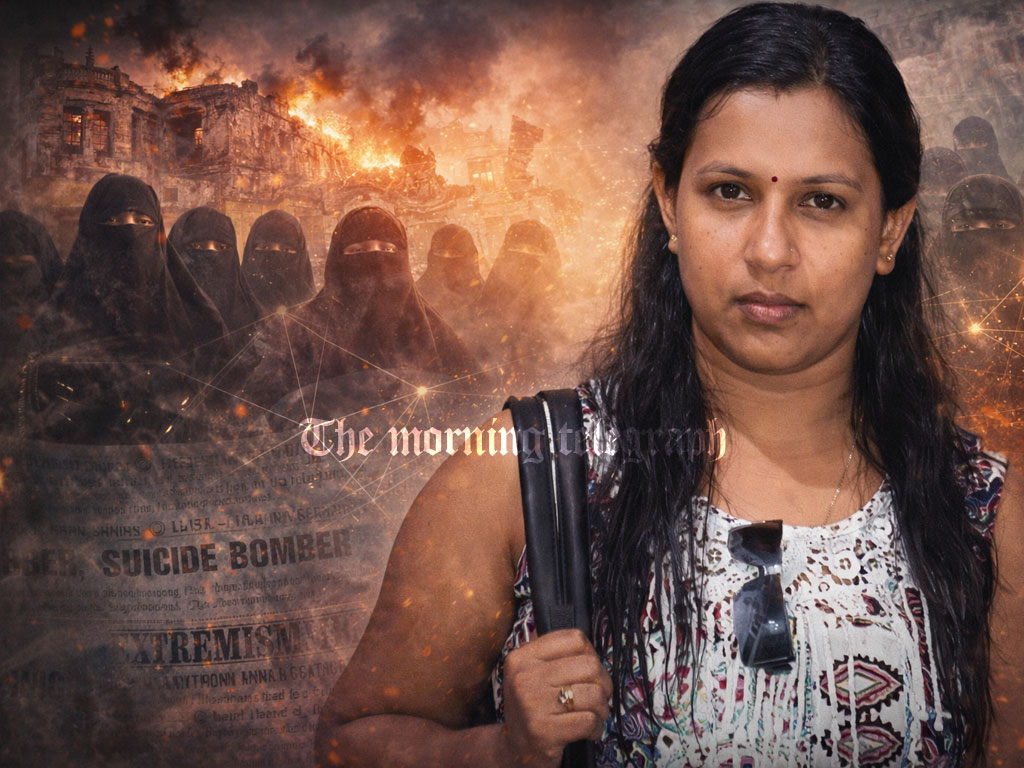
A single name dominates headlines, but beneath the surface lies a far deeper and more unsettling story of ignored networks, unanswered questions, and a silent group of women lost in the shadows of radicalization.
In complex investigations, facts are expected to lead the narrative, yet there are moments when the narrative begins to shape the facts themselves. When this shift happens, certain names rise above others, not because of proven importance, but because of how they are repeated, amplified, and framed. This is precisely what has unfolded in the case of Pulasthini Mahendran, widely known as Sara Jasmine. The lingering question remains how her name became the dominant narrative thread in the aftermath of the Sainthamaruthu incident while others faded into silence.

On the same day, another key figure, Saheeda, who is the sister of two individuals linked to the Mawanella Buddha statue vandalism, was taken into custody. She revealed that a group of fifteen women, including herself, had pledged bayat allegiance in 2018. This revelation opens up a broader and more alarming concern about the scale of indoctrination and extremist recruitment. Yet, this dimension continues to receive far less attention than the constant repetition of one name. Whether Saheeda remains under arrest is still unclear, but the possibility of fourteen additional female suicide bombers should raise far greater alarm than the continued focus on Sara Jasmine. Still, her name persists across court proceedings, media coverage, political debate, and public discourse, leaving one central question unanswered why is only her name echoed repeatedly and who benefits from it?
At Sainthamaruthu, multiple individuals lost their lives, including close relatives of Zahran Hashim, such as his parents, siblings, in-laws, his son, and six children. Despite their direct connection to the core network, their identities are rarely discussed, and their roles are seldom analyzed. Silence has effectively erased them from public conversation. Even the wife of the Ibrahim brothers, who carried out a suicide attack that killed herself, her unborn child, and two other children, is rarely mentioned. This imbalance raises serious questions. Why is Sara Jasmine consistently highlighted, even in parliamentary discussions and among politicized religious voices, while others directly linked to the network remain overlooked? Why does the spotlight remain fixed on a twenty-four-year-old Hindu convert while others are excluded from scrutiny?
Much of Sara’s prominence is attributed to her marriage to a suicide bomber. However, this reasoning does not hold when others in similar positions remain unexamined. There is no credible evidence suggesting that she held operational authority, planning roles, or command responsibility within the network. Her personal timeline shows that she met Hashtoon, the Katuwapitiya suicide bomber, in 2015, married him that same year, traveled to Abu Dhabi shortly after, and later returned to Sri Lanka. According to testimony given by her mother before the Presidential Commission, Sara was later taken by Zahran’s wife to a house in Naramala, where her last known communication occurred on 19 February 2019. Over time, however, her role in the narrative expanded beyond facts. She was portrayed as a central figure, a witness, a key connector, and even someone with answers about the alleged mastermind. This evolution reflects not the growth of evidence, but the weight of narrative repetition.
When security forces confronted the group in Sainthamaruthu, they were met with gunfire, and those inside eventually detonated themselves. In any identification process, names must be established before DNA confirmation, and narratives must exist before repetition takes hold. This raises critical questions about when and why Sara Jasmine’s name became the primary focus. Who introduced it into the investigation? Were alternative identities explored with equal intensity? What criteria elevated her above others? Most importantly, where is the evidence linking her to operational involvement? These unanswered questions reveal how easily a single name can gain disproportionate importance.
Complex extremist networks are inherently difficult to explain, often leading to the creation of a simplified focal point for public understanding. A single identifiable individual becomes the lens through which an entire story is told. Whether that person is alive, dead, or missing adds layers of intrigue, making the narrative more compelling and easier to manipulate. Sara, with her traceable background and connections, became that focal point. Her uncertain status further intensified attention, transforming her into more than just an individual she became a question. Questions invite repetition, and repetition can distort perception. While she entered the network through marriage and was not part of the immediate core family, the narrative framed her as a bridge between key actors. However, being a narrative bridge does not equate to being a central figure in evidence.
Once a name is embedded in police reports, court filings, media headlines, and televised discussions, it begins to take on a life of its own. Each repetition reinforces the perception of importance, regardless of the underlying evidence. Gradually, the narrative shifts from asking who she is to assuming that she must be important simply because her name appears repeatedly. This repetition serves multiple purposes. Investigators may use her as a connecting point, legal narratives may present her as an associative link, media outlets may highlight her for human interest, political actors may use her to symbolize unresolved issues, and public discourse may turn her into a focal point for speculation. A single name begins to carry multiple meanings depending on who is using it.
However, repetition should never be mistaken for proof. There is a fundamental difference between being connected, being present, and being central to an operation. This distinction must remain clear. The narrative that dominates public perception often diverges significantly from the legal and evidentiary record. Despite the repeated focus on Sara Jasmine, extensive investigations into the Easter Sunday attacks resulted in over 23,000 indictments, numerous court proceedings, and multiple individuals being formally charged. Yet, no indictments named Suresh Sallay, and no legal charges were established against him. This contrast highlights the gap between narrative prominence and evidentiary findings.
When a single individual’s name continues to dominate the conversation, it is necessary to question whether that prominence is based on actual evidence or on narrative convenience. Were others subjected to the same level of scrutiny and public exposure? Have critical questions been overlooked in favor of a more convenient storyline? The continued emphasis on Sara Jasmine risks diverting attention from deeper issues, including the broader networks of extremism, the role of women in radicalization, and the systemic failures that allowed such events to unfold. It also raises urgent questions about prior warnings and whether more decisive action could have prevented the loss of 269 lives.
This case ultimately demonstrates how narratives can shape perception, how individuals can become symbols, and how repetition can influence public understanding. When combined, these elements have the power to manipulate discourse and redirect attention. Even the introduction of additional figures into the narrative can reinforce this effect, despite the absence of supporting evidence in formal indictments. In any serious investigation, facts must guide the narrative, not the other way around. Evidence must remain the foundation upon which conclusions are built.
Until this standard is consistently upheld, the central question will persist why one name and not the others? When a name is repeated often enough, it can begin to define the entire story. The real issue is whether that narrative reveals the truth or replaces it. Names do not gain prominence on their own. They are introduced, amplified, and sustained through various channels, often for reasons that are not immediately visible. It is therefore the responsibility of the public to question what is presented, rather than accept it at face value. Justice must never be overshadowed by narrative convenience, and no single name should be allowed to divert attention away from the truth.