A dangerous escalation in the Middle East conflict now threatens to choke two of the world’s most critical oil shipping routes, raising fears of a global energy shock, disrupted trade flows, and a surge in fuel prices that could ripple across economies worldwide.
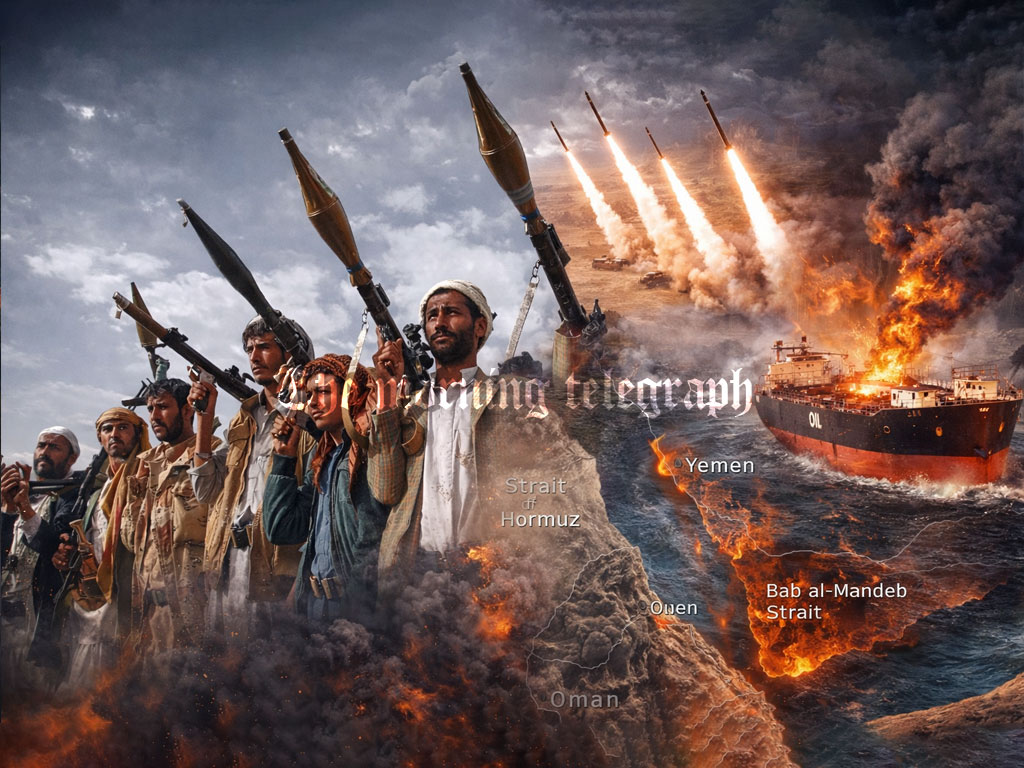
The Middle East conflict took a more alarming turn on Saturday as Yemen’s Houthi movement issued a stark warning that it could disrupt a second vital global oil shipping route, dramatically increasing the risk to energy security and international trade.
In what analysts are calling a major escalation in the ongoing war, the Iran-aligned group made its announcement shortly after launching a missile strike targeting what it described as sensitive Israeli military locations. The development signals a widening of the conflict footprint and a potential shift toward broader economic warfare.

The Houthis indicated that they are now considering blocking the Bab al Mandeb Strait, a critical maritime corridor in the Red Sea that serves as an alternative route for oil shipments when access through the Strait of Hormuz is restricted. With Iran already tightening control over Hormuz, such a move could severely disrupt the global oil supply chain.
The Bab al Mandeb Strait, often referred to as the Gate of Tears, is a narrow 18 mile wide passage linking the Red Sea to the Gulf of Aden. Its strategic importance lies in its control over shipping traffic bound for the Suez Canal, making it one of the most crucial chokepoints in global maritime trade.
If both the Strait of Hormuz and the Bab al Mandeb Strait are compromised, the consequences would extend far beyond the Middle East. Supply chains would face severe disruption, shipping costs would surge, and global energy markets would likely experience extreme volatility.
Approximately ten percent of global seaborne trade passes through the Red Sea, including a significant share of container shipments, vehicle exports, and around ten percent of the world’s crude oil supply. Any disruption to this route would therefore have immediate and far reaching economic consequences.
Mohamad Elmasry, a professor at the Doha Institute for Graduate Studies, described the Houthis’ potential involvement in the broader US and Israel confrontation with Iran as highly significant. He noted that the group has already demonstrated considerable military capability over the past several years.
According to Elmasry, if the Houthis move to shut down the Bab al Mandeb Strait, it could effectively paralyze the Red Sea route and, by extension, limit access to the Suez Canal. Combined with restrictions at Hormuz, this would create two major choke points that could cripple global shipping.
The Houthis position themselves as part of Iran’s so called axis of resistance, alongside groups such as Hamas and Hezbollah. Their alignment with Tehran places them at the center of a broader regional confrontation involving the United States, Israel, and Western allies.
As the conflict entered its fifth week, several developments highlighted the growing intensity and global reach of the crisis.
Around 24 American troops were reported injured following an Iranian strike on a military base in Saudi Arabia, underscoring the expanding geographic scope of the conflict.
In the United Kingdom, rising uncertainty has prompted hundreds of thousands of families to reconsider travel plans, with many opting for domestic holidays amid concerns over fuel prices and international instability.
Security concerns have also intensified in Europe. Authorities linked a foiled bombing attempt at the Bank of America headquarters in Paris to an Iranian proxy network, which had earlier claimed responsibility for an arson attack on Jewish charity ambulances in North London.
Energy experts are warning of a looming fuel supply crisis. A former oil industry executive has suggested that governments, including the UK, may need to consider measures such as driving restrictions to manage potential shortages.
Meanwhile, reports have emerged that Donald Trump privately discussed renaming the Strait of Hormuz, reflecting the heightened political rhetoric surrounding the crisis.
In Lebanon, an Israeli missile strike resulted in the deaths of three journalists, further illustrating the human cost of the conflict as it spreads across multiple fronts.
Although the Strait of Hormuz and the Bab al Mandeb Strait are geographically distant, their operational link is critical. If oil cannot exit the Gulf due to disruptions at Hormuz and cannot reach European markets because of blockages at Bab al Mandeb, the entire supply chain effectively breaks down.
The Houthis have controlled Yemen’s capital, Sanaa, since 2014. Until recently, they had not fully entered the current phase of the US Israel conflict with Iran, although they have been actively involved in attacks related to the Israel Hamas war.
Their previous actions in the Red Sea have already demonstrated their capacity to disrupt global shipping. Between 2023 and 2025, Houthi forces launched attacks on more than 100 commercial vessels using missiles and drones, sinking two ships and causing multiple casualties.
During that period, traffic through the Suez Canal dropped sharply from around 26,000 vessels to just 12,700, highlighting the economic impact of sustained maritime insecurity.
Mohammed Mansour, the Houthis deputy information minister, stated that the group is conducting its campaign in stages and confirmed that closing the Bab al Mandeb Strait remains one of the options under consideration.
Security analysts have expressed deep concern over this possibility. Ibrahim Jalal, a specialist on Yemen and Gulf affairs, described the threat as extremely serious, particularly if it forms part of a coordinated strategy involving multiple maritime choke points.
He warned that such a scenario appears consistent with broader regional strategies that Iran has been developing through its allied groups over several years.
At the same time, tensions have expanded into other areas of geopolitics. Iran recently claimed responsibility for destroying a Ukrainian anti drone system depot in the United Arab Emirates. This followed statements by Ukrainian President Volodymyr Zelensky about strengthening security and defence cooperation with Gulf states.
Ukraine has been positioning itself as a partner to countries in the Gulf region, as well as to Europe and the United States, in efforts to counter the threat posed by Iranian drone technology.
Iran, however, has declared that it considers Ukraine a legitimate target due to its support for countries aligned against Tehran.
Dr Burcu Ozcelik, a senior fellow at the Royal United Services Institute, noted that the involvement of the Houthis was always expected. She emphasized that while the group acts as a strategic asset for Iran, it also makes independent decisions on how far to escalate its actions.
She warned that a renewed disruption of Red Sea shipping would have wide international consequences and could lead to increased pressure on countries such as the United Kingdom to join military efforts against the Houthis alongside the United States.
Brigadier General Yahya Saree, the Houthis military spokesperson, confirmed that their air strikes would continue until what they describe as aggression against resistance forces comes to an end.
With tensions rising across multiple fronts and critical maritime routes under threat, the global economy now faces the prospect of a severe energy crisis that could reshape trade, security, and geopolitical alliances in the months ahead.