A shadowy bus procurement deal is now under intense scrutiny after shocking allegations surfaced that “gratification buses” were quietly handed over. With missing units, unanswered questions, and public funds at stake, this controversy could expose a deeper network of corruption lurking beneath the surface.
What was supposed to be a routine procurement of 100 buses has now erupted into a potential corruption scandal that is sending shockwaves through Sri Lanka’s political and public accountability landscape.
A civil society group has formally stepped in, filing a complaint with the Commission to Investigate Allegations of Bribery or Corruption, demanding a full-scale investigation into what appears to be a deeply questionable transaction involving taxpayer money.

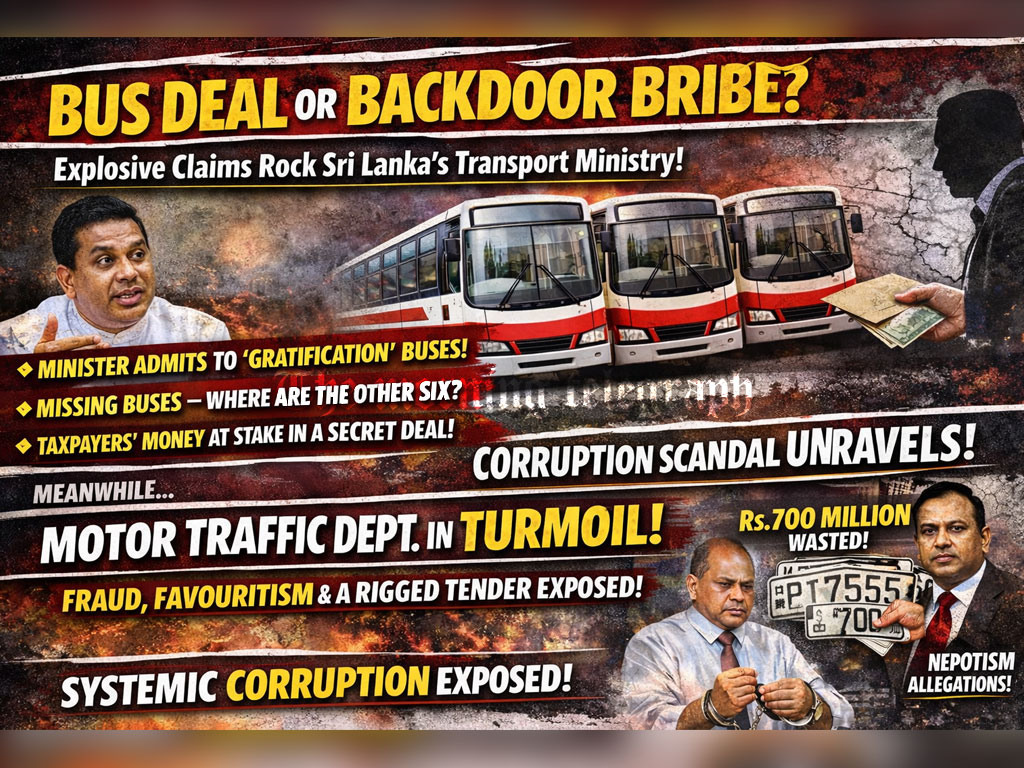
At the center of the storm is a startling claim made by Deputy Minister of Transport Prasanna Gunasena—that four buses were received as “gratification” in the deal. That single admission has triggered a cascade of suspicion.
Nuwan Thilakaratne, convener of the National Movement for the Protection of Public Rights, did not mince his words. According to him, the issue is not how the alleged bribe was taken—but the fact that it may have been taken at all.
“Whether a bribe is taken openly or secretly, it is still wrong,” he said, raising a critical red flag that now demands national attention.
But the real shock lies in what doesn’t add up.
Historically, bus procurement deals in Sri Lanka have followed a predictable pattern—suppliers often provide one additional bus free for every ten purchased. Based on that long-standing practice, a purchase of 100 buses should have yielded 10 additional buses.
Instead, only four have reportedly surfaced.
So where are the missing six?
That question now hangs heavily over the entire transaction. Was the remaining value diverted elsewhere? Were benefits received in another form—cash, favors, or undisclosed assets? Or was this simply a deal structured to quietly bypass accountability?
The implications are enormous.
“These buses were bought using taxpayers’ money, not personal funds,” Thilakaratne emphasized. “The public has a right to know what exactly happened.”
And that is precisely where the controversy deepens. If public funds were used, every detail—from tender specifications to supplier negotiations—must withstand scrutiny. Yet, key questions remain unanswered.
Were these “gratification buses” declared in official documentation?
Were procurement guidelines followed—or manipulated?
Did officials engage directly with suppliers outside formal procedures?
Or worse—was this a carefully engineered loophole designed to conceal corruption in plain sight?
The civil society group is now urging CIABOC to leave no stone unturned. They are demanding not just an investigation, but full public disclosure if wrongdoing is uncovered.
Because this is no longer just about buses.
It is about trust.
It is about transparency.
And it is about whether public institutions are serving the people—or exploiting them.
As pressure mounts, the nation watches closely.
If these allegations are proven true, this could become one of the most revealing procurement scandals in recent times—exposing not just missing buses, but a system that may be running off the rails.
Meanwhile… Another Scandal Erupts: Fraud, Favouritism, and a Broken System at the Motor Traffic Department
Just as the bus procurement controversy gains momentum, a parallel storm is gathering—this time within Sri Lanka’s vehicle administration system itself.
The Department of Motor Traffic, a critical institution responsible for vehicle registration, roadworthiness certification, and driver licensing, now finds itself engulfed in a scandal that appears far more systemic than isolated.
The arrest of its Commissioner General has cracked open what many now fear is a deeply entrenched network of abuse, where authority may have been weaponized for personal gain.
What is emerging is not a single act of misconduct—but a pattern.
Allegations suggest that senior officials may have siphoned off millions in public funds, turning what should have been a regulatory safeguard into an alleged conduit for corruption. If true, this represents not just failure—but betrayal of public trust at the highest administrative levels.
Even more alarming is the apparent collapse of oversight.
Questions are now being raised about the roles of the Secretary and the Minister in charge. Were they unaware—or did they turn a blind eye? Either scenario paints a troubling picture of governance, where accountability appears to have taken a back seat.
The Secretary’s position has come under particular scrutiny. As a non-SLAS officer, critics are questioning his understanding of public administration, pointing to his controversial tenure at the Ministry of Education as a warning sign of a pattern now repeating itself.
But it is the vehicle number plate tender that has truly ignited outrage.
In a decision that defies both logic and financial prudence, the contract was awarded to the third-highest bidder—at a staggering additional cost of Rs. 700 million to the public.
How did this happen?
The answer only deepens the mystery.
Samples submitted by bidders were tested at a materials laboratory of the University of Moratuwa—on the direct instructions of the Secretary, who previously served as Acting Vice Chancellor of the same institution.
Yet, this laboratory is not accredited by the Sri Lanka Accreditation Board.
Based on findings from this non-accredited facility, the two lowest bidders were disqualified—effectively clearing the path for the most expensive option.
When aggrieved parties appealed, the Presidential Appeals Board acknowledged the flaw and ordered retesting through an accredited laboratory.
But in a move that raises even more suspicion, only the rejected samples were retested.
The winning bidder’s sample—the very basis of the final decision—was never subjected to independent verification.
Why?
What exactly is being protected?
Adding yet another layer to this unfolding drama is a striking connection: the successful bidder is reportedly the son-in-law of the previous supplier, a company that dominated number plate contracts for over two decades.
This revelation fuels growing concerns of entrenched interests, favouritism, and a procurement system potentially manipulated to preserve a long-standing monopoly.
The consequences are stark.
A Cabinet-approved decision now rests on a product that has not been validated by an accredited authority, while the public is forced to bear the burden of significantly inflated costs.
This is no longer an administrative lapse.
It is a full-blown crisis of governance.
From missing buses to questionable tenders, a disturbing pattern is beginning to emerge—one that suggests Sri Lanka may not be dealing with isolated incidents, but with a deeper culture of systemic corruption.
Civil society is now on alert.
And the message is clear:
If authorities fail to act decisively and transparently, the cost will not just be financial—it will be the complete erosion of public trust in the system meant to serve them.