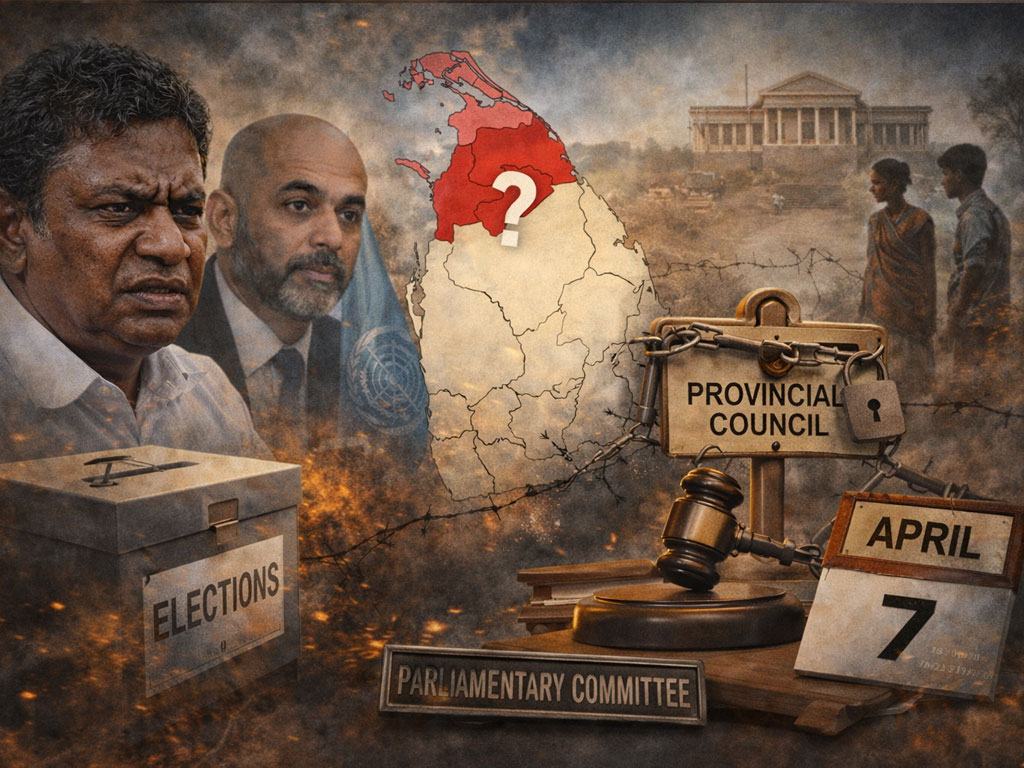
Tamil MP Sivagnanam Sritharan warns the UN of a massive administrative vacuum as years of postponed Provincial Council elections stall governance, development, and democratic representation in the Northern Province, while a parliamentary committee prepares to finally address the crisis on April 7.
A prolonged delay in holding Provincial Council elections in Sri Lanka has created what one senior Tamil lawmaker describes as a massive administrative gap, raising concerns about governance, development, and democratic representation in the country’s Northern Province. The issue has now reached international attention, with Member of Parliament Sivagnanam Sritharan formally highlighting the situation to the United Nations Resident Representative in Sri Lanka during a recent high-level meeting in Jaffna.

The meeting, which lasted approximately an hour and a half, brought together Sritharan, a representative of the Illankai Tamil Arasu Kachchi, and UN Resident Representative Marc André Franche. Their discussions focused on a wide range of pressing issues facing the Northern Province, including economic recovery, youth unemployment, and the broader political and administrative challenges that continue to affect post-war reconstruction efforts.
At the center of Sritharan’s concerns was the continued failure to conduct Provincial Council elections, which have been postponed for several years. According to the MP, this delay has effectively stalled the decentralization of power, leaving provincial governance structures weakened and, in some cases, non functional. Without elected representatives at the provincial level, decision making authority has become increasingly centralized, limiting the ability of local administrations to respond effectively to the needs of the population.
Sritharan emphasized that this administrative vacuum is not merely a procedural issue but one that has tangible consequences for everyday life. Essential services, infrastructure development, and regional planning have all been affected by the absence of functioning Provincial Councils. For residents of the Northern Province, this has translated into delays in development projects, reduced accountability, and a lack of responsive governance.
The MP further noted that the absence of elections has disrupted the intended system of devolved governance, which was designed to ensure that regions with distinct social, cultural, and economic needs could manage their own affairs more effectively. In its current state, he argued, the system is unable to fulfill its purpose, leaving communities without adequate representation or influence over decisions that directly impact their lives.
Economic concerns were also a major focus of the discussions. Sritharan highlighted the ongoing challenges faced by young people in the Northern Province, particularly in terms of unemployment and limited economic opportunities. Despite the region’s potential, including its natural resources and strategic location, progress has been slow. The lack of a functioning provincial administration has further complicated efforts to implement targeted development initiatives that could stimulate growth and create jobs.
Both parties explored the possibility of leveraging regional resources to build a more stable and sustainable local economy. However, the MP stressed that such efforts would require effective governance structures at the provincial level, underscoring once again the importance of conducting elections without further delay. Without elected bodies to plan and oversee development, he warned, even well-intentioned initiatives risk falling short.
The issue of Provincial Council elections is also gaining renewed attention within Sri Lanka’s national political framework. A special Parliamentary Committee tasked with reviewing the electoral system for Provincial Councils is scheduled to convene on April 7. This session is expected to include appearances by key institutional figures, including the Attorney General, the Chairman of the Election Commission, and other senior officials.
The committee’s mandate is to examine the legal and procedural obstacles that have prevented the holding of elections and to recommend a path forward. Its findings are anticipated to play a crucial role in determining whether and how the electoral process can be revived. For many observers, the upcoming meeting represents a critical opportunity to address longstanding delays and restore a key component of the country’s governance structure.
The absence of Provincial Councils has been a contentious issue for years, with critics arguing that it undermines democratic principles and weakens regional autonomy. Supporters of devolution have consistently called for elections to be held, emphasizing that local representation is essential for effective governance and equitable development. The current situation, they argue, risks deepening existing inequalities and exacerbating tensions in regions already affected by decades of conflict.
Sritharan’s engagement with the United Nations reflects an effort to bring greater international awareness to these concerns. By raising the issue with a senior UN official, he has signaled the urgency of the situation and the need for both domestic and international attention. While the UN’s role remains primarily advisory, its involvement can help highlight governance challenges and encourage dialogue among stakeholders.
The broader political context also adds to the complexity of the issue. Efforts to reform the Provincial Council system have been ongoing, with debates focusing on electoral mechanisms, representation, and the balance of power between central and regional authorities. These discussions, while necessary, have contributed to delays, leaving the system in a state of prolonged uncertainty.
For residents of the Northern Province, however, the consequences are immediate and deeply felt. The lack of functioning Provincial Councils has limited opportunities for public participation in governance and reduced the responsiveness of administrative institutions. In a region still recovering from the effects of war, this has posed additional challenges to rebuilding trust and fostering inclusive development.
As the April 7 committee meeting approaches, expectations are rising that concrete steps will be taken to resolve the impasse. Whether these efforts will lead to a clear timeline for elections remains to be seen. What is clear, however, is that the continued delay carries significant costs, both in terms of governance and public confidence.
Sritharan’s warning of a massive administrative gap underscores the urgency of the issue. Without timely action, the gap risks widening further, affecting not only the Northern Province but also the broader framework of decentralized governance in Sri Lanka. The coming weeks may prove decisive in determining whether the country can move forward in restoring this democratic institution or continue to grapple with its prolonged absence.