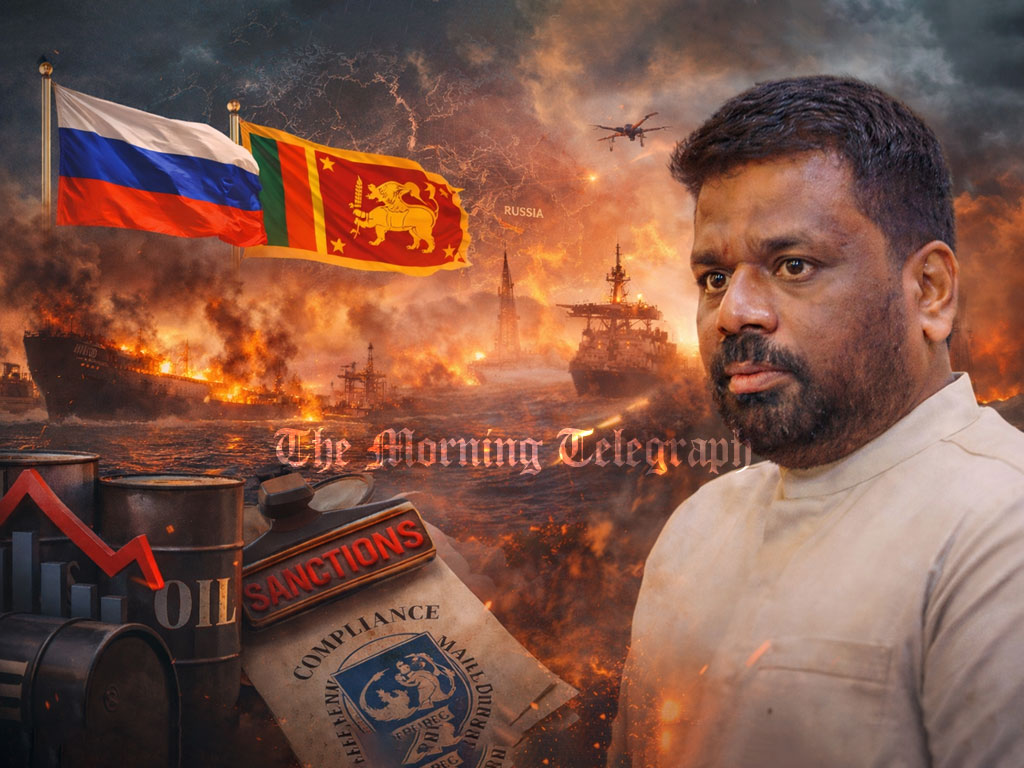
As global war tensions escalate and strategic waters heat up, Sri Lanka finds itself trapped in a high-stakes geopolitical contest, where neutrality is no longer a shield but a pressure point.
The 10th Synergia Foundation conclave unfolded in New Delhi at a moment of extraordinary global tension, taking place just days after a joint United States and Israel strike on Iran. What should have been a routine high-level strategic forum quickly evolved into a sobering reflection of a world drifting toward deeper instability. The timing was not incidental. It exposed the widening cracks in global diplomacy and the growing risk of conflict spilling into regions once considered peripheral.

Shockwaves intensified following reports that a United States naval action had sunk an Iranian vessel near Sri Lanka’s maritime zone. The implications were immediate and unsettling. The vessel had reportedly participated in high-profile international naval engagements, including events linked to India’s own maritime exercises. Its destruction so close to Sri Lankan waters raised difficult questions about intent, signaling, and the possibility of calculated geopolitical messaging directed at regional actors.
For India, the situation was particularly awkward. Having recently hosted international naval collaborations, New Delhi found itself entangled in a contradiction. A partner in global diplomacy on one hand, and a silent observer to escalating military aggression on the other. The discomfort was visible. Strategic ambiguity began to replace confidence, exposing vulnerabilities in India’s balancing act between Western alliances and regional stability.
The conclave itself, attended by policymakers, defense officials, and analysts, was expected to offer clarity. Instead, it revealed confusion. Despite ambitious expectations, there was little consensus on how the unfolding crisis in West Asia would evolve. The earlier Raisina Dialogue had already hinted at regime change ambitions targeting Iran. Yet, weeks later, outcomes remained uncertain, and the cost of miscalculation was becoming harder to ignore.
India’s economic anxieties began surfacing alongside its diplomatic dilemmas. Rising global oil prices and disruptions near the Strait of Hormuz placed immense pressure on energy security. Reports of Indian vessels stranded in sensitive zones underscored a deeper dependence on external stability. In response, Prime Minister Narendra Modi’s outreach to Iran suggested urgency rather than strategy, reinforcing perceptions of a reactive rather than proactive foreign policy posture.
Observers noted a glaring omission within the discussions. The broader consequences of the West Asia conflict, particularly its economic ripple effects, were not adequately addressed. Simultaneously, the ongoing Russia Ukraine war continued to stretch global alliances thin. NATO’s inability to maintain cohesion across multiple theaters of conflict raised uncomfortable questions about the durability of existing security frameworks.
The much-publicized Quad alliance also came under scrutiny. Despite its strategic positioning, it appeared ineffective in ensuring maritime security or stabilizing critical trade routes. The continued closure of the Strait of Hormuz exposed the limits of its influence. Even more striking were reports suggesting that the United States had quietly explored the possibility of Chinese assistance in securing maritime passages. Such developments pointed to a crisis far deeper than official narratives suggested.
Temporary pauses in attacks on Iranian oil infrastructure did little to calm markets. Analysts warned that volatility had already embedded itself into the global economy. The illusion of a short conflict was fading. What remained was a prolonged period of uncertainty with far-reaching consequences for energy markets, inflation, and economic stability.
Amid these global tensions, Sri Lanka’s position became increasingly fragile. Retired General Shavendra Silva offered a stark assessment, emphasizing that South Asia’s limited economic integration left the region dangerously exposed. Instability in one country could rapidly spill into another. His warning was clear. Without coordinated regional resilience, smaller nations like Sri Lanka would continue to absorb the shocks of larger geopolitical battles.
Silva also highlighted the role of military diplomacy as a stabilizing force. Drawing from his experience, he suggested that armed forces could serve as channels of coordination rather than confrontation. Yet his remarks carried an undertone of frustration. Global powers, he argued, were acting with aggression rather than restraint, escalating conflicts without fully considering their regional consequences.
The sinking of the Iranian vessel, which reportedly resulted in significant casualties, became a focal point of criticism. Questions emerged as to why such an operation occurred so close to Sri Lankan waters. The proximity suggested more than coincidence. It hinted at strategic signaling, a demonstration of power intended to test reactions and redraw lines of influence.
Further complications arose when Iranian vessels reportedly sought refuge in Colombo and Cochin. This placed Sri Lanka in an uncomfortable diplomatic position. Balancing humanitarian considerations with geopolitical sensitivities became increasingly difficult. Each decision carried potential consequences, both immediate and long term.
The situation escalated further when reports surfaced that the United States had attempted to move military logistics through Sri Lankan territory. The use of Mattala Rajapaksa International Airport highlighted the island’s growing strategic relevance. President Anura Kumara Dissanayake’s decision to reject requests from both Washington and Tehran was seen as a firm assertion of neutrality. Yet, neutrality itself was beginning to look like a fragile concept.
Conflicting narratives complicated matters. Iranian sources suggested that Sri Lanka had previously supported Iranian naval movements, raising concerns about policy consistency. Meanwhile, the United States reaffirmed its defense ties with Sri Lanka, signaling that strategic engagement would continue regardless of public positioning.
At the heart of this dilemma lies Sri Lanka’s economic reality. The country’s recovery remains closely tied to international financial institutions, particularly the IMF. This dependence limits its strategic flexibility. Every foreign policy decision must now be weighed against economic consequences, creating a delicate and often uncomfortable balancing act.
General Silva’s own experience reflects this broader contradiction. Despite his role in leading decisive military operations against the LTTE, he became the subject of international sanctions. The contrast between domestic recognition and international scrutiny highlights the complex interplay between national security narratives and global political agendas.
Sri Lanka’s post-war trajectory has been shaped by shifting alliances and competing interests. From political transitions in 2015 to increasing engagement with Western partners, the country has struggled to maintain a coherent strategic direction. Agreements such as ACSA and ongoing cooperation with Quad-aligned nations signal a gradual, though often understated, geopolitical shift.
Relations with China have added another layer of complexity. Projects like the Colombo Port City have strengthened economic ties while simultaneously raising concerns among Western powers. Sri Lanka finds itself navigating between opportunity and suspicion, development and dependency.
Efforts by global actors to secure a foothold in Sri Lanka have intensified. Proposals such as SOFA and MCC, alongside expanding military cooperation, reflect a broader strategy to position the island within the Indo Pacific power matrix. Each agreement carries implications that extend far beyond immediate economic benefits.
Recent moves to strengthen ties with Middle Eastern partners, including Saudi Arabia, further illustrate the evolving nature of Sri Lanka’s foreign policy. However, these relationships are increasingly interpreted through the lens of global competition. In a polarized world, even neutral engagement can be perceived as alignment.
Sri Lanka now stands at a critical juncture. The principle of neutrality, once a cornerstone of its diplomatic identity, is under sustained pressure. Global conflicts are no longer distant events. They are shaping domestic realities, influencing economic stability, and redefining national priorities.
The question is no longer whether Sri Lanka can remain neutral. It is whether neutrality itself can survive in a world where power is increasingly asserted through pressure rather than persuasion. As alliances shift and tensions rise, the island nation must navigate a narrow path between competing forces, each demanding influence, loyalty, or access.
What emerges is a stark reality. Sri Lanka is no longer on the sidelines of global politics. It is part of the game. And in that game, every decision carries weight, every silence sends a signal, and every misstep could come at a cost far greater than anticipated.