A high-profile political narrative around the Easter attacks unravels under scrutiny, raising deeper questions about motive, timing, and the battle over truth in Sri Lanka’s most painful tragedy.
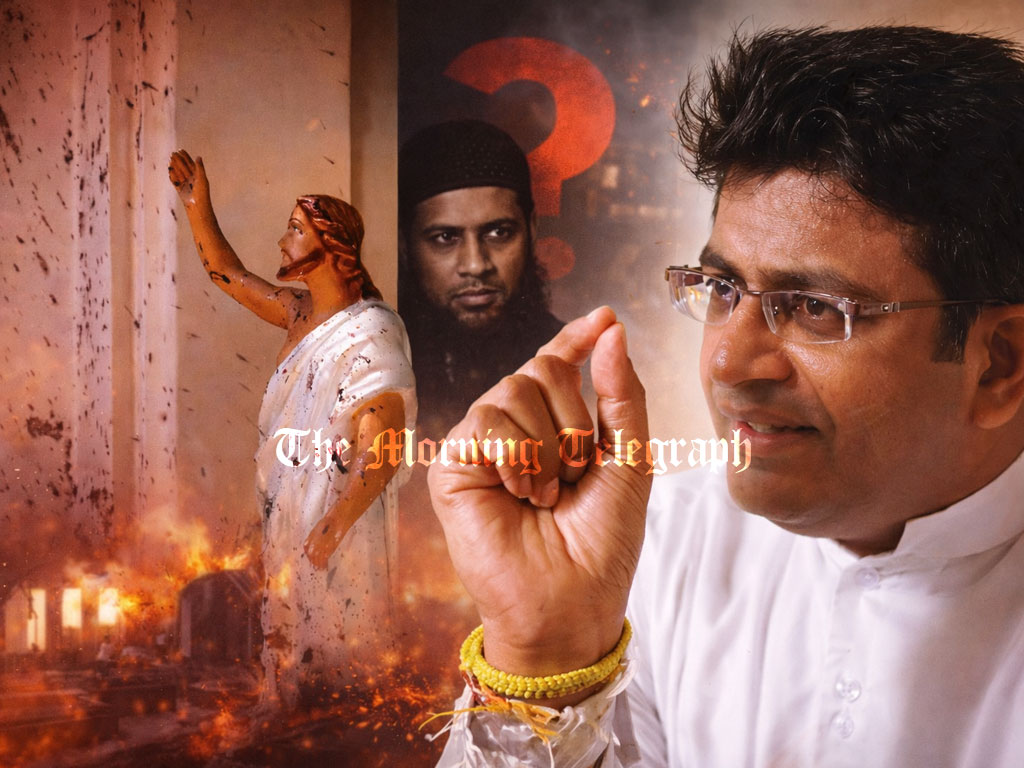
As a political operator, Udaya Gammanpila has once again thrust himself into the spotlight, but this time the outcome has sparked more ridicule than revelation. His widely publicized promise to expose the so-called mastermind behind the 2019 Easter Sunday terror attacks ended in what many view as an anti-climax. After weeks of intense buildup across both social media and mainstream platforms, his conclusion pointed to Zahran Hashim, the very leader of the suicide attackers who died during the coordinated bombings.

The declaration coincided with the launch of his Sinhala-language book titled In Search of the Mastermind of the Easter Attacks. While Gammanpila demonstrated undeniable skill in generating attention and marketing his narrative, critics argue that the substance failed to match the hype. The event itself drew significant attention not only for the content of the claims but also for the political personalities present.
The guest list at the book launch revealed an intriguing alignment of opposition figures. Nearly every prominent name in opposition politics attended, with one notable exception. Among those present were former Presidents Mahinda Rajapaksa, Gotabaya Rajapaksa, and Maithripala Sirisena, all figures whose political legacies intersect in complex ways with the events surrounding the Easter attacks. Their collective presence added a layer of political symbolism that did not go unnoticed.
Equally noteworthy was the attendance of Samagi Jana Balavegaya leader Sajith Premadasa. His presence raised eyebrows given his past criticism of the Rajapaksa family, whom he had previously accused in Parliament of links to the circumstances surrounding the attacks. Observers questioned whether Premadasa’s decision to attend signaled a shift in stance or simply reflected a reluctance to be absent from a politically charged gathering. Either way, it introduced a level of ambiguity into an already contentious narrative.
If Premadasa’s appearance drew scrutiny, Maithripala Sirisena’s presence attracted even greater irony. Sirisena, who served as President at the time of the attacks, has already been held accountable by the Supreme Court for negligence linked to the tragedy. He had previously claimed knowledge of the true mastermind but stated he would only disclose it privately to a judge. At the event, however, Sirisena dismissed Gammanpila’s book as nothing new, describing it as an old story and revealing he had not even read it.
In contrast, the absence of Patali Champika Ranawaka stood out. Once a close ally of Gammanpila during their time in the Jathika Hela Urumaya, the two have since drifted apart, with their political relationship marked by rivalry rather than camaraderie. Ranawaka’s absence did not surprise many, especially as he is believed to be quietly positioning himself for a potential presidential bid in 2029. His strategy appears to hinge on capitalizing on the continued fragmentation of major opposition parties such as the Sri Lanka Podujana Peramuna and the SJB.
Meanwhile, Gammanpila’s broader objective appears increasingly clear. His assertions this week largely restated findings already established in existing investigations and commission reports, emphasizing that Zahran Hashim was the operational leader of the attacks. This, however, is not disputed by most analysts or investigators. The more contentious element lies in his insistence that Hashim acted independently, driven solely by extremist ideology without any external influence or coordination.
Such a conclusion, while straightforward, raises questions about its convenience. There remains an ongoing investigation into the Easter attacks, with emerging evidence suggesting the possibility of a more complex network of responsibility. If Gammanpila’s version were to be accepted without scrutiny, it would require dismissing a range of preceding and subsequent incidents as mere coincidence. For many observers, that explanation appears overly simplistic given the gravity and scale of the attacks.
Rather than focusing solely on the content of Gammanpila’s claims, a more critical line of inquiry centers on his motivations. His recent statements and actions indicate a notable shift in political rhetoric. Once known for his strong nationalist stance, he has now publicly referred to Sivanesathurai Chandrakanthan, also known as Pillayan, as a war hero. This apparent contradiction has not gone unnoticed, prompting questions about whether his evolving narrative serves a broader political agenda.
The timing of these statements also coincides with renewed scrutiny of past investigations, particularly those led by the Criminal Investigations Department under Shani Abeysekara. Abeysekara’s reputation as a meticulous and effective investigator has been widely acknowledged. Reports suggest that he was reassigned shortly after Gotabaya Rajapaksa assumed office, a move that has fueled speculation about attempts to influence the direction of investigations.
Gammanpila’s insistence on a singular narrative that places sole responsibility on Zahran Hashim has therefore generated suspicion. Critics argue that such a position may serve to divert attention from other potential actors or beneficiaries of the attacks. The political context adds weight to this argument, as the aftermath of the Easter bombings played a significant role in shaping public sentiment ahead of the 2019 presidential election, ultimately benefiting the Rajapaksa-led political camp.
Despite these observations, it is important to acknowledge that no definitive conclusions have yet been reached regarding the full scope of responsibility for the attacks. The current government, led by the National People’s Power, has pledged to deliver justice to the victims, a commitment that remains under intense public scrutiny. As the seventh anniversary of the tragedy approaches, expectations continue to mount.
The complexity of the investigation presents both challenges and opportunities. On one hand, thorough and methodical inquiry is essential to ensure that any findings can withstand legal scrutiny. On the other, prolonged delays risk allowing alternative narratives to gain traction among segments of the public. In this environment, political figures with persuasive messaging can shape perceptions, even in the absence of conclusive evidence.
Until the investigations reach a definitive conclusion, competing interpretations of the Easter attacks are likely to persist. For some, Gammanpila’s narrative offers a straightforward explanation that absolves broader systems of accountability. For others, it represents an attempt to simplify a deeply complex and sensitive issue for political gain.
While it would be premature to pass judgment on the entirety of Gammanpila’s book without a comprehensive reading, his public explanations have already provided insight into its central thesis. Based on these statements, many observers remain unconvinced of its credibility or value. For those seeking clarity on one of Sri Lanka’s darkest chapters, the search for truth continues, far beyond the pages of any single publication.