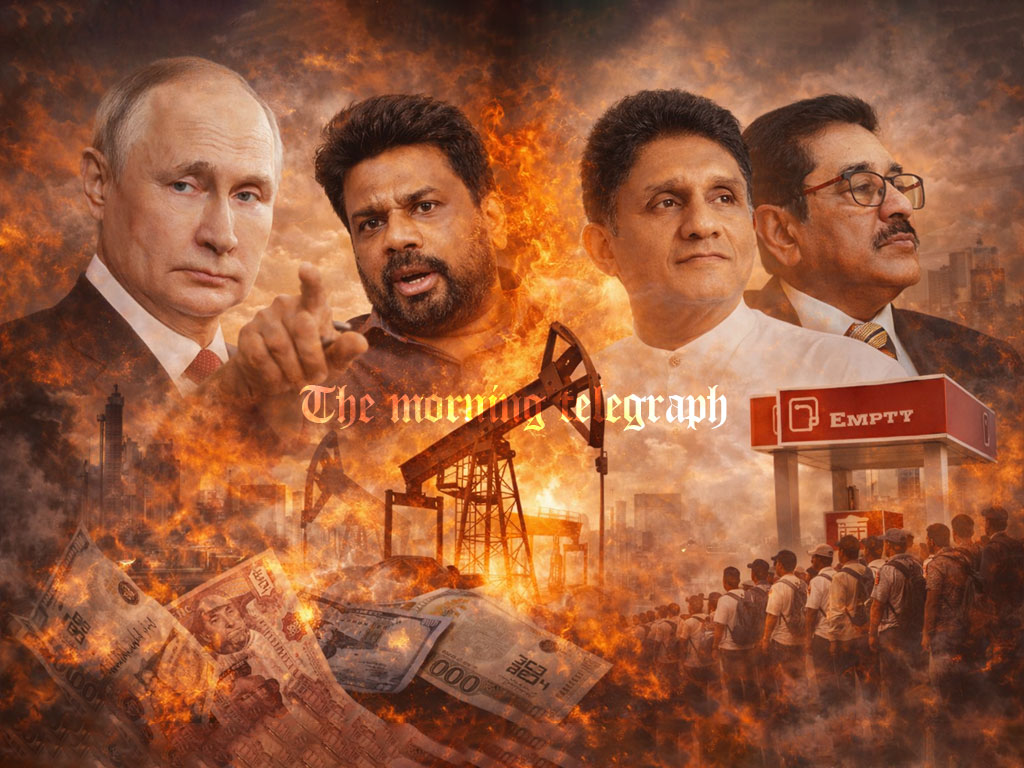
A deepening national crisis is beginning to take shape as diplomatic missteps, Russian oil uncertainty, substandard coal, drought, and rising political pressure combine to place Sri Lanka on the edge of another energy and governance storm.
It has now been 35 days since the United States began its war against Iran. What started as a confrontation involving only the United States, Israel, and Iran has steadily widened into a broader Middle Eastern conflict, sending shockwaves through the region and creating economic and political consequences that are now being felt far beyond its borders, including in Sri Lanka.
Within the very first hour of the conflict, Opposition Leader Sajith Premadasa made a special statement in Parliament, warning that the war could soon trigger a fuel crisis in Sri Lanka. He cautioned that the Strait of Hormuz might be closed and stressed that the country should urgently begin talks with nations such as Russia and India to ensure an uninterrupted supply of fuel and energy resources.

Foreign Minister Vijitha Herath, however, responded dismissively, even mockingly, arguing that there was no genuine danger of the Strait of Hormuz being shut. He further claimed that even if such a development took place, Sri Lanka would still face no real problem because oil could easily be sourced through Singapore.
Yet, in the end, those who mocked Premadasa’s warning now appear to have fallen directly into the very crisis he predicted. They were eventually forced to begin urgent discussions with Russia in an effort to secure fuel supplies, but by then the response looked far less like strategy and far more like a delayed reaction after the damage had already begun.
Last week, the Inside Politics column revealed that attempts to obtain oil from Russia were not being pursued primarily through formal government-to-government channels, but rather through personal networks and informal connections. Many had assumed that Russia, under a left-oriented political leadership, would naturally support Sri Lanka’s present self-described leftist government. But perhaps because the current administration has projected an ideologically confused posture, appearing to lean both left and right at the same time, Moscow did not initially seem eager to assist.
BRICS Summit
A major reason cited by many observers was Sri Lanka’s decision to decline a written invitation sent earlier by President Vladimir Putin for President Anura Kumara Dissanayake to attend the BRICS Summit soon after taking office. According to diplomatic circles, Russia interpreted this as a slight not only to its leadership but also to its broader strategic outreach. As a result, despite both governments being described by some as left-leaning, no particularly close relationship appears to have developed between the two sides. In fact, Russian authorities reportedly came to view the Sri Lankan administration not as an ideological ally, but as one leaning more toward the United States.
This situation has been worsened by the present government’s apparent lack of people with strong foreign policy networks and real experience in international engagement. That weakness has forced the administration to rely on third parties and outside intermediaries when dealing with major international actors. As was highlighted last week, the government has been trying to approach Russia through individuals who built close Russian contacts during earlier Sri Lankan administrations.
That assessment now appears to have been fully confirmed. Two former Sri Lankan ambassadors to Russia, one appointed under the Rajapaksa administration and the other during the 2015 good-governance government of President Maithripala Sirisena, have now begun making public remarks on the issue. Following the recent visit of Russia’s Deputy Foreign Minister to Sri Lanka for talks on fuel supply, comments posted by these former envoys on Facebook have effectively exposed the tensions, rivalries, and hidden realities behind the negotiations.
Who Brought Them In?
One of these figures is Dr. Saman Weerasinghe, who served as Sri Lanka’s ambassador to Russia during the good-governance administration. The other is Udayanga Weeratunga, who held the same post during Mahinda Rajapaksa’s government.
Many observers note that Udayanga, in particular, has broad and deep connections inside Russia, not only with official institutions but also with powerful informal circles and networks. It is often said that in Russia, major matters are frequently resolved more effectively through such networks than through rigid formal channels. Accordingly, many believe that Udayanga’s closeness to these circles makes it easier for him to gain access and secure practical results from the Russian establishment.
Special award
Dr. Saman Weerasinghe, however, is viewed in a different light. During his tenure in Russia, he earned considerable recognition for his work and, according to reports, was even honored with a special award by President Putin about six months ago. Information available to us suggests that it was through Saman’s channel that Russia’s Deputy Energy Minister and Deputy Foreign Minister came to Sri Lanka to hold discussions on fuel and energy cooperation.
Saman himself appeared keen to underscore this development in a Facebook post, writing:
“It is indeed encouraging that formal discussions on energy cooperation between Russia and Sri Lanka have commenced.
Russia has consistently appreciated Sri Lanka’s friendly and constructive engagement in strengthening cooperation in the energy sector.
The Russian delegation was represented by Deputy Energy Minister R. Marshavin and the Russian Ambassador to Sri Lanka, H.E. L. Dzhagaryan.
The Sri Lankan delegation included Deputy Minister of Finance, Planning and Economic Development and Minister of Labour A.J. Fernando, Minister of Power and Energy K. Jayakody, Central Bank Governor N. Weerasinghe, Treasury Secretary H. Suriyapperuma, and CPC Chairman D.J. Rajakaruna.
I firmly believe these bilateral discussions in the energy sector will lead to meaningful outcomes and pave the way for a sustainable and beneficial solution for the country.”
Udayanga’s Response
But while Saman projected the Russian visit as a breakthrough in bilateral energy diplomacy, Udayanga Weeratunga presented an entirely different interpretation.
In a Facebook post, he dismissed the claim that Sri Lanka was on the verge of obtaining genuine government-to-government fuel supplies from Russia, calling such claims “a complete myth.”
Referring to the March 26 meeting between the Russian delegation led by Deputy Energy Minister Roman Marshavin and President Anura Kumara Dissanayake, Udayanga argued that although Sri Lanka had indeed expressed readiness to buy fuel, fertilizer, and coal through direct state-to-state arrangements, there were serious questions about whether such arrangements were actually possible in practice.
Diplomatic advantage
Drawing on his long experience in Moscow, Udayanga argued that Russia usually enters into government-to-government agreements only with countries that offer it a clear political or diplomatic advantage. Those are typically nations that are strategic partners, close allies, or states aligned with Russian interests. Sri Lanka, in contrast, is not hostile to Russia, but nor is it part of Russia’s inner circle. Instead, it is seen as a neutral player.
He also pointed out that President Putin’s written invitation to President Anura Kumara Dissanayake for the 2024 BRICS Summit had been declined, and that this may have reduced Moscow’s willingness to provide special political or strategic support.
Udayanga further recalled an earlier attempt made during Gotabaya Rajapaksa’s presidency, when then minister Susil Premajayantha tried to obtain oil from Russia but failed. He suggested that then, as now, so-called government-to-government deals may actually have been private or semi-private transactions operating under the appearance of official state engagement.
He also referenced a past episode in which a letter sent by President Gotabaya Rajapaksa to President Putin reportedly included the name of a non-diplomatic Sri Lankan, an act that violated diplomatic norms and ultimately undermined the effort because the deal was in reality closer to a private sector transaction disguised as a state arrangement.
According to Udayanga, the current effort seems to follow the same pattern. The participation of a non-diplomatic third party in what should be high-level state discussions, reportedly with the blessing of the Russian Ambassador, strongly suggests that this is not an authentic government-to-government transaction but a deal shaped by specific interest groups.
He also noted that a senior Foreign Ministry official, fluent in Russian and experienced in embassy work, was absent from the discussions. In his view, this further indicates that the arrangement had not been formally cleared through the standard diplomatic process.
Therefore…
The idea that Sri Lanka can simply obtain Russian oil through a direct and clean government-to-government arrangement increasingly appears to be more propaganda than practical reality. Taking all of these factors into account, it is beginning to look as though, much like the controversial coal tender under the present administration, this too may turn into another private-sector transaction concealed behind the language of official state diplomacy.
That said, Udayanga argued that the government still has an opportunity to strengthen economic and political ties with Russia if it truly wishes to do so. He suggested several steps:
Securing Cabinet approval for a direct ruble-rupee transaction mechanism between the two countries.
Formal recognition of the ruble by the Central Bank of Sri Lanka.
Agreeing to a nuclear energy project in Sri Lanka based on Russian proposals.
However, there is also a strong view that such moves would face heavy geopolitical resistance, especially from the United States.
In addition, the Russian side has reportedly indicated that if sanctions are reimposed, any future transactions would need to be conducted in rubles or yuan rather than in U.S. dollars.
The Reality
As Central Bank Governor Nandalal Weerasinghe has reportedly pointed out, Sri Lanka’s existing international commitments and financial obligations mean that large-scale commercial transactions can realistically be handled only in U.S. dollars or major European currencies. He is said to have conveyed to both former President Gotabaya Rajapaksa and current President Anura Kumara Dissanayake that adopting a ruble-based or yuan-based system would be extremely difficult and operationally complex.
“After Consulting the Americans…”
As revealed last week in the Inside Politics column, Russia had initially agreed to provide only two fuel shipments in response to the immediate crisis. It was also reported that any continued supply would require Sri Lanka to enter into a long-term agreement extending over five years and structured on Russian terms.
Practical Dilemma
This creates a serious practical dilemma for the government. Before the Middle East conflict began, the United States had imposed sanctions that effectively discouraged countries from buying Russian oil. But after the war escalated and global fuel shortages deepened, Donald Trump temporarily eased those restrictions for a 30-day period as an emergency measure.
Russia has reportedly used that window to tell Sri Lanka that if it wants fuel supplies to continue, it must commit to a five-year arrangement. But this raises the central question: what happens after the 30-day grace period expires? If sanctions are restored, Sri Lanka may once again find itself cut off from Russian supplies.
Against this background, it is understood that the Sri Lankan government recently sought clarification from the United States about how the situation might evolve. According to available information, Washington did not respond favorably to the idea of a long-term arrangement. In fact, the indications are that once the temporary 30-day period ends, there is a strong likelihood that restrictions on Russian oil will return.
Hard line stance
At the same time, Russia has reportedly adopted a hard line of its own, deciding to stop fuel exports from April 1. Many believe this move, associated with President Putin, is meant to teach a lesson to countries that ignored Russia when relations were stable and convenient.
If that assessment is correct, obtaining Russian oil in the future may become even more difficult, increasing the danger of another fuel crisis in Sri Lanka. What was promoted as a government-to-government agreement increasingly appears to be turning into a deal run by private intermediaries rather than a formally structured state arrangement.
Power Cuts Topple Power
As signs of a renewed fuel crisis begin to appear, there are also growing warnings of a major electricity crisis. Last week, the Public Utilities Commission moved to increase electricity tariffs by nearly 25 percent.
From the very beginning, Opposition Leader Sajith Premadasa launched a strong campaign against the increase, pointing out the heavy burden it would place on households and businesses. He even appeared personally before the Commission to state his objections. His position was driven by a clear political truth: people may grudgingly endure increases in fuel and gas prices, but power cuts and electricity bill hikes are far harder for the public to tolerate.
History proves this repeatedly.
The most recent example came during Gotabaya Rajapaksa’s presidency in 2022. Then, soaring fuel and gas prices, combined with prolonged power cuts, became one of the central triggers of his government’s collapse.
The same pattern can be seen further back. During Chandrika Kumaratunga’s administration in 1997, Sri Lanka faced a major electricity crisis. Then Power and Energy Minister General Anuruddha Ratwatte, despite being seen as a war hero and being related to Chandrika, became the focus of public anger due to the power cuts. That crisis marked the beginning of a visible decline for the government.
By late 2000, the situation had worsened so dramatically that power cuts stretched for as long as 10 to 12 hours a day. Chandrika eventually dissolved Parliament and called an election. The opposition United National Party promised to restore uninterrupted power within 100 days. After coming to office, Energy Minister Karu Jayasuriya initially faced intense criticism and even earned the nickname “Darkness Jayasuriya.” But the government later fulfilled its promise and restored continuous electricity within the promised time.
12-Hour Power Cuts Ahead?
The point of recalling this history is not to suggest that the present government must meet the same fate, but rather to underline the gravity of the present situation.
A number of analysts are now warning that Sri Lanka may be moving toward a major electricity crisis, with power cuts potentially becoming unavoidable. One key reason, they say, is that all 13 coal shipments procured under the current administration have reportedly been of poor quality, reducing the daily generation capacity of coal power plants.
Because of this, the country has had to rely more heavily on fuel-based power generation, reportedly burning around 850,000 liters of diesel a day to meet demand. In the context of fuel uncertainty, this is widely viewed as unsustainable and as a major warning sign that widespread power cuts could occur at any moment.
The situation has been made worse by severe drought conditions, which have sharply reduced hydroelectric generation.
Alarming forecasts
Against this backdrop, opposition representatives held extensive discussions last week with energy experts. According to available information, these specialists made deeply troubling forecasts. They believe that while the crisis may have been manageable at an earlier stage, key opportunities have now been missed and the remaining options are rapidly shrinking.
Their assessment is that power cuts of up to 12 hours a day could soon become a reality. They also warned that the pathways available to prevent such an outcome are now extremely limited.
Another major concern raised by these experts relates to the recent tariff increase. The roughly 25 percent hike approved by the Public Utilities Commission was based on conditions that existed in December last year. Normally, tariffs are revised quarterly, and this adjustment covered the October to December period, before the Middle East war and before the present coal and fuel complications had emerged.
Now, however, the landscape has changed completely. The war has transformed the global energy market. The next tariff revision is expected around June, and by then pricing discussions will reflect post-war realities.
Accordingly, experts are warning that another electricity price increase may be approaching, one that could be far more severe than the public currently imagines. If that happens, it may feel less like a tariff revision and more like an electric shock to ordinary consumers.
Backfiring Photo
With crisis after crisis now unfolding, some who view politics through an astrological lens claim the government is passing through a period of severe misfortune. Fuel shortages, gas problems, electricity pressures, and now even the threat of a fertilizer crisis have combined into a wave of difficulties hitting the public all at once.
Perhaps because of that atmosphere, even carefully staged efforts to project simplicity and relatability are starting to fail. A clear example is the almsgiving event recently held at the residence of Minister K.D. Lalkantha.
Lalkantha has long been known as a blunt and outspoken politician, someone willing to speak frankly even if it embarrasses his own government. But this time he became a national talking point not because of his words, but because of what people saw in the images released from his home.
Photo Simplicity
A photograph released to the media showed President Anura Kumara Dissanayake and Prime Minister Harini Amarasuriya seated in simple chairs at Lalkantha’s house, eating from paper plates in what was clearly intended to project simplicity and ordinariness.
Such imagery has long been politically effective. In the past, images of leaders opening their own car doors, jogging casually, eating humble meals, or mingling warmly with ordinary people often generated broad public approval.
This is not a new phenomenon. During the Mahinda Rajapaksa era, images of him climbing steps in a sarong, doing yoga, or boxing were widely circulated and often warmly received. During Maithripala Sirisena’s presidency too, gestures of simplicity, such as eating on banana leaves, drew public interest.
But history also shows that when dissatisfaction begins to rise, the political value of such imagery falls sharply. What once built popularity can later provoke irritation or even resentment. Mahinda Rajapaksa, despite winning the war, was rejected amid corruption allegations, while Maithripala Sirisena, once celebrated as a reformer, came to be seen as ineffective.
Lalkantha’s Case
That same shift now seems to be occurring again. What might once have helped the government now appears to have produced the opposite effect.
Instead of seeing simplicity, the public quickly focused on something else: the apparent luxury of Lalkantha’s residence.
Until now, he had largely been seen as a politician from a modest, working-class background. He himself had often spoken openly about hardship, about his wife continuing to work to support the family, and about the strain of maintaining a household after decades of full-time political activism.
But the house shown in the photograph did not fit that image. What people saw instead was a modern residence reportedly worth millions, complete with air-conditioning, expensive furnishings, and even a solar power system.
As a result, what was intended as positive publicity turned into a controversy. Rather than strengthening the government’s image, the photograph triggered suspicion and criticism. Reports suggest that a social media activist even lodged a complaint through the 1818 hotline over the matter.
The broader lesson is becoming clear. The public is no longer easily swayed by carefully crafted images of simplicity. Whether it is eating on banana leaves, jogging casually, or standing in the rain with an umbrella, those optics no longer carry the same political power they once did.
In other words, the age in which media optics alone could shape public opinion appears to be fading.
What Is Sajith Doing?
Amid all these overlapping crises, what exactly is Opposition Leader Sajith Premadasa doing? In parliamentary democracy, the opposition is expected to function as an alternative government, and the Opposition Leader is expected to act as the next possible national leader.
Although organized smear campaigns on social media have repeatedly targeted Sajith, he has not tried, unlike some others, to inflate his image through a media bubble. Instead, over the last two weeks, he appears to have focused on acting as an alternative leader ready to deal with the country’s most urgent problem, namely the energy crisis.
Energy Crisis
In line with this, he convened a special discussion with leading academics and energy experts. During the meeting, he engaged in detailed discussions about realistic and practical steps that could be taken to manage the present crisis. He also held parallel discussions with experts in related sectors. At the conclusion of those exchanges, Sajith reportedly asked them to prepare a comprehensive report with actionable recommendations and a clear roadmap for navigating the crisis.
In addition, he organized another highly confidential discussion last week with a large group of scholars. Among those present were prominent academics including Ananda Jayawickrama of the University of Peradeniya, Kennedy D. Gunawardana of the University of Sri Jayewardenepura, K. Amirthalingam and Priyanga Dunusinghe of the University of Colombo, Nevis Morais of the Open University, Prasanna Perera of the University of Peradeniya, Harsha Aturupane, and Gunaratne, among others. These academics stressed that only a well-balanced policy mix would offer a workable response to the crisis.
Heated Discussion
At times, these discussions reportedly became intense because of sharp differences in academic opinion. Even so, Sajith is said to have remained calm, listening carefully to all viewpoints and asking thoughtful questions to clarify the most difficult issues.
At the opening of the discussion, Verité Research presented its assessment of the fuel pricing formula, pointing out that it must reflect real costs accurately. This implied that some price increases may be unavoidable, though alternative pricing methods could still be explored instead of rigidly applying the present formula.
Later, Murtaza Jafferjee argued that price adjustments should be permitted and that freer market mechanisms in the fuel market might reduce inefficiencies. At the same time, he emphasized that the government should step in with targeted subsidies for vulnerable groups. Dhananath Fernando, Executive Director of Advocata Institute, also contributed actively, offering clarifications throughout the discussion.
By the end of the meeting, many participants reportedly came away with a shared impression: Sajith was seriously interested in the energy crisis and genuinely focused on identifying practical solutions. He appeared willing to engage directly with experts and gather implementable ideas. University academics and other representatives are said to have appreciated that approach.
At the close of the discussions, Sajith requested that several of the experts urgently prepare a report detailing the likely consequences of the current economic crisis, along with short-term and long-term policy responses.
Coal on the Streets
At the same time, through his party machinery, Sajith Premadasa also launched a political campaign last week to build national awareness about the alleged substandard coal scandal connected to the current government. The opposition has now taken the issue both inside Parliament and out to the public, and it is evident that widespread awareness has already been created.
Credit for first bringing the matter into the national spotlight belongs above all to Sajith, who initially presented details of the alleged coal irregularities in Parliament, as well as to MP Ajith P. Perera. In addition, S. M. Marikkar, Chairman of the Sectoral Oversight Committee on Energy, has played a major role in explaining the matter clearly to the public.
At the outset, the government rejected all allegations and insisted that no coal fraud had taken place. But as arguments mounted, even senior government minister Bimal Rathnayake eventually acknowledged publicly that the imported coal had in fact been of substandard quality. Other ministers too have since admitted that recent coal supplies were inferior, though they continue to insist that poor quality does not necessarily prove procurement fraud.
No-confidence motion
According to available information, the opposition is now preparing to present a series of major revelations about this coal issue during the coming no-confidence motion debate against Energy Minister Kumara Jayakody. These revelations are expected to have major political impact.
In that context, Sajith has instructed his party to take the issue directly to the grassroots. The SJB has already begun organizing village-level seminars and protests under the slogan “Lies and Theft, Anura Has Failed.” Sajith himself was seen actively participating in these efforts last week. As a result, the no-confidence debate scheduled to begin on the 10th is shaping up to become a closely watched and politically charged showdown.
Sagale Left Isolated
Meanwhile, another significant political development last week was a special meeting between senior SJB and UNP members at the Galle Face Hotel in Colombo. The occasion was a farewell dinner hosted by former MP Mayantha Dissanayake, who was preparing to return to Canada.
Mayantha, the brother of UNP Deputy Chairman Navin Dissanayake, had stepped away from politics and moved abroad. He recently returned to Sri Lanka for a memorial event honoring his father and hosted this dinner before leaving again.
The gathering brought together senior SJB figures, including Sajith, as well as UNP leaders such as Ruwan Wijewardene, Akila Viraj Kariyawasam, Sagale Ratnayaka, and Talatha Atukorale.
Although the event was generally warm and filled with light conversation, the most striking moment appears to have been the arrival of Sagale Ratnayaka. Despite being the UNP’s National Organizer, his presence seemed to alter the mood. Unlike on previous occasions, both SJB and even UNP seniors reportedly kept a noticeable distance from him. Perceiving this, Sagale is said to have withdrawn early and begun dinner before the others.
SJB-UNP
As reported on several earlier occasions, there is significant support among both party supporters and many senior figures for a possible SJB-UNP alliance. Yet a small group of strategists inside both parties is believed to be working actively against such unity. These individuals have reportedly been pushing alternatives such as a common opposition or a joint candidate formula.
There are indications that one such figure inside the UNP has already started mobilizing resources, including social media campaigns, to promote a common candidate strategy. The apparent objective is to weaken Sajith’s position and once again deploy the old common candidate formula in a way that would undermine a clear united victory for the SJB and UNP.
Looming conspiracy
Sources indicate that several SJB MPs are preparing to expose this alleged strategy in the coming days.
It is also worth recalling that during the period when Ranil Wickremesinghe was President, Sagale Ratnayaka served as his Chief of Staff and adviser. There are now claims that his conduct during that period contributed to Ranil’s political decline, which may partly explain the cool atmosphere he faced at the dinner.
Despite those undercurrents, discussions at the event reportedly centered at length on how a future alliance between the two parties could be structured. Leaders explored how they might contest together in future elections, including how nominations could be allocated district by district.
Meanwhile, during the past week, a close associate reportedly informed Sajith over the phone that some were trying to promote a common candidate for the next presidential election with the backing of a senior SJB figure. The caller alleged that this individual, despite benefiting from Sajith’s support within the party, had been speaking against him privately.
In response, Sajith reportedly remained calm and unconcerned, saying there was no need for panic and that all such matters would be dealt with at the appropriate time.