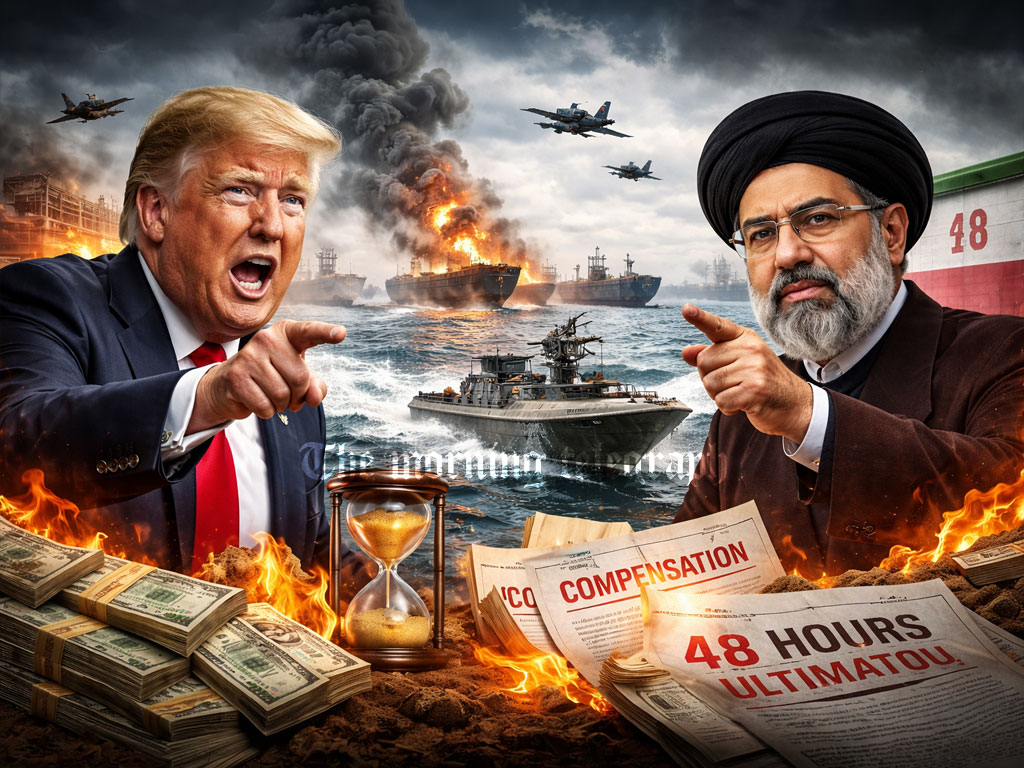
Iran has openly defied Donald Trump’s ultimatum on the Strait of Hormuz, demanding war compensation before reopening the crucial oil route and pushing an already dangerous US-Iran confrontation closer to a wider regional crisis.
Iran has sharply rejected US President Donald Trump’s 48-hour ultimatum to reopen the Strait of Hormuz, declaring that the strategic waterway will remain shut until compensation is secured for the destruction caused by war. In a fierce response, the Iranian President’s office condemned Trump’s warning of a massive military strike, describing his language as reckless, desperate, and dangerously provocative. The exchange has pushed tensions in West Asia to a new level, with both sides now locked in a public confrontation over one of the most vital maritime chokepoints in the global energy market.

The closure of the Strait of Hormuz has triggered deep concern across international oil markets, shipping networks, and the wider global economy. Iran’s move has placed enormous pressure on energy supplies because the narrow passage handles a significant share of the world’s oil trade. Tehran has made it clear that it will not bow to American pressure and has warned that any direct US attack could bring retaliation against energy infrastructure across the region. With the Strait of Hormuz sitting at the center of global oil security, the standoff has become far more than a bilateral dispute. It is now a major geopolitical and economic flashpoint.
According to the Iranian President’s office, the Strait of Hormuz will be reopened only after war-related damages are compensated, with officials suggesting that transit-related mechanisms could be used to recover those losses. Tehran’s message was unambiguous: Iran sees itself as holding leverage over a vital international shipping corridor and is prepared to use that leverage in the face of military threats. By refusing Trump’s deadline, Iran appears determined to project strength, resist outside pressure, and reinforce its claim that it will not reopen the waterway on Washington’s terms.
Trump, however, has responded with threats of overwhelming force, warning that if Iran does not reopen the Strait of Hormuz within the stated deadline, severe consequences will follow. His rhetoric has been blunt, aggressive, and designed to signal that patience is running out. But Tehran has dismissed those warnings outright, accusing the US President of acting out of frustration and anger rather than strategy. The exchange has deepened fears that inflammatory language on both sides could move the region closer to direct military confrontation, with global consequences for oil prices, trade routes, and regional stability.
US-Iran Escalating Tensions
The wider confrontation between Washington and Tehran has already evolved into a dangerous cycle of retaliation, with each side accusing the other of targeting critical energy assets and military positions. The consequences have been severe, with reports of heavy casualties, financial losses, and intensifying market anxiety. Every escalation now sends shockwaves beyond the battlefield, reaching global investors, oil-dependent economies, and shipping industries already bracing for prolonged instability. What was once a strategic rivalry has increasingly taken on the characteristics of a high-risk regional conflict.
World leaders have urged restraint, diplomacy, and immediate efforts to prevent the situation from spiraling into a broader war. International mediators are attempting to create space for dialogue between the United States and Iran, but those efforts remain fragile and uncertain. Tehran has shown limited willingness to engage directly with US officials under threat, insisting that outside pressure and military intimidation cannot form the basis of meaningful talks. As a result, diplomatic channels remain strained just as the need for de-escalation becomes more urgent.
Iran’s Response To Trump’s Ultimatum
Iran’s military leadership has forcefully rejected Trump’s warning, portraying it as an act of panic, imbalance, and political weakness rather than strength. General Ali Abdollahi Aliabadi, speaking on behalf of the Khatam al-Anbiya Central Headquarters, warned that any expanded military action would not remain confined to one theater. He said the entire region could be turned into a zone of chaos and destruction for the United States and its allies if Washington chooses escalation over negotiation. That warning signals Iran’s readiness to widen the consequences of any direct confrontation.
Iranian Foreign Minister Abbas Araqchi has indicated that Tehran remains open to mediated dialogue, but only if any future arrangement addresses what Iran calls the illegal war against it. At the same time, Iranian officials have warned that if the conflict escalates into a US ground invasion, Tehran could move beyond Hormuz and threaten other strategic maritime routes, including the Bab al-Mandab Strait. Such a step would dramatically expand the crisis, putting multiple global shipping lanes at risk and increasing fears of a prolonged regional war involving trade, oil, and military logistics.
Trump’s Threats And Options
Earlier, Trump argued that nations dependent on the Strait of Hormuz should assume greater responsibility for securing it, suggesting that countries with the most at stake should take action if necessary. He also intensified pressure by threatening devastating consequences for Iran if no agreement is reached within his timeline. The language coming from Washington has made clear that the White House wants to project dominance, deter further Iranian moves, and reassert control over a crisis that is now reshaping energy politics across the region.
The US President also referred to the rescue of an American pilot shot down over Iran, describing the mission as unusually dangerous and difficult due to the operational risks involved. He said another crew member had earlier been rescued in daylight after spending several hours over Iranian territory. These comments were clearly intended to underline the seriousness of the military situation and to showcase US capabilities even as the crisis deepens. For now, the world watches and waits, with further developments in the escalating West Asia conflict expected in the coming hours and days.