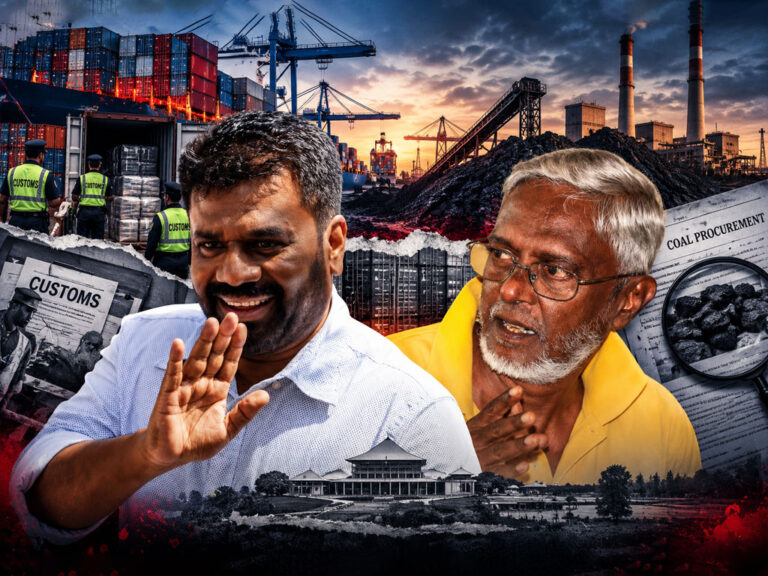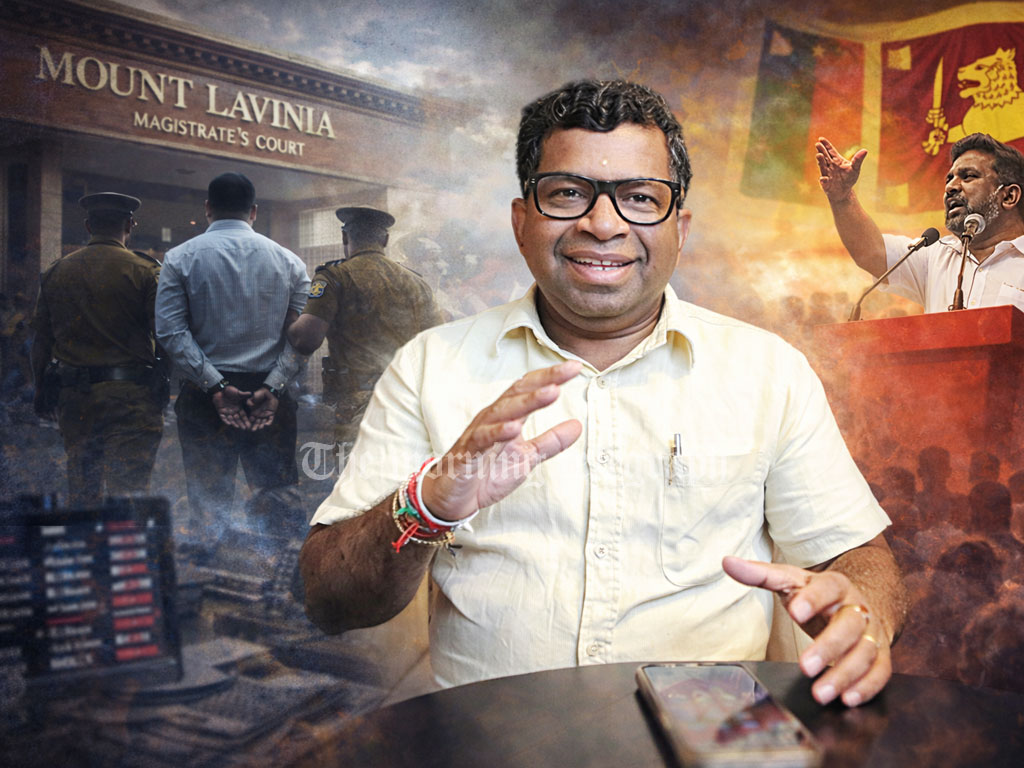
For nearly a year, Sri Lanka’s government publicly tied Pillayan’s arrest to the Easter Sunday attacks. But when the case finally reached court, the Easter narrative disappeared, exposing a troubling gap between political messaging, parliamentary claims, and the charges actually placed before a magistrate.
Sri Lanka spent months hearing one version of events from its government, only to see a very different version emerge when the matter finally reached a courtroom. That contradiction now sits at the center of a deeply disturbing legal and political controversy. On April 8, 2025, the Criminal Investigation Department arrested Sivanesathurai Chandrakanthan, better known as Pillayan, at the TMVP headquarters in Batticaloa. Almost immediately, senior government figures framed the arrest as a breakthrough in the Easter Sunday bombings investigation, one of the darkest chapters in Sri Lanka’s recent history. Public Security Minister Ananda Wijepala told Parliament that significant information had surfaced linking Pillayan to the 2019 attacks that killed 269 people. President Anura Kumara Dissanayake, who had campaigned heavily on promises of Easter Sunday justice, echoed that implication on political platforms.

Yet after 359 days in detention under the Prevention of Terrorism Act, Pillayan was produced before the Mount Lavinia Magistrate’s Court on April 2, 2026, and no Easter Sunday-related charge was filed. The case brought before court was not about the 2019 bombings at all. It concerned the 2006 abduction and murder of Eastern University Vice Chancellor Professor Sivasubramaniam Raveendranath. The magistrate remanded Pillayan pending advice from the Attorney General. That stark contrast has triggered serious questions about whether the government used Easter Sunday rhetoric to shape public opinion while proceeding in court on an entirely different legal basis.
Just two days after the arrest, on April 10, 2025, Minister Wijepala told Parliament that substantial evidence had emerged linking Pillayan to the Easter attacks. On April 12, President Dissanayake went even further by publicly connecting the arrest to his administration’s promise to deliver Easter Sunday justice. The timing was politically significant. As the May 2025 local council elections approached, Pillayan’s arrest was presented to the electorate as evidence that the NPP government was finally doing what previous governments had failed or refused to do. The political value of that message was obvious, and it was repeated with confidence at a moment when public expectations were high.
The narrative became even more specific in July 2025, during an adjournment debate on the Easter Sunday attacks. ITAK MP Shanakiyan Rasamanickam questioned the progress of the investigations, prompting a more detailed response from Minister Wijepala. He stated that Pillayan, who was in remand custody at Batticaloa Prison at the time of the 2019 bombings, had prior knowledge of the attacks. He further claimed that Pillayan had met National Thowheed Jamath leader Zahran Hashim and later given a secret statement to a magistrate regarding the Easter conspiracy. The minister declared that investigations had revealed Pillayan knew about the attacks, though he said he would not reveal more because inquiries were continuing.
Wijepala also referred to the November 30, 2018 killing of two police officers in Batticaloa. He said a former LTTE member named Ajantha had originally been arrested after allegedly confessing, but that later CID investigations found he had been framed. According to the minister, a riding jacket belonging to Ajantha had been used to plant false evidence in order to shield the real perpetrators and conceal wider links to the Easter Sunday conspiracy. These were not passing comments or political whispers. They were detailed allegations, containing names and investigative claims, presented in Parliament with the full authority of the state. Yet despite all of that, none of those Easter-related claims matured into charges when the case finally came before court.
This is where parliamentary privilege becomes central to the story. Under Article 67 of the Constitution and the Parliament Powers and Privileges Act No. 21 of 1953, parliamentary speech and proceedings enjoy absolute legal protection. The law makes clear that what is said in Parliament cannot be challenged or questioned in any court or outside forum. That protection exists to preserve free debate within the legislature, but in this case it also created a shield behind which serious public allegations could be made without evidentiary scrutiny, defamation consequences, or legal testing. A minister could identify a man as tied to terrorism from the floor of Parliament without having to prove the claim in court.
In this case, that is exactly what appears to have happened. The Easter Sunday allegations existed entirely within protected political and parliamentary spaces. President Dissanayake repeated the Easter link at campaign events, but those were political statements, not assertions tested under legal standards. Minister Wijepala made his strongest claims in Parliament, where privilege insulated him from judicial challenge. Meanwhile, the CID issued no public official statement clearly setting out what Pillayan had supposedly disclosed or how the Easter link was being legally pursued. The result was a split narrative. The government spoke one language to the public and another to the judiciary. It made its strongest case in places where it could not be meaningfully challenged and then appeared in court with an entirely different case file.
The matter actually presented before the Mount Lavinia Magistrate was serious in its own right, but it had nothing to do with Easter Sunday. It centered on the disappearance and murder of Professor Sivasubramaniam Raveendranath, Vice Chancellor of the Eastern University of Sri Lanka. He vanished on December 15, 2006, during a tense period in the East following the LTTE split. On the day he disappeared, he had attended the annual conference of the Sri Lanka Association for the Advancement of Science at Science House in Colombo 07. Investigators told the magistrate that an armed group allegedly linked to Pillayan’s Tamil Makkal Viduthalai Pulikal had earlier abducted the Dean of the Faculty of Arts and held him until Raveendranath agreed to resign. Because his vice chancellorship was a presidential appointment, the resignation was not immediately accepted, and he continued working from Colombo.
According to CID investigators, Professor Raveendranath disappeared after his final administrative meeting on December 15, 2006, and was never seen again. They told court that he had been taken to an illegal detention and torture camp in Sevanapitiya in the Eastern Province, where he was allegedly murdered and his body burned. Pillayan was named as the first and principal suspect in that case. Investigators described Sevanapitiya as a place where civilians, officials, and businessmen were unlawfully detained, tortured, and killed. They also said evidence showed Pillayan had led what they portrayed as part of Sri Lanka’s notorious white van abduction network. In addition, the CID disclosed that 362 T-56 rifles, 36 9mm pistols, and one micro pistol issued to Pillayan’s group during the Mahinda Rajapaksa administration had never been returned to the state.
After the April 2, 2026 court appearance, Udaya Gammanpila, Pillayan’s lawyer and leader of the Pivithuru Hela Urumaya, addressed reporters and sharply challenged the government’s conduct. He said he would appeal the remand order and argued that the entire public narrative built around Easter Sunday had collapsed. Given that no Easter-related charge was filed after nearly a year in detention, his criticism struck a politically sensitive nerve. Gammanpila said the claims made by President Dissanayake and Minister Wijepala about Pillayan being arrested under the PTA for Easter Sunday investigations had now been exposed as false. He added that what had been said in Parliament was said there precisely because it could not be said elsewhere under legal scrutiny.
The larger legal context makes the issue even more serious. Sri Lanka’s Prevention of Terrorism Act has faced decades of criticism from the United Nations Human Rights Council, Amnesty International, Human Rights Watch, and several UN Special Rapporteurs. Its most controversial feature is the power to detain people for long periods under executive order without judicial oversight and without formal charges. That power has historically been used disproportionately against Tamil suspects and former combatants. President Dissanayake himself promised during the 2024 election campaign that he would replace the PTA with a legal framework that would address security threats without trampling civil liberties. The Pillayan case now places that promise under sharp examination.
What lies ahead is a prosecution focused on the 2006 abduction and murder of Professor Raveendranath. His family has waited nearly twenty years for justice, and that case deserves a full, fair, evidence-based, and transparent process. The same standard should apply to the Easter Sunday attacks. The victims, survivors, and their families deserve a legal process grounded in verifiable evidence and tested in open court, not one driven by politically useful allegations made under parliamentary privilege and left to fade when the judiciary requires proof. The sequence is now plain: April 8, 2025, Pillayan is arrested under the PTA. April 10, 2025, Minister Wijepala tells Parliament significant information links him to Easter. April 12, 2025, President Dissanayake invokes the arrest in Easter-related campaign messaging. July 2025, the minister claims Pillayan had prior knowledge of the attacks, met Zahran Hashim, and gave a secret statement. April 2, 2026, Pillayan appears in court after 359 days in CID custody. Easter charges filed: none. Court case presented: the 2006 murder of a vice chancellor. The political message and the legal record are no longer the same story.