A brewing political storm exposes cracks within the ruling coalition, as corruption allegations, power crisis fallout, and a no-faith motion threaten to test the government’s unity and credibility.
A statement made by JVP General Secretary Tilvin Silva at a commemorative event for members killed during the 1971 JVP uprising has stirred significant debate within Sri Lanka’s political landscape. Speaking to party supporters on Sunday, he claimed that substandard coal used at the Norochcholai power plant had contributed to a decline in national electricity generation. While attempting to clear his party of responsibility, the remark has drawn attention at a time when the Opposition is intensifying efforts to leverage the coal controversy to politically weaken the government.

Internal group dynamics within political parties, often shaped by competing ambitions and differing agendas, show that even strong parliamentary majorities do not guarantee stability. This is especially true for coalition governments that bring together ideologically diverse factions. Few would have anticipated that the powerful UPFA government under President Mahinda Rajapaksa would fracture in 2014 and collapse the following year despite holding a two thirds majority and facing a relatively weak Opposition at the time.
Historically, governments in Sri Lanka with overwhelming parliamentary strength have often collapsed due to internal divisions rather than external pressure. The SLFP led United Front government experienced a major split in 1975 when the LSSP broke ranks. More recently, the SLPP government under President Gotabaya Rajapaksa also unraveled under internal strain. These examples highlight how dominant administrations can become overconfident and resistant to internal criticism.
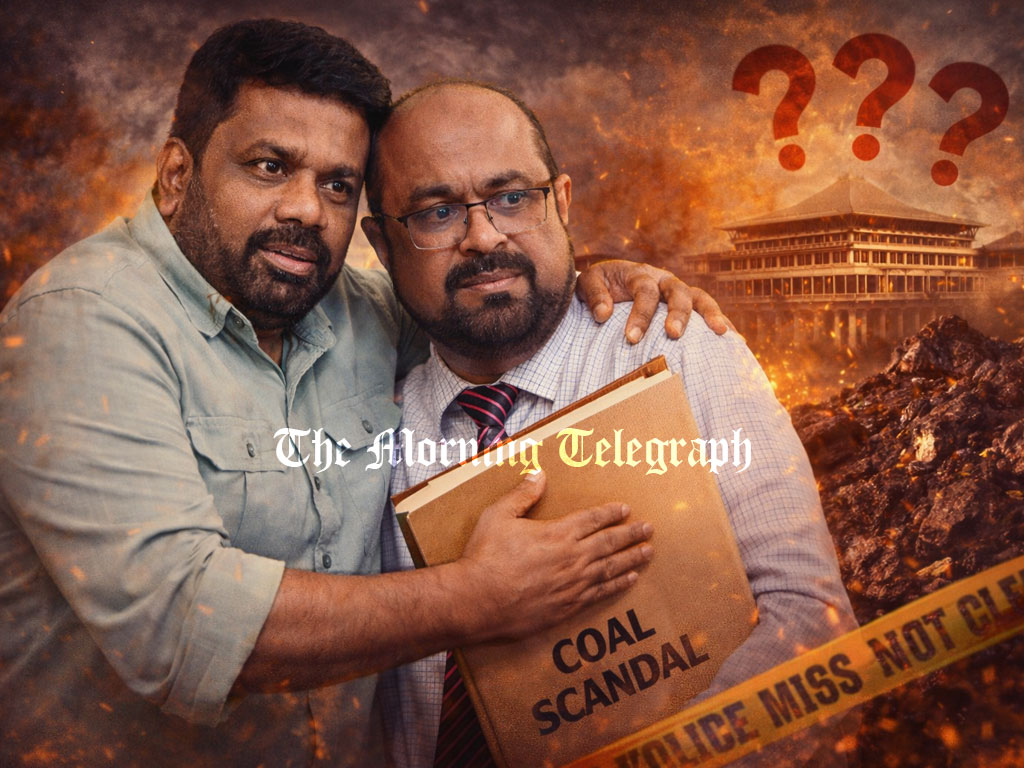
Against this backdrop, speculation about internal tensions within the ruling JVP NPP coalition has been gaining traction on social media. Reports suggest that some senior figures within the JVP are calling for Energy Minister Kumara Jayakody, who faces corruption allegations linked to a coal procurement scandal, to be suspended or removed from the Cabinet. However, these calls are reportedly facing resistance from both the NPP and sections of the JVP itself. It is in this context that Tilvin Silva’s recent remarks are being interpreted, with many viewing them as a reflection of underlying rivalries within the coalition.
The Opposition’s no faith motion against Minister Jayakody is widely seen as a calculated political strategy. Although it has little chance of passing, it forces government MPs to publicly defend a minister facing serious allegations. This situation allows the Opposition to associate the entire government with the controversy. Given that the JVP NPP has consistently positioned itself as an anti corruption force, defending a minister accused of wrongdoing presents a significant political dilemma.
The government now appears to have committed itself to defending Jayakody, leaving little room to reverse course without further damage. Removing him at this stage could create additional instability, while continuing to support him carries reputational risks. The manner in which Jayakody was indicted and subsequently granted bail has also come under scrutiny, with critics arguing that he has not been treated in the same manner as others accused of similar offences, raising concerns about equality before the law.
There is also speculation that the government may attempt to delay or prevent the no faith motion from being debated in Parliament on April 10. Some analysts suggest that the ongoing legal proceedings against Jayakody could be used as justification for such a move. However, blocking the motion could prove politically costly, as it may shift the Opposition’s campaign from Parliament to public protests, further intensifying pressure on the government.
The JVP NPP leadership is acutely aware that the Opposition is targeting its core political identity, particularly its anti corruption stance. Continued support for a minister facing serious allegations risks undermining its credibility and moral authority. The coalition now finds itself in a difficult position, balancing political survival with its commitment to clean governance. In hindsight, earlier decisive action against the minister might have strengthened public confidence and avoided the current crisis.