By Roshan Jayasinghe
A reflection on what is revealed when power loses its conscience, and why no human system can remain just if the human being itself remains uncorrected.
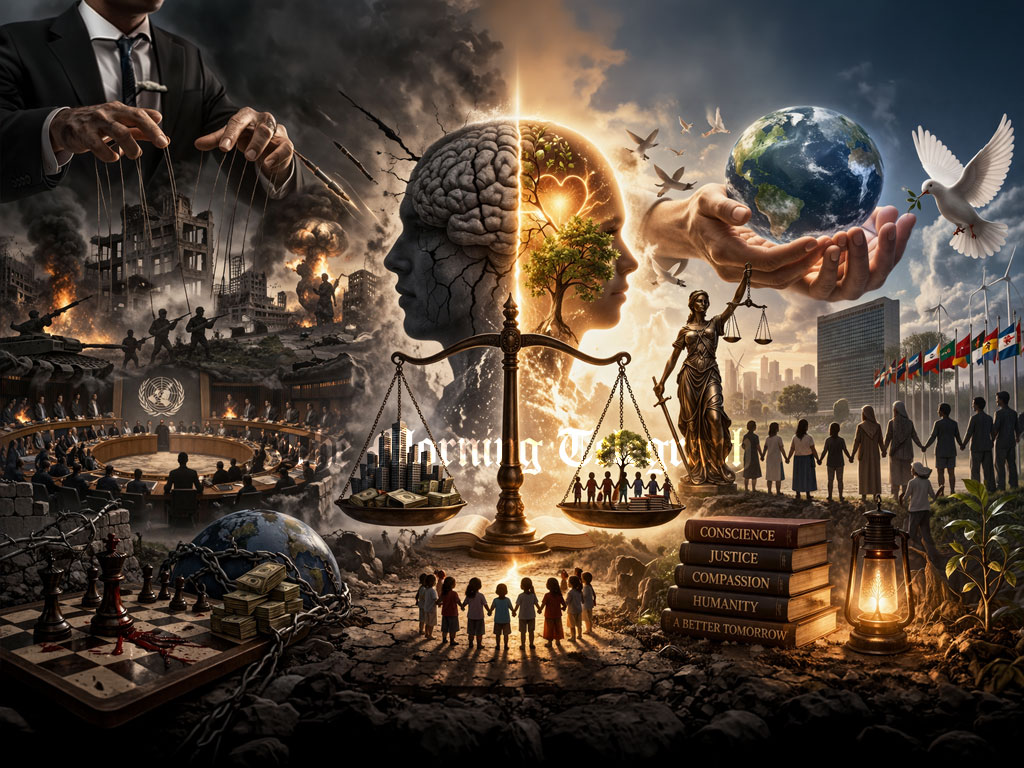
There are times when the world becomes so revealing that no explanation can soften what is plainly before us. The language of diplomacy begins to sound hollow, the speeches become thinner than the suffering they try to contain, and what remains is a much simpler and harder truth. We are not only watching political failure. We are watching what happens when human beings build power without conscience and then call it order.
What is breaking the heart of the world is not only war, not only destruction, not only the collapse of international credibility, and not only the repeated sight of institutions failing at the very moments they were said to exist for. What is being exposed is something deeper than politics. It is something deeper than law. It is something deeper than strategy. What is being exposed is the condition of the human being itself.

We have created a civilization that has become highly skilled in power, but not equally deep in conscience. We have advanced in systems, in weapons, in technology, in trade, in communication, and in every outward structure that gives the appearance of progress, yet the human being operating these structures has not evolved at the same pace. The outer world has grown in capability while the inner world has remained confused, fearful, greedy, ambitious, wounded, proud, and too often untouched by the seriousness of what it means to hold another life in one’s hands.
That is why moments like this shake people so deeply. It is not only because they are tragic. It is because they reveal the lie we have been living under. We have been told that the modern world is orderly, governed, regulated, protected by international norms, guided by institutions, and restrained by law. Yet every time real moral courage is required, we see how fragile that promise becomes. A few powerful hands can still block justice, delay action, dilute truth, and leave human suffering to negotiate with procedure. And so once again the ordinary person, watching all this unfold, feels the same bitter realization: the structure is not built equally for all human lives.
This is why I keep returning to the human being and not only the system. Because every system is an extension of the mind that built it. Every law carries the shadow or the clarity of the consciousness behind it. Every institution will eventually resemble the character of the people who design it, lead it, defend it, and protect it. If the human being remains inwardly disordered, then whatever he builds will carry that disorder into the world, no matter how sophisticated the outer form may appear.
A human being without conscience is dangerous enough in private life. But place that same inwardly uncorrected human being inside government, military authority, corporate power, ideological influence, or global institutions, and the damage multiplies. It becomes organized. It becomes defended. It becomes explained. It becomes legal. It becomes something spoken of in neutral language while lives are broken beneath it. This is one of the darkest abilities of the human mind: to create suffering and then surround it with enough language to make it seem complicated.
But in truth, some things are not complicated at all. The destruction of innocent life is not complicated. The protection of self-interest at the expense of human dignity is not complicated. The refusal to act when one has the power to prevent harm is not complicated. We complicate such things because clarity threatens too many arrangements. Clarity exposes where profit is being protected, where alliances are being preserved, where ego is being defended, and where moral language is being used only when it is convenient.
That is why this cannot be seen only as the failure of one nation, one leader, one council, one alliance, or one episode in history. Those are only the visible faces of a deeper problem. The deeper problem is that humanity still rewards the wrong things. We continue to admire dominance as though it were strength. We continue to confuse cleverness with wisdom. We continue to celebrate accumulation while neglecting character. We continue to raise human beings into systems of competition without first teaching them the seriousness of responsibility. We continue to produce minds that know how to win, but do not know how to care. Then later, when carelessness arrives at the scale of nations, we act shocked.
Why should we be shocked, when the same seeds were visible all along?
If a society rewards image more than substance, then performance will rise. If it rewards ambition without inward correction, then ruthless people will flourish. If it values power more than truth, then truth will always be negotiated by power. This is not mysterious. This is not accidental. This is the direct outcome of a civilization that has developed an impressive exterior while leaving the human interior largely unattended.
And yet I do not say this in hopelessness. Because there is still one saving truth that remains visible even now. The ordinary human heart still responds. Ordinary people still feel grief. Ordinary people still gather, protest, cry out, write, pray, and refuse inwardly to cooperate with what they know is wrong. That matters. It tells us that conscience has not disappeared from humanity. Compassion has not died. Moral clarity still exists. The problem is that this clarity does not yet live strongly enough inside the institutions that claim to represent civilization.
That gap is the real crisis. The distance between the human heart and organized power. The distance between what ordinary people know to be wrong and what official systems are prepared to stop. The distance between conscience and consequence.
So when people ask what is wrong with the world, I do not think the answer lies only in geopolitics, or in policy, or in treaties, or in negotiations, however important these may be. The answer lies earlier. It lies in the making of the human being. It lies in what we teach, what we reward, what we excuse, what we call success, and what we are willing to overlook for the sake of comfort, gain, or alignment with our side. Until the human being is corrected inwardly, the structures he builds will continue to carry his distortions outwardly.
No lasting peace can come from minds that remain inwardly violent, even if that violence is hidden beneath education, status, and ceremony. No just order can come from hearts that are still governed by greed, ego, and selective morality. No structure can become truly humane unless the human being who sustains it has first come to understand something basic and sacred: that life is not there to be manipulated for strategy, advantage, or display.
This is why I believe the world’s deepest need is not only reform of institutions, though that too is necessary. The deeper need is the restoration of the human center. A return to conscience. A return to responsibility. A return to the seriousness of being human. Without that, every new structure will eventually decay into the old pattern. Different names, different speeches, different flags, different offices, but the same human confusion moving through them.
And perhaps that is what these painful times are forcing us to see. Not only that the system is broken, but that the system was always limited by the consciousness of those who made it. Not only that power is dangerous, but that power without inward maturity becomes a threat to life itself. Not only that the world needs better leadership, but that leadership without conscience is merely organized self-interest with a title.
What we call civilization will remain incomplete until conscience becomes more central than power. Until then, the world will continue to watch polished people in polished rooms speak polished words while mothers bury children, nations harden themselves behind language, and human beings everywhere ask how something so obviously wrong can still continue under the banner of order.
The answer is painful, but it is plain. It continues because we have not yet become honest enough about the kind of human being we are still producing.
And unless we begin there, unless we are willing to return to the root and not merely rearrange the branches, power without conscience will keep reappearing in new forms, under new governments, within new institutions, and behind new justifications, while the human being remains old in all the wrong ways.
Author’s Note
This reflection is not written to accuse one side while protecting another, nor to reduce human suffering to a political argument. It is written from a deeper concern that has been present in much of my work: that our greatest crisis is not only institutional, but human. If we do not return to the correction of the human being itself, then whatever we build in the name of peace, law, or civilization will continue to carry the same fracture within it.
About the Author
Roshan Jayasinghe is a writer and observer of human systems. His work explores the gap between man made constructs and lived humanity, with a focus on how economics, trade and everyday choices intersect with questions of fairness, responsibility and inner alignment. Through essays for publications in The Morning Telegraph, he aims to remind readers that they are not passengers in a fixed machine, but active custodians of a shared world.