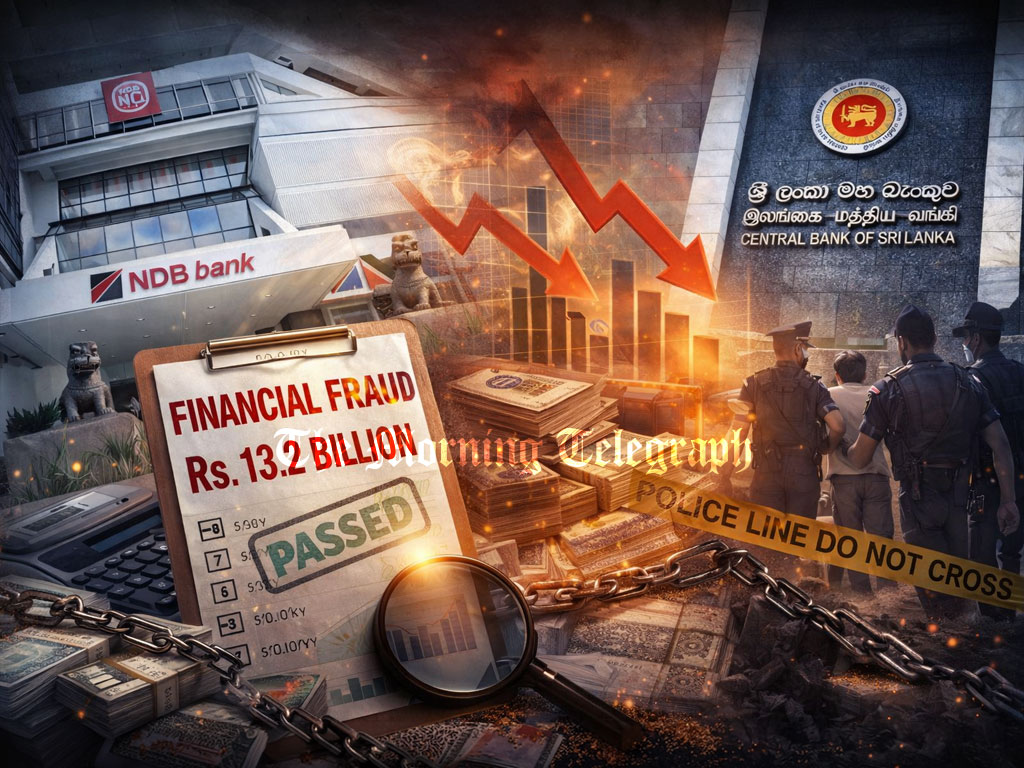
A massive internal fraud at NDB Bank triggers national concern, raising urgent questions about governance, oversight, and financial system integrity in Sri Lanka.
A major public debate has erupted following revelations of an alleged financial fraud exceeding Rs. 13 billion at National Development Bank PLC, one of Sri Lanka’s leading commercial banks.
In an official statement issued on April 6, the Central Bank of Sri Lanka confirmed that NDB Bank had reported the discovery of an internal fraud that could result in a significant financial loss. However, the Central Bank also reassured the public that, according to the bank, no customer accounts or deposits had been impacted by the incident. NDB Bank echoed this assurance through its own communication to customers via social media platforms.

Initial Discovery
The first disclosure of the fraud was made by NDB Bank in a letter to the Colombo Stock Exchange dated April 2, 2026, signed by Deputy Chairperson and Company Secretary Shehani Ranasinghe.
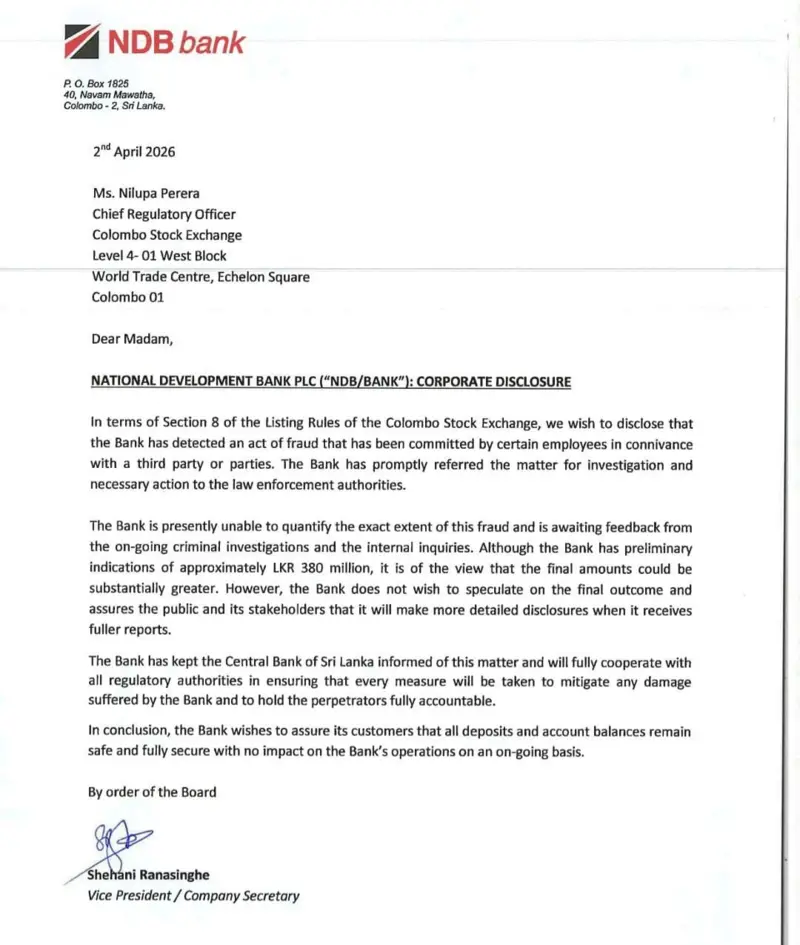
In that communication, the bank revealed that a fraudulent act had been identified involving a group of employees working in collaboration with external third parties. This disclosure was made in line with the Colombo Stock Exchange Listing Rules. At that stage, the estimated value of the fraud was reported to be approximately Rs. 380 million. The bank also noted that the exact extent of the loss had not yet been fully determined and confirmed that the matter had been referred to law enforcement authorities for further investigation and action.
Second Disclosure
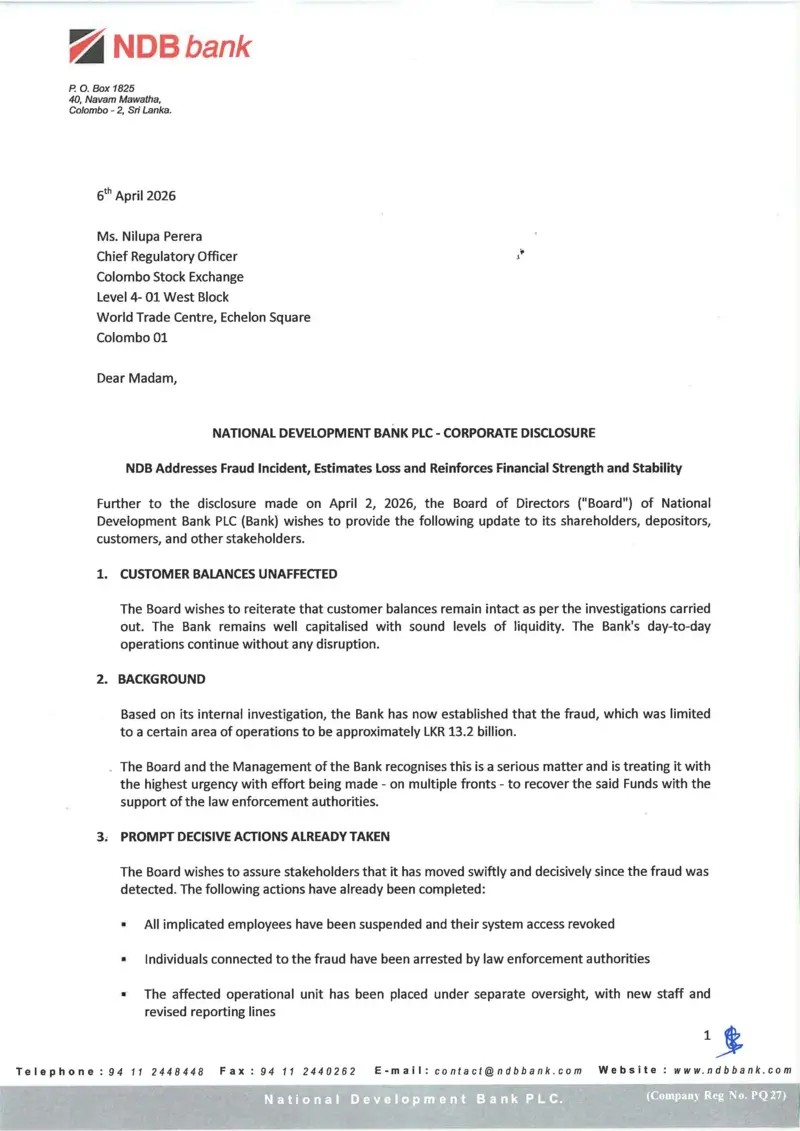
A subsequent disclosure issued on April 6, 2026, significantly revised the scale of the fraud. According to the updated findings from the bank’s internal investigation, the incident was confined to a specific operational division, but the estimated loss had escalated dramatically to approximately Rs. 13.2 billion.
The bank’s Board of Directors and senior management classified the matter as extremely serious and confirmed that they were working closely with law enforcement agencies to recover the misappropriated funds and identify all parties involved.
What steps has the bank taken so far?
In response to the incident, NDB Bank has taken immediate corrective and containment measures. All employees suspected of involvement in the fraud have been suspended, and their system access has been revoked to prevent further risk. Law enforcement authorities have already arrested several individuals connected to the case.
The bank also stated that all relevant records and evidence have been secured to support ongoing investigations. The affected operational division has been placed under enhanced supervision, while internal controls, reporting structures, and access management systems have been strengthened across the institution to improve governance and prevent recurrence.
Additionally, following regulatory directives, the bank has suspended the cash dividend payment that was scheduled for April 6, 2026. However, it confirmed that the share dividend plan will proceed as originally intended.
What is the impact on the bank?
NDB Bank has acknowledged that the financial impact of the fraud is significant. The bank estimates that, even under worst case assumptions and after making full provisions for potential losses, the unaudited after tax loss for the quarter ending March 31, 2026, will be approximately Rs. 4 billion.
Despite this setback, the bank highlighted its financial resilience by pointing to its previous performance. For the financial year ending December 31, 2025, the bank reported a net after tax profit of Rs. 11 billion, including a profit of Rs. 3.5 billion in the final quarter of that year.
The bank also emphasized that its capital adequacy ratios remain above the statutory minimum requirements of 7.0 percent, 8.5 percent, and 12.5 percent. Furthermore, the estimated impact on its total asset base, which stood at approximately Rs. 990 billion as of March 31, 2026, is relatively limited at around 0.7 percent.
What does the Central Bank of Sri Lanka say?
The Central Bank of Sri Lanka has conducted a preliminary assessment based on information provided by NDB Bank. It stated that, even after accounting for the reported losses, the bank is expected to maintain capital adequacy and liquidity levels above the required regulatory thresholds.
The regulator confirmed that it will continue to closely monitor developments and take appropriate action if necessary. It also noted that NDB Bank has access to temporary liquidity support mechanisms under existing frameworks governed by the Central Bank and relevant banking laws, should the need arise.
The Rs. 290 million fraud
Separately, a previous fraud case involving over Rs. 290 million at NDB Bank has also drawn renewed attention in light of the current developments. In November 2025, Colombo Chief Magistrate Asanga S. Bodaragama ordered the remand of five suspects, including a deputy manager and a general manager from the bank’s information technology division.
During court proceedings, officers from the Financial Crimes Investigation Division of the Criminal Investigation Department informed that investigations had revealed that part of the misappropriated funds had been credited to accounts linked to the suspects. They further stated that three additional suspects had been arrested earlier and remanded, while statements from several other bank officials were still being recorded.
By January 7, 2026, the CID had arrested a total of 16 suspects in connection with the case, including two employees of the bank. The magistrate instructed authorities to expedite the investigation, recognizing the seriousness and complexity of the financial crime.
What are social media users saying?
The unfolding scandal has sparked intense debate across social media platforms, with users questioning the effectiveness of internal controls, audit mechanisms, and regulatory oversight within the banking sector.
Some commentators have raised concerns about how such a large scale fraud could have remained undetected for an extended period. Others have pointed to the rapid escalation in the reported figures, noting that what was initially disclosed as Rs. 380 million had grown to Rs. 13.2 billion within days, prompting skepticism about the accuracy and transparency of disclosures.
There have also been calls for greater accountability from both the bank and regulatory authorities, with some users questioning whether sufficient information has been shared with the public regarding the duration and nature of the fraud. The silence or delayed response of key financial sector authorities has also been highlighted as a concern by several observers.