
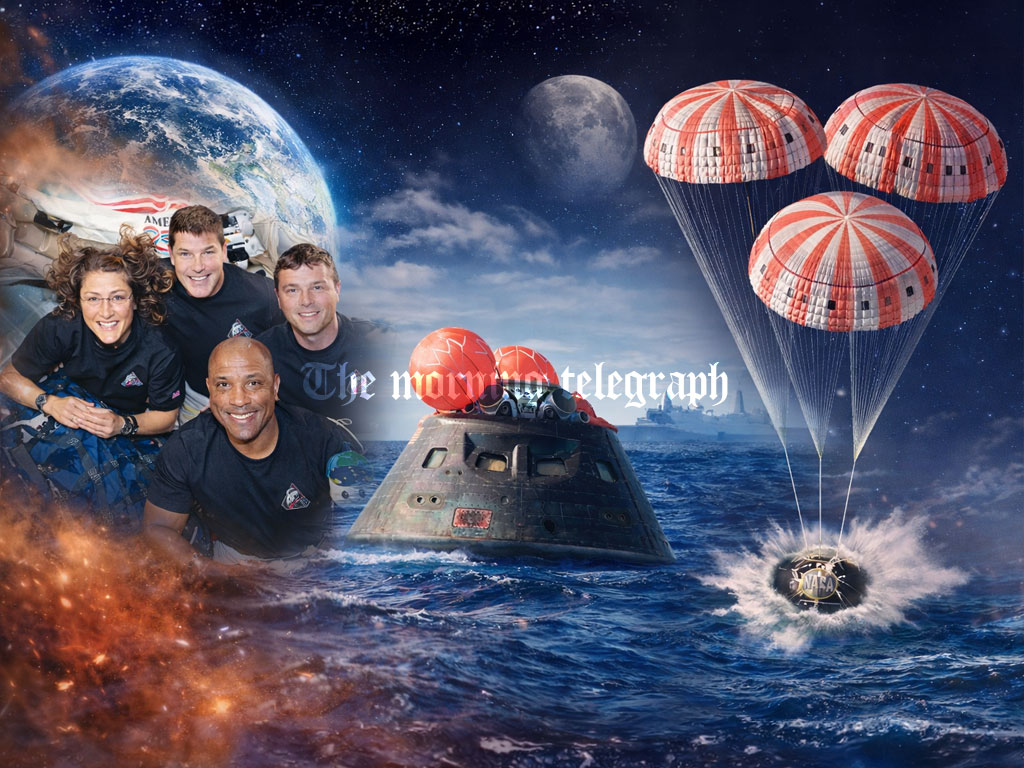
A breathtaking return from the edge of deep space, Artemis II marks humanity’s boldest step back to the moon in over half a century, blending science, emotion, and global unity into a mission that redefines the future of space exploration.
The Artemis II mission, carrying four astronauts aboard the Orion space capsule, has successfully splashed down in the Pacific Ocean off the coast of San Diego, according to confirmation from NASA.
The spacecraft landed at exactly 5.07pm local time, completing its journey around the moon and back in 9 days, 1 hour, and 32 minutes. Orion covered an astonishing distance of 694,481 miles, or 1,117,659 kilometers, during the mission. Although the timeline slightly exceeded nine days, the mission is officially recorded as a ten day operation because launch day was counted as flight day one.

Commander Reid Wiseman, pilot Victor Glover, and mission specialist Christina Koch from NASA, along with Canadian Space Agency astronaut Jeremy Hansen, have now etched their names into history. They are the first humans since the Apollo 17 crew in December 1970 to travel to the moon and safely return to Earth.
With this achievement, they join an elite group of just 24 individuals who have ever completed a journey to the moon and back, reinforcing the rarity and significance of this milestone in modern space exploration.
As Orion descended toward Earth, dropping below 17,000 miles above the surface, Wiseman described the view of the planet with awe. He noted the striking blue hue of Earth, calling it beautiful, capturing a moment that resonated deeply with audiences worldwide.
Following splashdown in the Pacific Ocean, recovery operations were swiftly carried out by the USS John P Murtha. Teams approached the capsule using boats and secured it with an inflatable platform attached to Orion’s hatch. The astronauts were then medically assessed by navy personnel before being airlifted by helicopter to the naval vessel.
NASA has now demonstrated its renewed capability to send humans safely into cislunar space, the region between Earth and the moon, and return them home. This success lays the groundwork for the Artemis program’s next ambitious goal, a crewed lunar landing scheduled for 2028, marking 56 years since humanity last set foot on the moon.
Beyond the technical achievements, the mission delivered something equally powerful. For over a week, people around the world shared in a rare sense of unity, captivated by stunning video footage and high resolution images of the lunar surface and distant Earth. The astronauts also offered deeply personal reflections that added emotional depth to the mission.
Christina Koch described her first close view of the moon during Orion’s approach, when the spacecraft passed just 4,067 miles above the lunar surface. She spoke of a sudden and overwhelming emotional connection to the lunar landscape, a moment that lasted only seconds but left a lasting impression.
She reflected on the uniqueness of the moon and how comparing it to Earth highlights the shared elements that sustain life. Koch emphasized that everything humanity needs is provided by Earth, describing it as nothing short of a miracle.
Koch also made history as the only woman to travel to the moon and return during this mission. Jeremy Hansen became the first non American to complete such a journey, while Victor Glover became the first person of color to reach the moon and return. Together with commander Wiseman, the crew traveled farther from Earth than any humans before them, reaching a maximum distance of 252,756 miles, surpassing the previous record set by Apollo 13 in April 1970 by more than 4,000 miles.
The mission was not without challenges. Orion’s onboard toilet system experienced repeated malfunctions inside the compact capsule, requiring the use of backup urine collection systems and in flight repairs carried out by Koch, who temporarily took on the role of onboard technician.
Amid the challenges, there were lighter moments. On Easter Sunday, the crew held a playful egg hunt, searching for packets of dehydrated scrambled eggs hidden throughout the spacecraft. A plush mascot named Rise, designed by an eight year old student from California, became a regular presence during onboard broadcasts, adding a touch of warmth and relatability to the mission.
One of the most emotional moments occurred when the crew proposed naming a previously unnamed lunar crater after Carroll Taylor Wiseman, the late wife of commander Reid Wiseman and mother of their two daughters, who passed away in 2020. The tribute was deeply moving, with Jeremy Hansen visibly struggling to speak as emotions overwhelmed the crew, leading to a moment of shared grief and support.
On the operational side, the astronauts conducted critical evaluations of Orion’s life support systems, radiation monitoring equipment, and next generation spacesuits. They also tested key procedures essential for future deep space missions, contributing valuable data to NASA’s long term vision for the Artemis program, which includes plans for a 20 billion dollar lunar base within the next decade.




Worst pilots at Sri Lankan are Themia Abeywickrema & Navin De Silva…. Hungry for popularity…at any cost