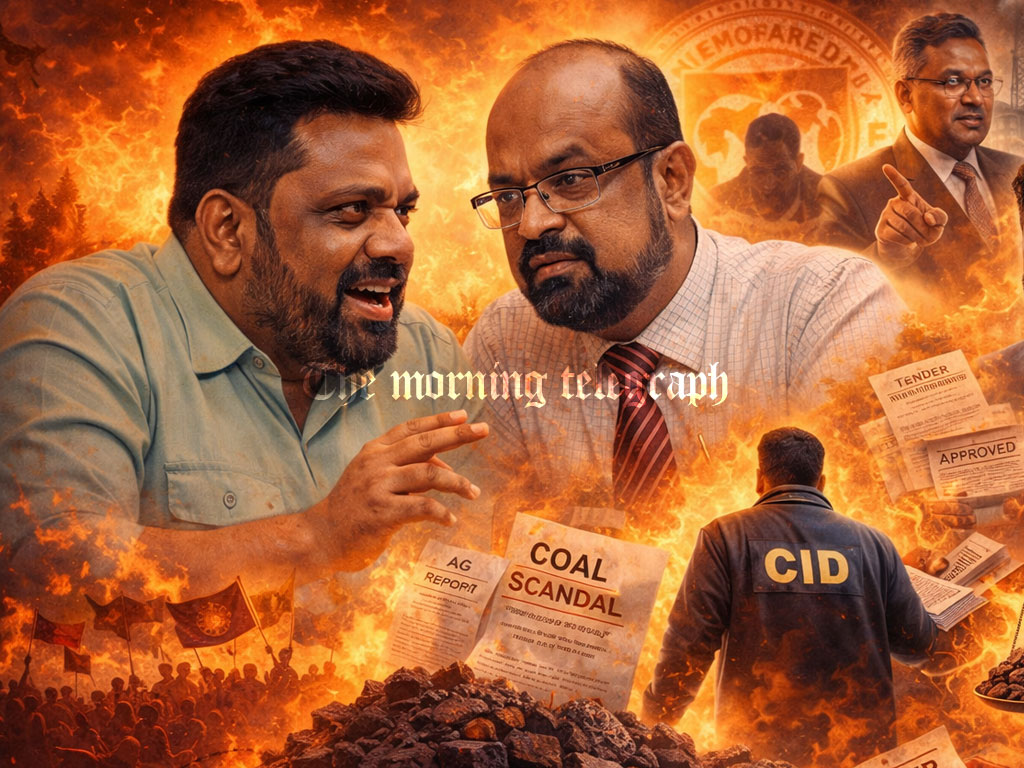
A fierce opposition offensive over the coal scandal, the Auditor General’s report, IMF scrutiny, and the fate of former presidential residences has pushed the government into one of its most politically damaging defensive battles yet.
It would not be an exaggeration to say that last week’s parliamentary sittings were effectively dominated by the Samagi Jana Balawegaya. In what now appears to be a major political turning point, the opposition succeeded in doing what many thought would take far longer. Within barely a year and a half of a government coming to power with an overwhelming two thirds majority, the SJB managed to force the administration into a bruising and sustained defensive posture over one explosive issue.

That issue was the allegation that the importation of substandard coal had caused massive losses to the country. By the end of the week, a government that came into office claiming moral clarity, anti corruption credentials, and administrative discipline found itself politically bruised, scrambling to answer questions, and struggling to keep control of the public narrative. What began as an opposition charge had evolved into a national controversy with audit findings, parliamentary drama, committee action, and public mobilisation all converging at the same moment.
Calculated political checkmate
At the heart of this operation was Opposition Leader Sajith Premadasa, whose comparatively small parliamentary team executed what many observers saw as a carefully planned political checkmate. This was not just a parliamentary intervention. It was a coordinated political campaign that functioned both inside the chamber and outside it, in the wider court of public opinion.
Premadasa was the first to sound the alarm over the coal issue. Initially, he was met with mockery and open hostility from government benches. Ministers and ruling party MPs appeared to dismiss the matter as just another opposition slogan. But Premadasa did not retreat. He returned repeatedly with documents, figures, details, and pointed arguments, steadily building a case around what he described as a large scale fraud linked to substandard coal imports and financial losses to the state.
Standing shoulder to shoulder with him were S. M. Marikkar and Ajith P. Perera. Their roles were crucial. Marikkar helped create the institutional and investigative pressure. Perera transformed that material into a legal and political challenge that could not easily be brushed aside. Together, they helped turn accusation into evidence driven pressure.
Marikkar made full use of his position in the Sectoral Oversight Committee on Power and Energy. He methodically called before the committee officials from institutions such as the Ceylon Electricity Board and the Lanka Coal Company. Through those committee proceedings, layers of alleged irregularities began to emerge. With each session, more details surfaced. What seemed at first like a technical procurement issue gradually began to look like a major governance controversy involving accountability, oversight failure, and potential wrongdoing.
At the same time, Ajith P. Perera played a wider strategic role. He understood that for the coal scandal to gain real momentum, it could not remain confined to the SJB alone. He therefore took pains to present the facts and the legal significance of the issue to other opposition groupings as well. In doing so, he helped shape a broader opposition front around the issue, bringing in parties and factions that had until then been absorbed by their own political agendas.
The result was a relentless campaign that neither the government nor the media could ignore. Traditional media outlets, digital platforms, and political talk shows all found themselves pulled into the issue. In just eighteen months, what had begun as a disputed opposition claim became a national political flashpoint. It spread from Parliament to committee rooms, from the committee room to television debates, and from there into the public mind.
In the end, the coal scandal did not merely raise questions about alleged corruption. It exposed something deeper. It exposed a government that appeared surprisingly vulnerable when confronted by a focused and disciplined opposition capable of sustaining a single issue long enough to make it politically costly.
The Auditor General saga
This political pattern is not entirely new in Sri Lanka. There was a similar moment in 2015 when the Joint Opposition effectively captured the political narrative within roughly one and a half years of the Yahapalana administration coming to power. Back then, the issue was the Central Bank bond scandal.
At that time, around forty opposition MPs pursued the bond controversy relentlessly. They turned what might have remained a technical financial issue into a national political story. It became one of the most damaging issues faced by the Yahapalana government. Eventually, the bond scandal contributed significantly to that government’s internal breakdown and later became one of the factors in its political collapse.
Against that background, the coal controversy began to look even more dangerous for the present administration. Compounding the suspicion was another unresolved development that had taken place earlier. For nearly a year, there had been repeated delays in appointing a new Auditor General. That delay, once seen as a procedural issue, now began to look politically significant.
AG’s retirement
When then Auditor General C. Wickramaratne retired, many expected that Deputy Auditor General Dharmapala Gammampila, the most senior official within the department, would naturally be elevated to the position. That is how continuity would ordinarily be expected to work in such an institution.
Instead, the President nominated someone else to the Constitutional Council. This immediately sparked political concern. The opposition alleged that, for the first time in history, an external candidate was being pushed over the head of a senior career official from within the department itself. They argued that such a move suggested more than a routine administrative choice. It hinted at a possible hidden agenda.
Those suspicions hardened when the President’s nominee was rejected at the Constitutional Council after strong opposition. Opposition Leader Sajith Premadasa, Ajith P. Perera, and three civil society representatives voted against the nomination. What made the matter even more extraordinary was that the President did not stop there. On four separate occasions, different nominees were sent forward, and each one was rejected.
The consequence was unprecedented. For more than eight months, the office of the Auditor General remained vacant. During that period, Dharmapala Gammampila functioned repeatedly in an acting capacity. Yet the government still did not move to confirm him permanently.
Even when the Chief Prelates of the Malwathu and Asgiri Chapters, along with other senior Buddhist clergy, formally requested that Gammampila be appointed, there was no visible sign that the President was prepared to act on the request. That refusal added further political meaning to what might otherwise have been treated as an administrative delay.
A game that backfired
In this setting, the opposition maintained that the government was trying to shape the Constitutional Council in a way that would eventually allow it to install a compliant Auditor General. Their argument was simple. With the terms of the three civil society representatives in the Constitutional Council due to expire in January, the government was allegedly trying to replace them with loyalists who would support its preferred candidate.
Once those terms expired, a series of discussions took place in Parliament between the Prime Minister and the Opposition Leader about appointing new members. According to the opposition, the government’s real intention was to solve the impasse by placing three figures aligned with its interests into those vacancies.
Yet the Constitution created a problem for that strategy. At least one civil representative had to be appointed with the concurrence of the Opposition Leader. That gave Sajith Premadasa leverage, and he used it. On two separate occasions, he opposed the Prime Minister’s proposals, causing talks to fail.
During the second round of discussions, Speaker Jagath Wickramaratne was also present. Premadasa objected to that as well. He argued that the Speaker had no proper role in the matter and emphasized that nominations of this kind required his consent, not merely the Prime Minister’s decision.
Third round success
Only during the third round of negotiations did a mutually acceptable formula emerge. In the end, both the Prime Minister and Premadasa were forced into three rounds of bargaining before the composition of the Constitutional Council could be settled.
Still, the settlement did not come without a political cost. Premadasa’s decision to eventually agree to the nomination drew criticism, including from within his own party. Some argued that agreeing to a name previously resisted, especially that of Mrs. S. Wijeratne, amounted to a retreat in the struggle over the Auditor General’s appointment. The criticism from outside the party was predictable, but the criticism from within SJB ranks was especially telling.
Once the Constitutional Council was reconstituted, the President nominated Mrs. Wijeratne, then the second most senior official in the Auditor General’s Department. She was approved and became Sri Lanka’s first female Auditor General. Almost immediately, her first major test became the audit of the controversial substandard coal imports.
“No one tasted the coal”
What happened next added even more drama to the controversy. The audit report on the coal imports was released at the very start of the week in which the opposition’s no confidence motion against Power and Energy Minister Kumara Jayakody was due to be debated.
The issue surfaced on Tuesday, the first sitting day of the week. Parliament had been informed that the President would address the House at noon regarding a Cabinet approved relief package. Leader of the House Bimal Rathnayake told Parliament that the President would arrive at 12 noon. He also mentioned that the Auditor General’s report into the so called coal fraud had already been released and tabled.
Under normal parliamentary practice, such a report should be made available to all MPs in the relevant languages. Yet, despite the announcement, opposition MPs had not received copies. When questioned, the response was that only about five copies had been printed and that more would be distributed later.
As opposition members pressed for access, Rathnayake said distribution was not the government’s responsibility but that of the Parliament Secretariat. That explanation did not satisfy Ajith P. Perera and S. M. Marikkar, who by then had grown suspicious that something was being held back. Throughout Tuesday morning, they made repeated attempts to secure a copy, going to the library and meeting parliamentary officials.
Before they could obtain the document, the President arrived, delivered his remarks on the relief package, and then addressed the coal issue directly. In a notable admission, he acknowledged that the imported coal was in fact substandard. At the same time, however, he denied that there had been any wrongdoing in the tender process. He insisted that neither he nor anyone in the government had engaged in corruption, adding in a phrase that immediately drew attention that nobody had “tasted the coal” before importing it.
The report released
Even after this statement, opposition MPs still struggled to access the audit report. The government showed no real urgency in making it widely available. Then, unexpectedly, shortly after the President’s speech ended, the report appeared on the official website of the Auditor General’s Department.
That changed everything. Until that moment, the substandard coal issue had remained a matter of accusation and denial. With the publication of the final audit report, it became a political bombshell backed by an official institutional document. Opposition MPs quickly downloaded the report and began examining it in detail.
It was Ajith P. Perera who moved fastest. Using his legal training, he combed through the report and identified critical findings, especially those on page 13, which he believed were central to the scandal. Before the parliamentary session ended, he secured time to present these findings on the floor of the House.
Ministers appeared stunned
As Perera outlined what the report revealed, the atmosphere shifted. Even government ministers appeared visibly shaken. The issue immediately eclipsed the President’s relief package. What had been intended as a message of economic comfort became overshadowed by the findings of the audit report.
The first major report of the new Auditor General had landed with maximum political impact. More importantly for the opposition, the findings strongly echoed the claims Sajith Premadasa, S. M. Marikkar, and Ajith P. Perera had been making repeatedly both inside and outside Parliament.
The signs that the government felt the heat were unmistakable. Although the President attempted to defend Minister Kumara Jayakody, key government figures such as Harini Amarasuriya, Bimal Rathnayake, and Nalinda Jayatissa did not launch an aggressive public defense. Even more revealing was that Rathnayake himself, when initially referring to the report, used the phrase “coal fraud.”
The late night call
By Wednesday, the next stage of the battle had begun. Opposition MPs now had copies of the report and were studying it closely. Then came a crucial phone call to Sajith Premadasa on Wednesday night. He was informed that COPE would meet the next day and that the government planned to present broad data covering coal imports from 2020 to 2025. The suspicion was that this was an attempt to broaden the debate and dilute the immediate scandal.
Premadasa reacted without delay. That very night, he held an emergency conference call with all SJB MPs serving on COPE. The strategy was clear. If the government tried to shift public attention toward historical coal imports, the opposition needed to be united and prepared.
After that discussion, Premadasa contacted Marikkar and tasked him with mobilizing public support outside Parliament on Friday, the day of the no confidence motion. Through a rapid burst of phone calls and coordination, Marikkar managed to gather a substantial crowd near the Parliament roundabout in a short span of time.
What next for Kumara?
Once the audit report clearly showed that the coal imports had caused major losses, the obvious question became what action the government would now take against Minister Kumara Jayakody.
This administration came to power promising zero tolerance of corruption and immediate action where wrongdoing was concerned. It had already demonstrated that posture in the case of former Speaker Ashoka Ranwala, who was removed after allegations surrounding his qualifications were confirmed.
Naturally, many expected the same standard to apply to Jayakody. Yet no such action followed. Instead, reports circulated from within government circles that Jayakody should ideally resign before the no confidence motion was debated. Others went further and argued that if he did not resign, the President should dismiss him.
Those claims were even reported by The Leader website. But the more revealing story was the one emerging from internal party discussions.
According to reports from Pelawatte, strong views were expressed that Jayakody, who is not a formal JVP member and not an elected MP but a National List appointee, should be removed without delay. Party insiders reportedly warned that allowing him to remain in Cabinet under such serious allegations would inevitably damage the government’s credibility.
No removal
But another view emerged from figures seen as close to the President. Their argument was that similar allegations had been raised against the current Speaker and yet no move had been made to remove him. Therefore, they contended, there was no basis for singling out Jayakody.
They also pointed out that complaints had been made to the Bribery Commission against the Speaker. Since the Speaker was seen as close to the Pelawatte faction, and since that faction had not insisted on his removal, they argued that the same logic should protect Jayakody, who is seen as aligned with the President’s camp.
Even so, after the release of the Auditor General’s report, pressure from within Pelawatte reportedly intensified. According to inside accounts, there is now a strong push to remove Jayakody, with some believing the party can no longer afford to defend him. Continuing to do so, they fear, risks deepening the damage to the government’s public image.
That leaves a central political question hanging over the administration. Can the President continue shielding Jayakody in the face of rising pressure? There are signs that even if the no confidence motion is defeated, a later resignation may still be engineered. Whether the JVP itself would continue defending him under such circumstances remains uncertain.
Ravi steps in
While the no confidence battle dominated headlines, another important development quietly unfolded inside Parliament. IMF officials met opposition leaders for a special discussion, something that had not happened in recent months under the current administration.
In earlier periods, IMF representatives visiting Sri Lanka routinely met both government and opposition figures. But recently that practice appeared to have shifted, with the Fund engaging only the government. After repeated opposition complaints, IMF officials finally agreed to meet opposition leaders in Parliament through a request routed via the Speaker’s office.
The conversation that followed was intense, and much of that intensity came from former Finance Minister Ravi Karunanayake.
Strong dissatisfaction
Ravi wasted no time in expressing dissatisfaction with comments made by IMF Managing Director Kristalina Georgieva during her recent visit to Sri Lanka. He criticized her for praising the government’s economic performance and recovery narrative while failing to acknowledge the role played by former President Ranil Wickremesinghe in beginning the reform process after bankruptcy.
He argued that such praise created the false impression that the current government alone had engineered the recovery, even though it was continuing a path set in motion earlier. To ignore that fact, he said, was inappropriate and deeply disappointing.
IMF’s current program
Ravi did not stop there. He questioned the wider direction of the IMF’s program itself. In his view, the Fund’s role should be to help a country escape the debt trap and move toward sustainable growth. Instead, he suggested that Sri Lanka risked being guided toward continued borrowing.
He also challenged the IMF on whether its engagement in Sri Lanka was aligned with its own stated principles of transparency, anti corruption, and sound economic governance. If corruption allegations were surfacing and transparency appeared weak, he asked, where were the IMF’s corrective signals?
According to those present, IMF officials had little to say in response.
Archuna intervenes
At that point, MP Archuna Ramanathan joined in. He raised corruption allegations directly, referring to the release of 323 containers without inspection and then to the coal scandal. If the IMF said corruption free governance was important, he asked, why was it not questioning the government more aggressively on such matters?
His intervention reinforced the pressure Ravi had already created. The exchange gathered enough weight that, at the end of the meeting, an IMF representative reportedly approached Ravi, praised the quality of his questioning, and expressed a desire to continue the discussion privately. Ravi replied that he was ready at any time.
Days later, The Island reported, quoting an IMF representative, that the Fund was closely watching the government’s compliance with IMF conditions and that future support would depend on adherence to those requirements. In that sense, Ravi’s intervention may already have had an effect.
Mansions falling apart
Another issue now gathering political attention is the fate of official residences previously occupied by former presidents. After coming to power, the current administration made a highly publicized show of repossessing those residences.
Properties used by Chandrika Kumaratunga, Mahinda Rajapaksa, Maithripala Sirisena, and Gotabaya Rajapaksa were all taken back by the state. At the time, government ministers said some would be used for judicial purposes, some for embassies, others for government offices or even luxury hotel projects. The public therefore assumed the properties would be put to productive use.
Stark transformation
But the reality appears far less impressive. While some properties remain largely hidden from public view, Mahinda Rajapaksa’s former residence on Wijerama Mawatha now stands as a symbol of decay. People passing by reportedly see an abandoned and deteriorating structure where there was once constant activity.
Further inquiries suggest that although the government reclaimed these residences, the Ministry of Public Administration has still not formally taken charge of them. The reason given is that asset inventory lists connected to the properties are missing. Without that documentation, the ministry has reportedly refused to assume official responsibility.
This has opened up a fresh legal problem. Questions now arise about ownership, accountability, and the legal status of the properties. According to reports, a senior opposition figure has already engaged a team of lawyers to examine the matter. That legal team has reportedly met Chandrika Kumaratunga and is expected to meet Mahinda Rajapaksa and Maithripala Sirisena as well. There are signs that legal action may soon be filed seeking a judicial determination on the status of these residences.
Taken together, all these developments point to one conclusion. The coal scandal may have begun as a procurement controversy, but it has expanded into something much bigger. It has become a test of the government’s anti corruption credibility, its treatment of institutions, its handling of political allies, its relationship with the IMF, and even its ability to manage the symbols of state power it reclaimed with such fanfare. For now, the opposition has seized the initiative, and the government is still trying to recover.