A high-stakes legal battle unfolds as explosive claims challenge the legality of General Suresh Sallay’s arrest, raising urgent questions on abuse of power, due process, and the use of the Prevention of Terrorism Act in Sri Lanka.
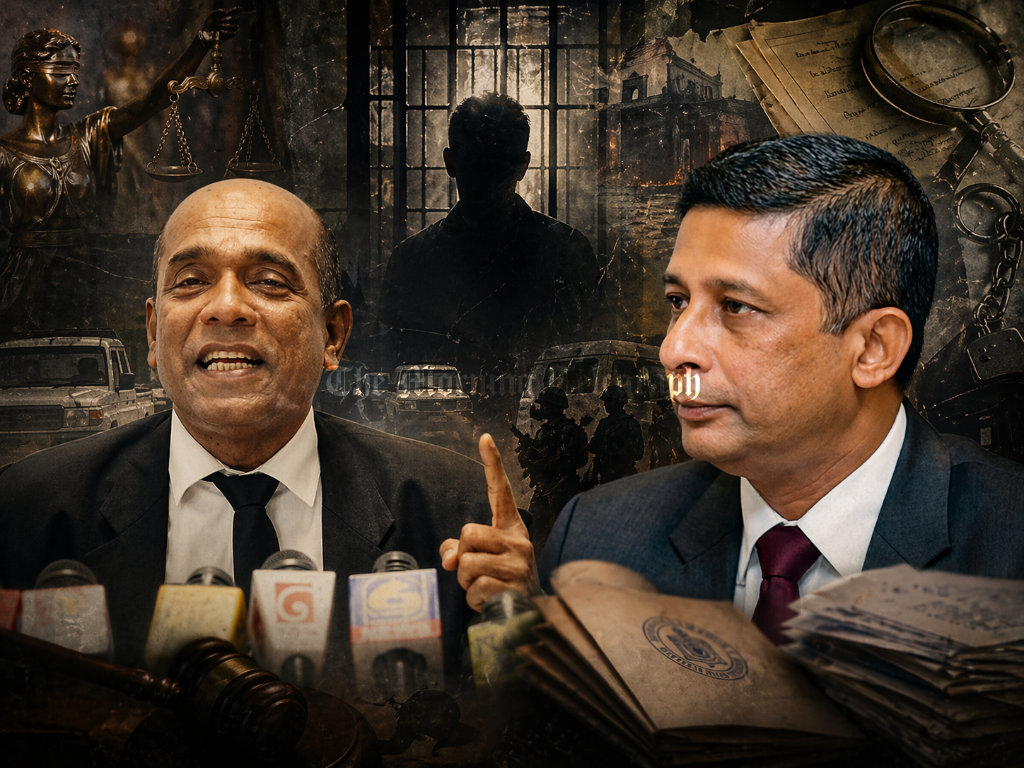
“General Suresh Sallay was not arrested on the basis of an arrest warrant issued by the court… the arrest of General Suresh Sallay was carried out without the knowledge of the court or the esteemed judges. Under what and by whom? That is what is extremely important,” said Attorney-at-Law Sanjeeva Weerawickrama, framing the central controversy surrounding the arrest and detention of the former Director General of the State Intelligence Service. He made these remarks during a recent press conference in Colombo.

He continued by stressing the absence of judicial procedure at the initial stage of the arrest. “The court had never stated that General Suresh Sallay should be made a suspect in any case. The court had never issued a notice, summons or warrant to General Suresh Sallay and asked him to appear at the police station or the court for investigation.” In this context, he argued that the arrest did not arise from standard criminal procedure. “Before taking General Suresh Sallay into custody, no proper judicial direction had been issued, and yet he was deprived of liberty,” he stated, questioning both legality and authority.
Turning to the legal framework, he said, “General Suresh Sallay is being arrested under the Prevention of Terrorism Act. The officer operating under that act is the Commander-in-Chief of the Armed Forces.” He identified the authority directly. “The current Commander-in-Chief of the Armed Forces is the President His Excellency Anura Kumara Dissanayake. So we must remember that General Suresh Sallay was arrested at the request of the President His Excellency Anura Kumara Dissanayake.” He added clarity to the chain of command. “The order to arrest and detain him was issued by the Minister of Defence… under Section 92 of the Prevention of Terrorism Act.”
Weerawickrama repeatedly raised the issue of who determined the necessity of detention. “Then, who decided that there were sufficient grounds to arrest and detain him? That was decided by the Defence Minister.” He extended the argument to detention conditions. “He will not be detained in a prison as an ordinary prisoner. Instead, he is being detained in a very small room under the Criminal Investigation Department under extremely difficult conditions. That was also decided by the Defence Minister.” He highlighted that even the place of detention was specified in the order. “Section 92 of his own detention order states that he should be detained in that place.”
Addressing public discourse, he recalled earlier criticism of the same law. “When you arrested organizations and activists in the past, you raised a big voice. The Prevention of Terrorism Act is a draconian law… this law should be abolished.” He framed the present case as a turning point. “Now I would like to remind you that a very good test case has come up in Sri Lanka. You can all learn whether this action was right or wrong… whether the arrest under the Prevention of Terrorism Act is right or wrong.”
He explained the expected judicial process following an arrest. “Only if a police officer presents sufficient facts does an honorable judge sign an arrest warrant. The judge does not make arrests. Only for a request.” He questioned whether those standards were followed. “We are asking whether there were facts that justified this arrest.”
Further, he described procedural requirements after detention. “After an arrest is made, the police officers shall produce him before the High Court for his detention and obtain an order from the High Court. That order shall be obtained at the same time. A summary of evidence shall be produced.” He emphasized evidentiary justification. “We request permission to take him into custody according to the evidence collected so far.” He then questioned the likelihood of approval. “When no clear facts have been revealed, will an ordinary judge allow him to be detained? I believe he will never be allowed.”
He reiterated the legal timeline. “After a person has been arrested and detained, when the person is presented before the Magistrate before 24 hours have elapsed, we should inform the Honorable Judge about the situation before the arrest… what is the status of the investigation after the arrest… what is the evidence… on what grounds are we requesting further detention.” He referred to the scheduled hearing. “General Suresh Sallay supposed to be presented to the court on April 22nd (today).” He demanded clarity. “Why was he arrested? What facts were found after his arrest? If he should be further remanded… then present on what grounds. Otherwise, the detention will be an illegal detention.”
Weerawickrama placed the issue within constitutional principles. “Sri Lanka is a republic. Sri Lanka is not a monarchy. The law of a republic is that everyone is subject to the law.” He contrasted past powers with current limitations. “There were presidents with very high executive powers… but don’t forget that the current president is a president after the 19th and 21st Amendments. A president subject to the law.” He insisted on accountability. “We are asking… why this President arrested General Suresh Sallay? Why did he decide to detain him? Why did he sign the order? And why did he decide to detain him for such a long time? This President must come forward and answer the questions before the court.”
Turning to investigations into the Easter Sunday attacks, he outlined prior inquiries. “There were presidential commissions. There were special committees appointed by the President. The FBI investigated. The Indian authorities investigated. Intelligence agencies in England and Australia conducted investigations.” He pointed to their findings. “Through which investigation was it revealed that General Suresh Sallay was involved in any Easter attack incident? We are saying that his name was not mentioned anywhere.”
He contrasted pre-arrest and post-arrest narratives. “By the day of his arrest, no information had been reported about the General.” He noted new claims after detention. “Two weeks later, a report was submitted and mentioned three things.” He challenged one allegation. “They claimed that the bomber who went to detonate the bomb in Katuwapitiya had been given the location by General Suresh Sallay. We said that was a complete lie.”
He referred to investigative findings. “There is a long description of how that person went to the place where the bomb was detonated. If you see it, you will understand the nature of the plan.” He pointed to operational networks. “Twenty safe houses have been used throughout Sri Lanka… now the people of this country should remember why such a large number of these extremist terrorists have so many safe houses.” He questioned the purpose. “Why were there safe houses in multiple areas? They must have been used to detonate bombs.”
Discussing forensic investigations, he noted DNA analysis. “The DNA of Sarah Jasmine was examined on three occasions,” he said, explaining the need for certainty. “To ensure certainty, this previous DNA investigation was conducted.” He rejected criticism. “Who says that the investigation was wrong? If two investigations were being carried out with faults, it means the order given to conduct the third one was correct to establish certainty.”
He also highlighted contradictions. “What is interesting here is the contradiction in the CID’s statements on the DNA tests. On one hand, it is said that Sara Jasmine is dead. On the other hand, it is said that she has been taken away. Can one institution hold two such opinions at the same time?” He questioned legal consistency. “Isn’t that a contradiction? Can you hold two such positions before the law?”
He referred to witness testimony. “Abdul Aziz Rumi recorded his statement… he says that he spoke to a military officer.” He clarified the implication. “People who work in intelligence speak to military officers. That is a normal process.” He concluded, “It is very clear that it was not General Suresh Sallay.”
He criticized the basis of the case. “You are starting this case in a very strange way… according to a request to investigate a program broadcast by Channel Four.” He noted previous arrests. “You have arrested two people. This is the third one.” He mentioned another detainee. “Mr. Pillayan was taken into custody and kept under Section 92… for a year.” He questioned outcomes. “Not a single word about the Easter Sunday attack was said in court.”
He continued questioning the narrative. “Now are you saying that General Suresh Sallay can be linked to this Channel Four story? What kind of situation is this?” He urged scrutiny. “The intelligent people of this country need to understand this.”
Turning to international findings, he highlighted another aspect. “Three people have been indicted in the United States.” He emphasized leadership roles. “Mohammad Naufer was identified as the mastermind.” He added, “It is stated that 45 people were trained to commit suicide.” He raised a key question. “Who is the intelligence officer who calls General Suresh Sallay instead of investigating these individuals?”
He described ideological preparation. “There was a very clear religious teaching before the attack… training… methods to detonate… people’s minds were prepared to the point of committing suicide.” He emphasized the real issue. “Shouldn’t the government investigate those extremist attempts to make our country safe?”
Finally, he returned to the individual at the center of the case. “General Suresh Sallay is an army officer who has been trained to be honest for the state, respect the law, stand up for the truth, and give his life for justice.” He ended with a strong assertion. “General Suresh Sallay is not a person who tells lies for personal goals. He is not a person who suppresses justice. Even if you detain him for months or years, the truth will remain.”