
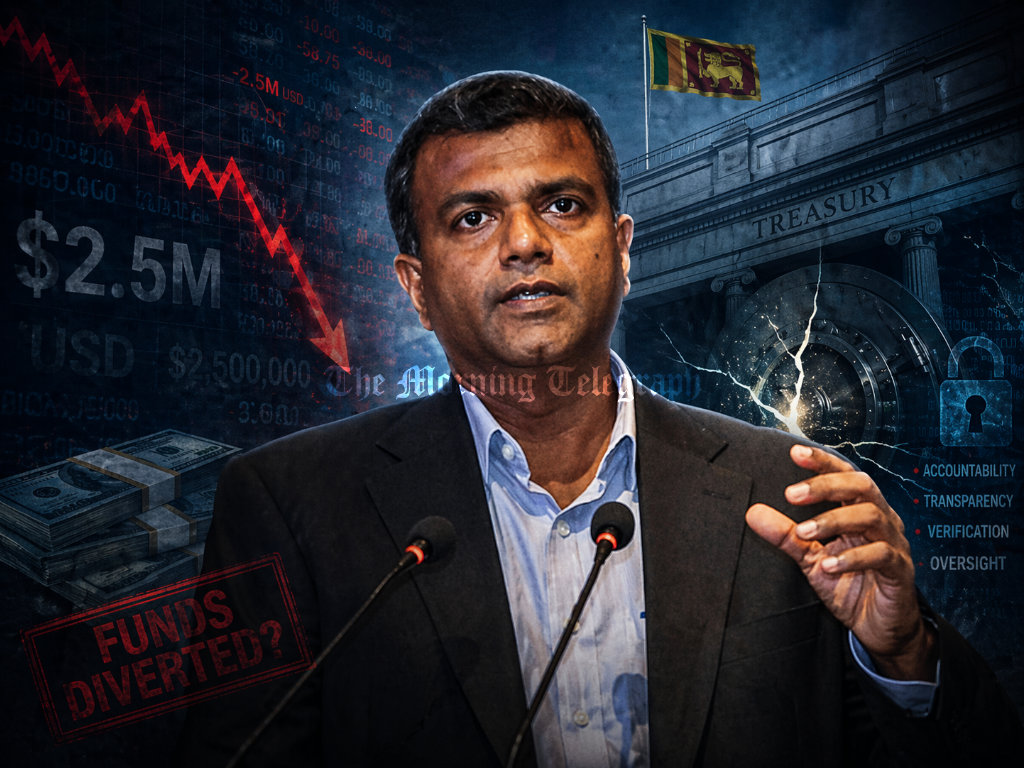
A deepening financial scandal raises urgent questions about accountability, governance failure, and whether Sri Lanka’s promise of clean administration is collapsing under pressure.
The allegation that USD 2.5 million in public funds may have been diverted into the hands of cybercriminals is not just another passing controversy; it represents a defining moment that cuts to the core of how a state understands responsibility, competence, and truth. When a government that rose to power promising discipline, integrity, and a clean break from past failures finds itself unable to clearly explain whether millions of dollars have disappeared from the Treasury, the issue ceases to be technical and becomes unmistakably political. The silence, hesitation, and reliance on a single communication as the basis for public explanation suggest not caution, but confusion. At this level of governance, such uncertainty is not a minor flaw; it signals a systemic breakdown in financial oversight.

What stands out is not merely the seriousness of the allegation, but the government’s inability to present a coherent and consistent position. Nalinda Jayatissa has alternated between acknowledging reports and insisting that there is no verified information beyond what was communicated by Maithri Gunaratna. This is not how a functioning public finance system responds to a potential breach of this magnitude. A Treasury does not need external prompts to determine whether a payment has been made, where it was sent, and whether it reached its intended destination. These are traceable financial transactions, not abstract uncertainties. The fact that the government appears to be discovering its own financial reality through outside disclosures is itself a troubling reflection of institutional weakness.
At the center of this unfolding situation is Harshana Suriyapperuma, a figure who moved from political office to one of the most powerful bureaucratic roles within the country’s financial system. A minister turned Finance Secretary cannot retreat into silence or procedural delay when confronted with such a serious issue. This is not a distant administrative oversight; it is a direct test of his authority, competence, and control over the Treasury. If millions can be transferred or potentially lost without immediate clarity from the institution he oversees, then the failure is not abstract. It becomes personal, institutional, and impossible to ignore.
The broader concern is that this episode is beginning to expose a widening gap between the promises of a corruption-free administration and the lived reality of governance. During the election campaign, the language was clear and uncompromising. There would be accountability, professionalism, and an end to the negligence that had weakened public institutions. Yet today, the public is confronted with a situation where millions of dollars may have been misdirected, and the very institutions tasked with safeguarding public finances appear uncertain about what has taken place. The rhetoric of reform now risks sounding hollow, not because reform is unattainable, but because current events contradict the narrative.
This situation cannot be reduced to a conventional corruption story alone. Even if no individual has directly benefited, the incident points to something equally dangerous, gross negligence. If a payment was diverted due to fraudulent instructions or a failure in verification protocols, then it reflects a breakdown in the most basic safeguards of public finance. Governments do not lose money by accident; such failures occur when systems fail, procedures are ignored, or those in authority lack the capacity to identify and prevent risk. Whether this was a cyberattack, a clerical lapse, or something more complex, the responsibility cannot be diluted. It rests with those entrusted to manage the state’s financial machinery, and at the highest point of that structure stands Harshana Suriyapperuma.
The timing only intensifies the seriousness of the issue. Just days after attempts to defend mismanagement in the energy sector, the Minister of Energy stepped down alongside his secretary, signaling that accountability should follow failure. That moment was expected to restore confidence and demonstrate a willingness to act decisively when governance falters. Instead, the country now faces an even more alarming development, one that strikes at the heart of fiscal credibility. If accountability in the energy sector was presented as a corrective step, this new financial controversy raises an unavoidable question about whether such accountability will extend to the financial core of the state.
In this context, the role of the Finance Secretary becomes impossible to overlook. This is not a ceremonial position; it is a critical function within the state apparatus, responsible for overseeing the integrity of public expenditure and financial systems. When such a significant lapse occurs under his watch, the issue is not simply whether an explanation can be offered, but whether he can continue to hold office with credibility. A failure of understanding is not an excuse; it is itself evidence of unfitness for the role. At this level, incompetence and negligence become indistinguishable, and negligence with public funds amounts to a serious breach of public trust.
The risks extend beyond the immediate financial loss. The precedent set by this episode could have lasting consequences. If a government responds to a potential multi-million-dollar financial breach with uncertainty and delay, it raises deeper concerns about the security of larger transactions, international obligations, and the broader economic framework. Sri Lanka remains in a fragile recovery phase, dependent on the confidence of lenders, investors, and global institutions. Incidents of this nature, particularly if mishandled, do not remain isolated. They ripple outward, affecting negotiations, investor sentiment, and the country’s standing within the global financial system. In such a context, a Finance Secretary unable to command confidence becomes a liability the country cannot afford.
There is also a deeper issue of political culture at play. Governments often campaign on ideals that are easy to articulate but difficult to sustain in practice. The promise of being corruption-free carries weight, but it also establishes a higher standard by which actions are judged. When failures occur under such a banner, they are not dismissed as routine lapses; they are seen as contradictions. The current situation reflects a familiar pattern in Sri Lankan politics, where each new administration defines itself against the failures of its predecessors, only to encounter its own limitations once in power. Harshana Suriyapperuma, as both a former political figure and a current senior bureaucrat, embodies this tension more than most.
The path forward is not complex, but it demands decisiveness. The Ministry of Finance must provide a clear, verifiable account of what happened, when it happened, and how it happened. If there has been a breach, it must be acknowledged without hesitation. If negligence has occurred, those responsible must be held accountable, regardless of their position. If systemic weaknesses have been exposed, they must be addressed with urgency and transparency. Beyond explanations, this moment calls for accountability at the highest level. When trust collapses at the center of financial governance, explanations alone cannot restore it.
Ultimately, this is a test not only of administrative competence but of political integrity. It will reveal whether the ideals that brought this government to power are reflected in its actions, or whether they remain persuasive narratives disconnected from reality. The public does not demand perfection, but it does expect honesty, clarity, and responsibility. When millions of dollars of public funds are at stake, anything less is unacceptable. And when such a failure occurs under the direct watch of the Finance Secretary, the conclusion becomes unavoidable: accountability must be real, and it must begin at the top.



If we reduce this to just a “hacking incident,” we risk missing the real issue.
A USD 2.5 million payment is not a casual transaction — it goes through a structured, multi-layered verification process.
So if there is uncertainty about whether it reached the correct destination, that is not merely a transaction error — it is a control failure.
As highlighted in the analysis , the deeper concern is the apparent lack of clarity within the system itself. That points less to a technical glitch and more to an institutional weakness.
From a governance perspective, the principle is simple:
👉 In any public finance system, a payment must be immediately traceable — when it was made, where it was sent, and whether it reached the intended recipient.
If that basic clarity is missing, then:
either procedures failed,
or controls were bypassed,
or oversight is weak.
In any case, “we don’t yet know” is not an acceptable position at this level.
Bottom line:
This is not just about proving whether money was stolen.
It is about proving whether the system itself is reliable.
Because trust is not lost only when money disappears —
👉 it is lost when the system cannot confidently track its own money.