SriLankan Airlines hid Airbus A330-200 lease costs as commercial secrets. RTI Commission orders disclosure of USD 26.6 million deal.
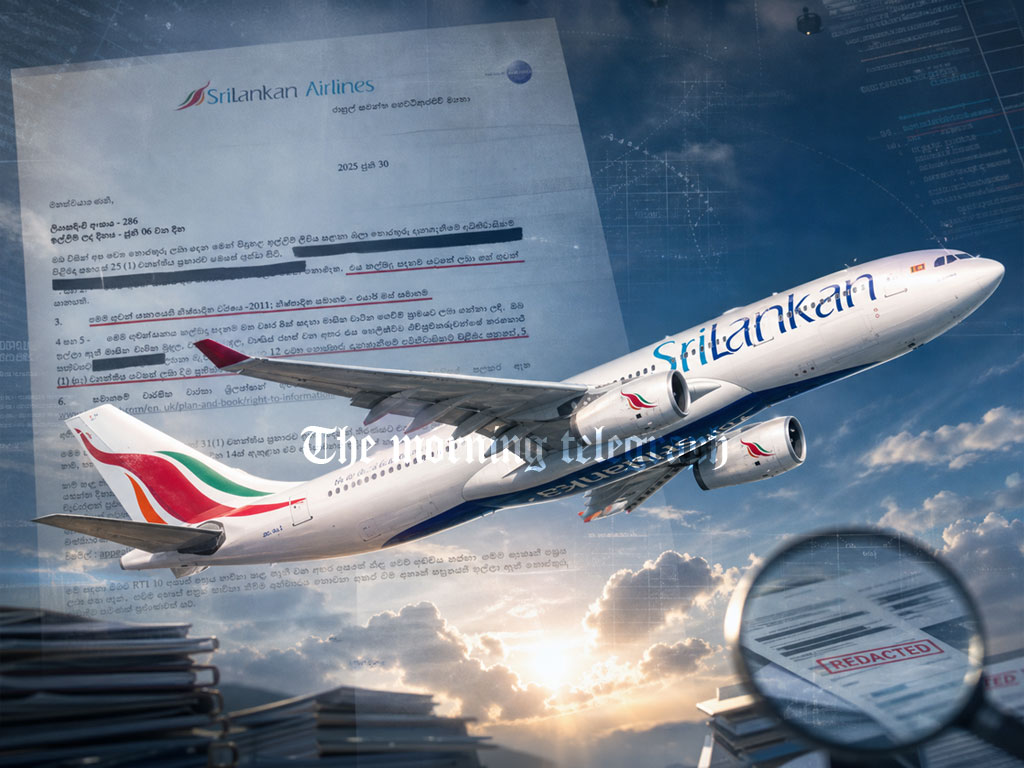
The financial details of the transaction to acquire the Airbus A330-200 aircraft (4R-ALT) brought in under the current government, which SriLankan Airlines had tried to conceal from the public for months citing commercial secrets, have now been revealed. According to information provided by SriLankan Airlines following a crucial order by the Right to Information Commission (RTIC), this transaction is not a purchase but an Operating Lease agreement for a period of 8 years.
According to this confidential agreement, the first monthly installment payable by SriLankan Airlines for the aircraft is USD 275,000. Signed to be in effect from June 2025 to June 2033, the annual lease cost of this agreement is USD 3,300,000. Accordingly, at the end of the full 8-year lease period, the national carrier will be obligated to pay approximately USD 26.6 million (USD 26,675,000) for this single aircraft.

Hidden Behind the Commercial Secrecy Claim
An information request was submitted on June 6, 2025, seeking details about the newly acquired Airbus A330-200 aircraft by SriLankan Airlines, which has been facing a severe financial crisis. The request sought details under six questions regarding the total value of the transaction, the institution from which the aircraft was obtained, the year of manufacture, and lease installment details. While the public authority, SriLankan Airlines, provided information for items 1, 2, 3, and 6 of the request, it refused to provide the lease information under items 4 and 5.
However, by a letter dated June 30, 2025, issued under registration number 286, SriLankan Airlines refused to provide the relevant information. They based this on Section 5(1)(d) of the Right to Information Act. According to that section, if disclosing certain information would harm the commercial interests or competitiveness of the relevant parties, that information may be withheld. This raises concerns about what truth lies behind considering financial data of an institution maintained for years with public tax revenue as confidential.
How the RTI Commission Stepped In
After the appeal to the designated officer of the public authority was also disregarded, the appellant appealed to the Information Commission. The appeal was heard under Appeal No: RTIC APP/No: 1061/2025. At this stage, SriLankan Airlines’ position was that disclosing lease agreement conditions would harm their competitiveness in the global market and the trust they maintain with suppliers.
However, the key issue before the Commission was Public Interest. According to Section 5(4) of the Act, if the public interest served by disclosing certain information outweighs the harm caused by such disclosure, that information must be provided. During the appeal hearing on January 21, 2026, the Commission ordered SriLankan Airlines to submit a sealed copy of the relevant lease agreement to examine whether it includes a clause preventing the release of third party information.
What happens next could be critical for transparency. All financial transactions of a state-owned enterprise (SOE) like SriLankan Airlines ultimately involve public funds. The appellant pointed out that assessing the commercial viability and fairness of a transaction of a loss-making institution is a fundamental public need. It was also pointed out that the public authority had not presented sufficient evidence to prove that disclosing specific costs would harm the taxpayer’s market competitiveness.
The Landmark Order That Broke the Wall
After considering the submissions of both parties, on March 5, 2026, the Information Commission issued a crucial order, directing the public authority to provide the information to the requester within 30 days. The Right to Information Commission rejected the airline’s argument, emphasizing the following: Only matters protected under the Intellectual Property Act No. 36 of 2003 can be considered commercial secrets. Lease rates and schedules are bilateral agreements tied to public funds. Furthermore, the Commission observed under Section 5(4) that the public interest served by disclosing the information outweighs the harm.
This order, obtained after a lengthy nine-month legal battle, is considered a citizen’s victory that broke down the wall of confidentiality in state institutions. Accordingly, the information was revealed based on details provided by SriLankan Airlines dated March 30, 2026.
What the Numbers Reveal About Public Funds
According to the revealed information, the aircraft was manufactured in 2011. Economic questions now arise regarding agreeing to pay USD 3.3 million per year for a 14-year-old aircraft.
Aircraft Type: Airbus A330-200 (Wide-body)
Year of Manufacture: 2011
Nature of Transaction: 08-year Operating Lease
Monthly Lease: USD 275,000
Annual Lease: USD 3,300,000
Total Cost (8 years): USD 26,675,000
This Airbus deal reveals the attempt by state institutions to conceal their decisions from public scrutiny under the label of commercial secrets. This order by the Information Commission is an important precedent obtained to dispel doubts about secretive transactions and to rebuild public trust in state institutions. However, questions remain about how many similar deals remain hidden behind similar confidentiality claims.