By Marlon Dale Ferreira
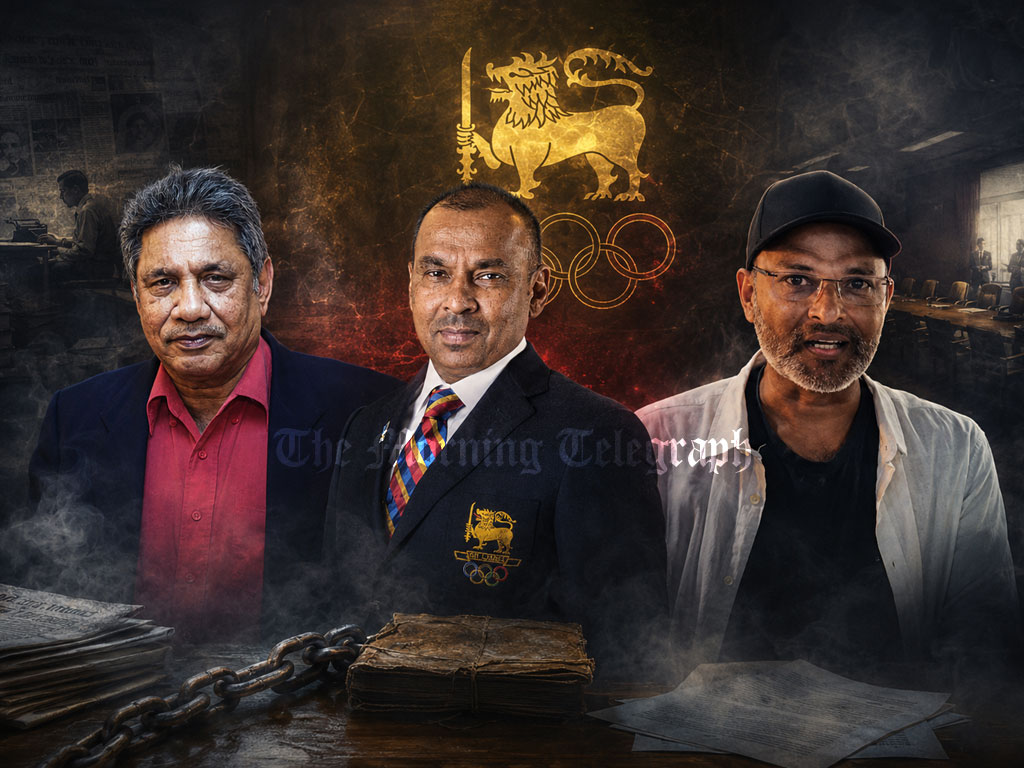
The Sunday Leader, once a fearless newspaper shaped by the legacy of slain editor Lasantha Wickrematunge and later carried forward by journalists such as Frederica Jansz, is back in the spotlight after its former seller and buyer resurfaced inside the National Olympic Committee of Sri Lanka, while an old unpaid journalist’s dues remain unresolved.
In a remarkable twist of fate, the seller and buyer of the now-defunct newspaper The Sunday Leader have once again found themselves operating within the same institutional space, this time inside the National Olympic Committee of Sri Lanka.
The irony is difficult to ignore.
Lal Wickrematunge, the brother of slain Sunday Leader editor Lasantha Wickrematunge, was recruited some time back as General Manager of the NOCSL. Meanwhile, Asanga Seneviratne, the businessman who later purchased The Sunday Leader, was recently elected President of the National Olympic Committee of Sri Lanka at the elections held on 25 April 2025, under circumstances that have been widely viewed as controversial and reportedly backed by powerful government influence.

That has now placed both men, once connected through the sale and eventual demise of one of Sri Lanka’s most fearless newspapers, within the same Olympic administrative structure.
The Sunday Leader was once remembered as a newspaper that challenged power without fear, especially under the editorship of Lasantha Wickrematunge, who was assassinated in broad daylight in January 2009, leaving the entire nation in shock.
The newspaper was also home to Frederica Jansz, another popular and fearless journalist who became widely known for her hard-hitting reporting on the ruling Rajapaksa establishment. Jansz, who took over the editorial mantle after Lasantha Wickrematunge’s assassination, continued the newspaper’s confrontational style of journalism and exposed the regime with relentless scrutiny. But she too eventually fled to the United States with her two young sons after reportedly receiving death threats and fearing for her life and the safety of her children.
Years later, Lal Wickrematunge sold the publication to Asanga Seneviratne, a businessman often described by critics as closely aligned with the former Mahinda Rajapaksa-led Pohottuwa establishment. Following that sale, the newspaper was eventually shut down.
But while the former seller and buyer have now resurfaced as working associates within the NOCSL, an old and uncomfortable matter connected to The Sunday Leader remains unresolved.
Popular journalist Uvindu Kurukulasuriya, a close media colleague of the late Lasantha Wickrematunge, who later left for the United Kingdom after allegedly receiving death threats, was reportedly owed Rs. 125,000 by The Sunday Leader since January 2013.
Email correspondence seen by this writer shows repeated attempts to recover the outstanding payment on Kurukulasuriya’s behalf. In one email, Kurukulasuriya stated that he had been waiting nearly one year for the Rs. 125,000 and requested that the money be paid to Ravaya newspaper, saying he had promised to donate the amount there. The correspondence also shows Lal Wickrematunge replying, “I will talk to him again Uvindu.”
The correspondence further shows that this writer later intervened by forwarding the matter to Asanga Seneviratne and then to Nalin Jayetileke, then listed as Director/Chief Executive Officer of Leader Publications (Pvt) Ltd. In an email dated 28 August 2015, Jayetileke acknowledged the matter and stated that he would arrange payment by mid-September, citing “liquidity issues” and saying he would at least arrange payment in instalments.
However, despite that written assurance, the payment appears to have remained unresolved. In a later email dated 9 February 2016, this writer informed Jayetileke, while copying Kurukulasuriya, that the Rs. 125,000 dues owed to him by The Sunday Leader had still not been received and asked why the payment had not been made despite the earlier promise.
For a businessman of Seneviratne’s scale, critics may argue that Rs. 125,000 was hardly an impossible sum. Yet for a journalist who had earned it, and who had even intended to redirect the money to another publication, the unpaid amount carried moral weight beyond its financial value.
That is what makes this story more than a forgotten payroll dispute.
It is about the afterlife of a newspaper that once stood for accountability. It is about Lasantha Wickrematunge’s murder. It is about Frederica Jansz fleeing with her children after threats. It is about journalists who paid a price for challenging power. It is also about the unresolved debts left behind after a once-powerful publication was sold, weakened, and eventually silenced.
And now, with Lal Wickrematunge serving as General Manager and Asanga Seneviratne occupying the presidency of the NOCSL, it is also about the uncomfortable optics of old newspaper ghosts reappearing inside one of Sri Lanka’s most powerful sporting institutions.
The Sunday Leader may no longer be on the newsstands.
But its ghosts, its unpaid debts, and its unanswered questions have clearly not disappeared.