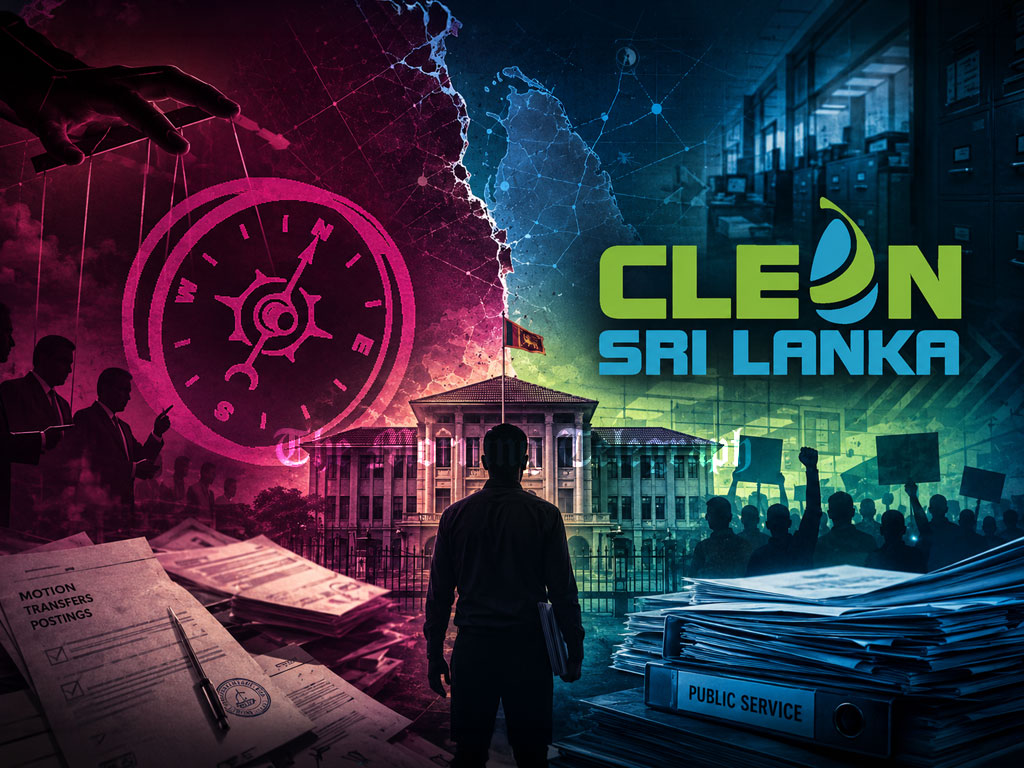
Clean Sri Lanka controversy deepens as SLADA warns divisional secretariat appointments could threaten public service independence.
Clean Sri Lanka has become the centre of a growing political storm after a government move to assign programme representatives to Divisional Secretariats across the country triggered strong resistance from public administrators and the Opposition.
Old habits, it is often said, die hard.
The Sri Lanka Association of Divisional Secretaries and Assistant Divisional Secretaries, known as SLADA, has written to the Secretary to the President urging the government to withdraw the decision. The association has warned that the proposed appointments could seriously undermine the independence of the public service.

Opposition Leader Sajith Premadasa has also strongly objected to the government’s plan to assign several JVP cadres to Divisional Secretariats as Clean Sri Lanka coordinators. Speaking to the media yesterday, Premadasa alleged that the JVP was attempting to infiltrate the state service and said the Opposition would resist the move “tooth and nail.”
SLADA has argued that Sri Lanka already has a long-established administrative system to ensure effective public service delivery. This framework runs from ministries, departments, provincial councils, district and divisional secretariats, down to Grama Niladhari divisions.
The association has pointed out that the existing system is supported by internal audit units, the National Audit Office, and coordination committees operating at divisional, district, and national levels. These bodies already oversee, monitor, and review the implementation of public programmes.
While acknowledging that there may have been isolated cases of politically influenced conduct by a small number of officials, SLADA has stressed that the broader administrative structure has functioned as an independent and professional system. It has insisted that this independence must not be compromised.
The decision to appoint Clean Sri Lanka representatives to Divisional Secretariats must also be viewed against the wider backdrop of the JVP’s political strategy to expand influence within state structures. In some quarters, this has been described as an attempt to create conditions for a parallel state.
JVP stalwart K. D. Lalkantha created controversy in 2024 when he claimed that, under a JVP-NPP government, legislative and judicial powers would be devolved to villages.
The JVP/NPP appears to be working according to a plan to expand its power base through Constituency Councils, or Kottasha Sabha. These structures remind many observers of the Citizen Committees, also known as Janatha Committees, established by the SLFP-led United Front government from 1970 to 1977.
Those committees were introduced, at least officially, to bring administration closer to the people. They were set up in government departments, public corporations, and local administrative units to monitor state administration, advise public officers, help eliminate corruption, reduce delays and waste, encourage public participation in governance, and assist the implementation of development initiatives.
In reality, however, they became highly politicised. Their members undermined the authority of state officials, clashed with administrators and trade unions, and eventually became little more than appendages of the government.
They also contributed to the downfall of the United Front government. The JVP/NPP now appears to be repeating that disastrous experiment.
Old habits are said to die hard. The JVP is now accused of using the Clean Sri Lanka programme to enter vital state institutions and arrogate to itself the powers of the state, instead of exercising them through the NPP government within its elected five-year mandate.
This is something the party failed to achieve through extra-parliamentary means for nearly six decades.
Speaking at a recent May Day rally, JVP General Secretary Tilvin Silva said the JVP-led government would remain in power indefinitely. Some other JVP senior figures have also said they would not let go of power. Given the JVP’s violent past, such statements cannot be brushed aside as mere political rhetoric.
It is possible that, in an attempt to perpetuate its grip on power, the JVP is trying to emulate the Soviet model by setting up party cells inside state institutions, similar to those created by the Communist Party in the USSR to function as its “eyes and ears.”
The Soviet system operated on the principle that the party was the “leading and guiding force” of society. Reports suggest that by the late Soviet period, there were hundreds of thousands of such primary organisations covering almost every sphere of public life.
Those cells, however, did not survive the collapse of the USSR.
Ordinary people are not favourably disposed toward the state service, which is widely associated with delays, malpractice, and arrogance. There is no doubt that the public service needs a radical shake-up.
But what is required is depoliticisation and revitalisation, not further politicisation.
For that reason, SLADA’s demand that the government revoke its decision to place Clean Sri Lanka representatives inside Divisional Secretariats deserves serious attention. Existing administrative mechanisms should be allowed to handle programme implementation without creating a precedent that could have long-term consequences for the independence of the public service.