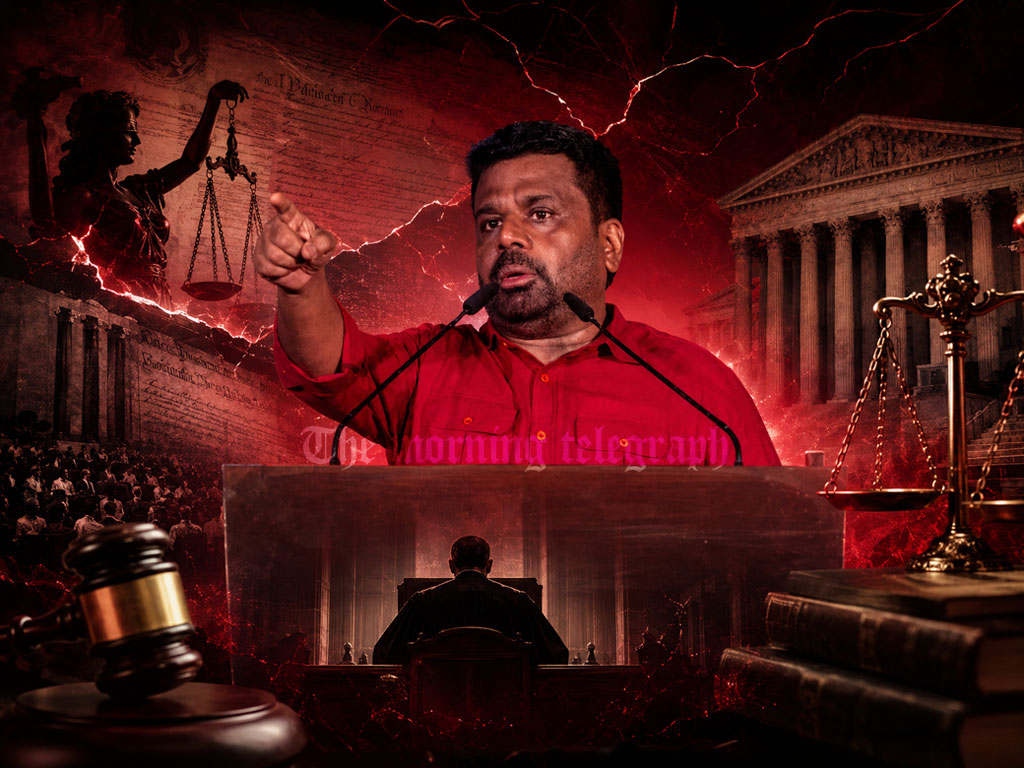
President’s court remarks on pending corruption cases trigger legal backlash over judicial independence and alleged interference.
President’s court remarks at the National People’s Power May Day rally have triggered a major debate over judicial independence and possible interference in pending cases.
The Constitution of Sri Lanka clearly states that improper interference in judicial proceedings is an offence.
A statement made by President Anura Kumara Dissanayake during his speech at the National People’s Power May Day rally in Maharagama on May 1 has now become the centre of intense political and legal controversy.
“They are hearing cases quickly. Just for this May month alone, I have seen 15 cases against major corrupt politicians, including 10 major corruption cases and 5 criminal cases, scheduled before the courts this May. One was heard yesterday on April 30. They said the verdict will be given on May 25. A case was heard yesterday. The verdict is on May 25. Wait and be ready to clap,” President Anura Kumara Dissanayake said.
The President further stated that court proceedings are now being conducted swiftly.
The remark has since drawn various responses in Parliament, with the opposition requesting the Speaker to adjourn the House for a debate on the President’s speech.

‘This Is a Very Bad Situation’
Attorney and Member of Parliament Ajith P. Perera said the President’s statement regarding court verdicts undermines the constitutional principle that the executive, the legislature, and the judiciary must remain separate and independent.
“What happened there was that he told his supporters to wait and clap on the 25th when the verdict is given in the case heard on the 30th. This shows that the President knows whether the accused in the case is guilty or not. Telling his supporters to clap implies that an opposition politician is about to be convicted. The direct implication is that the President has prior knowledge of the judge’s decision. Either the judge has informed the President, or the President and the judge have conspired on the verdict. This is a very bad situation.”
Perera said the Constitution provides for the separation of the judiciary, legislature, and executive as three distinct institutions.
He stressed that one institution is not subordinate to another.
“If the executive is interfering in judicial matters, influencing the decisions of honourable judges and trying to convict their opponents, if the judge and the President are discussing the verdict before it is delivered, that is definitely interference in judicial affairs. That is a massive blow to the independence of the judiciary,” he added.
‘The President’s Statement Must Be Condemned’
Attorney Nuwan Bopage also said the President’s statement regarding court verdicts, especially as head of the executive, must be condemned.
“First of all, the President’s statement as the head of the executive must be condemned. The government has promoted a narrative that they will punish wrongdoers and eliminate fraud and corruption. That narrative is a good thing. But if they are trying to manipulate the judiciary’s mindset to convict anyone for the sake of that narrative, I think that is wrong. That is not justice.”
Bopage said the government’s role should be limited to providing the necessary infrastructure to strengthen and accelerate the judicial process.
He warned that influencing judges to speed up trials or deliver verdicts in line with political expectations would be unacceptable.
“If they are politically interfering by pressuring judges, hinting at promotions, to obtain a desired verdict, that is wrong. There are indications that such a situation exists on the ground. We believe that the President’s speech itself reflected the reality of that decision-making structure. That is not suitable for a just and fair society. A new situation has been created where benches are appointed and verdicts are pressured in line with the government’s popular mood. There are certain indications. We must oppose that.”
‘Leave Verdicts to the Judiciary’ – Law and Society Trust
Sandun Thudugala, Director of Programs and Operations at the Law and Society Trust, said decisions on court cases and verdicts must be left entirely to the judiciary.
“My clear opinion is that cases and their verdicts should be entirely judicial decisions. There should be no political interference. The people gave this government a mandate to enforce the law accordingly. If the government appears to be interfering, there is an issue of legitimacy regarding the decisions made. The better course is for the government to ensure that judicial decisions and the judicial process are handled by the judiciary and to grant the judiciary the necessary independence.”
He further said the government’s interest in verdicts involving opposition politicians must also apply to cases involving politicians of the current government who face allegations.
According to Thudugala, the same standard should be maintained across all political lines if public confidence in justice is to be protected.
‘These Cases Are Not Heard by the NPP Government or the Justice Minister’ – Justice Minister
Meanwhile, speaking at a May Day rally, Justice Minister and Attorney Harshana Nanayakkara revealed details, including case numbers, of several cases scheduled to be heard against certain politicians.
However, he insisted that “those cases are not heard by the National People’s Power or the Justice Minister.”
He said the cases are handled by an independent judiciary.
“Remember, these cases are not heard by the National People’s Power government or the Justice Minister. These cases are heard by the independent judiciary. They function independently without any influence. Verdicts are due… Don’t ask me now what will happen to those cases. We are not the ones who will deliver the verdict. The verdict will be given by the court. But remember the promise we made? Remember that our comrade Anura promised that under our government, every fraudster and every corrupt individual would be brought before the court and cases would be heard. We made that promise. And we kept it.”
BBC Sinhala also attempted to obtain comments from several government representatives regarding the President’s statement.
Attorney Upul Kumarapperuma said he could not comment because he was not present at the location where the President made the speech.
Deputy Minister of Public Security Sunil Watagala was contacted by telephone and the question was presented to him. He responded by saying, “just a moment, wait a bit,” before disconnecting the call.
Further attempts were made to contact him again by telephone after a short while, but he had not responded by the time the article was published.
Response of the Bar Association of Sri Lanka
The Bar Association of Sri Lanka also issued a strong response to the President’s statement in a release dated May 5.
The Bar Association stated that the President’s remarks appeared to suggest interference in the judiciary.
It further warned that such remarks could undermine public confidence in the judicial system.
The response has added further weight to the growing legal and political debate over whether the President’s statement crossed a constitutional boundary.
Article 111A of the Constitution
The Constitution of Sri Lanka states that improper interference in judicial matters is an offence.
Accordingly, the Constitution states that “every judge, every presiding officer, every public officer and every other person shall, in the exercise of their powers and the performance of their duties, be subject only to the command or interference of a superior court, judicial authority, institution or other person entitled by law to command or interfere, and not to the command or interference of any other person.”
This constitutional provision has now become central to the debate over the President’s remarks.
Legal commentators and opposition politicians argue that public statements by the head of the executive about pending court verdicts can create the appearance of pressure on the judiciary, even if no direct interference has occurred.
What Is the Case the President Hinted At?
The verdict in four cases filed by the Bribery Commission against former Deputy Minister Sharan Gunawardena on charges of corruption is scheduled to be delivered by the Colombo High Court on May 26.
It had earlier been announced that the verdict in these cases would be delivered on April 30.
However, when the case was called on that day, High Court Judge Mohamed Mihail stated that the verdict would instead be delivered on May 26.
Sharan Gunawardena, who is facing charges in these cases, is currently out on bail.
The Bribery Commission filed the four cases against Gunawardena, alleging that while serving as Chairman of the National Lottery Board in 2006, he caused a loss to the government when obtaining vehicles for the Board on a rental basis.
The controversy now surrounding the President’s remarks has therefore raised wider questions about political speeches, pending court verdicts, judicial independence, and the constitutional limits placed on the executive in matters before court.