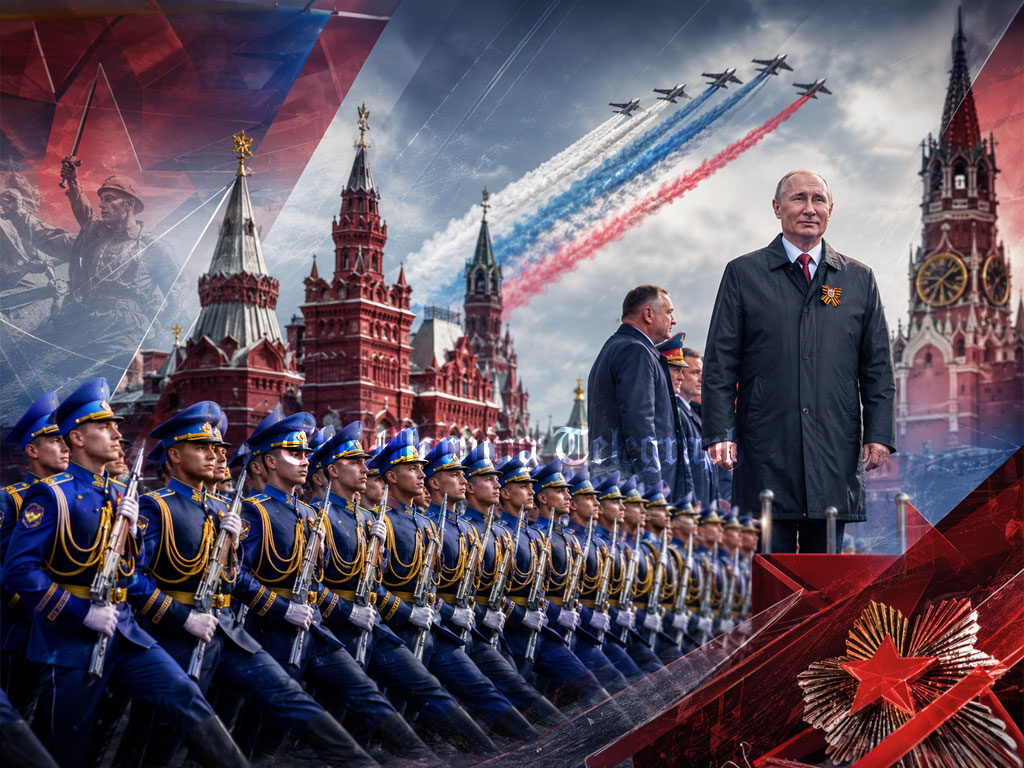
Russia Victory Day commemorations in Moscow honoured Soviet wartime sacrifice as security tightened and military hardware displays were absent.
Russia Victory Day was marked in Moscow on May 9 as the country commemorated the 81st anniversary of the surrender of German Nazi forces and the end of the Second World War.
The annual commemoration was celebrated with great festivity across Russia, but this year’s events in Moscow took place under heavy security. The internet was also partially blocked as the country observed the occasion following an agreement for a short-term ceasefire in the Ukraine conflict, which has dragged on for over five years.
A notable feature of this year’s Victory Day celebration was the absence of the familiar military hardware and equipment usually displayed by Russia to project its military strength. For the first time in two decades, Russia did not showcase such equipment during the event, giving this year’s ceremony a markedly different tone.

Speaking during the traditional Victory Day address at Red Square, President Vladimir Putin said Russia holds the utmost respect for the bravery of Soviet soldiers who sacrificed their lives for victory. He also extended his best wishes to those taking part in the parade.
Victory Day traces its origin to May 8, 1945, when Field Marshal Wilhelm Keitel, the Commander-in-Chief of the Nazi forces, signed the unconditional surrender act. The signing took place at 10:43 pm European time, but by then it was already May 9 in Moscow.
That morning, the Soviet people learned that the war had ended and that the enemy had surrendered. For them, the end of the Second World War was almost unbelievable news after years of suffering, destruction, and sacrifice. The first celebration of victory took place that very day.
For Russians, this remains a war victory won with their very lives.
Nearly 27 million Soviet citizens lost their lives during the war. Although there was quiet joy over the defeat of Nazi forces, the pain of losing loved ones remained deeply rooted in the hearts of Russia’s older generation for decades. Because of that grief, the earliest celebrations marking victory over the Nazi forces were notably restrained.
Victory Day was officially recognised as an annual celebration only 20 years later. In 1965, then Soviet leader Leonid Brezhnev declared May 9 a national holiday in Soviet Russia and also introduced Victory Day military parades.
The tradition of laying wreaths at the Tomb of the Unknown Soldier, built in the Kremlin, also began during Brezhnev’s period of rule.
Although post-Soviet Russia has faced challenges over how to deal with its Soviet legacy, no major challenge has emerged against the country’s commemoration of May 9 as National Victory Day.
As a result, traditional events such as Victory Parades and tributes at the Tomb of the Unknown Soldier continue to be observed in the same manner to this day.