Trump–Xi summit in Beijing could shape trade, Taiwan, Iran diplomacy, AI rivalry and superpower relations for years ahead.
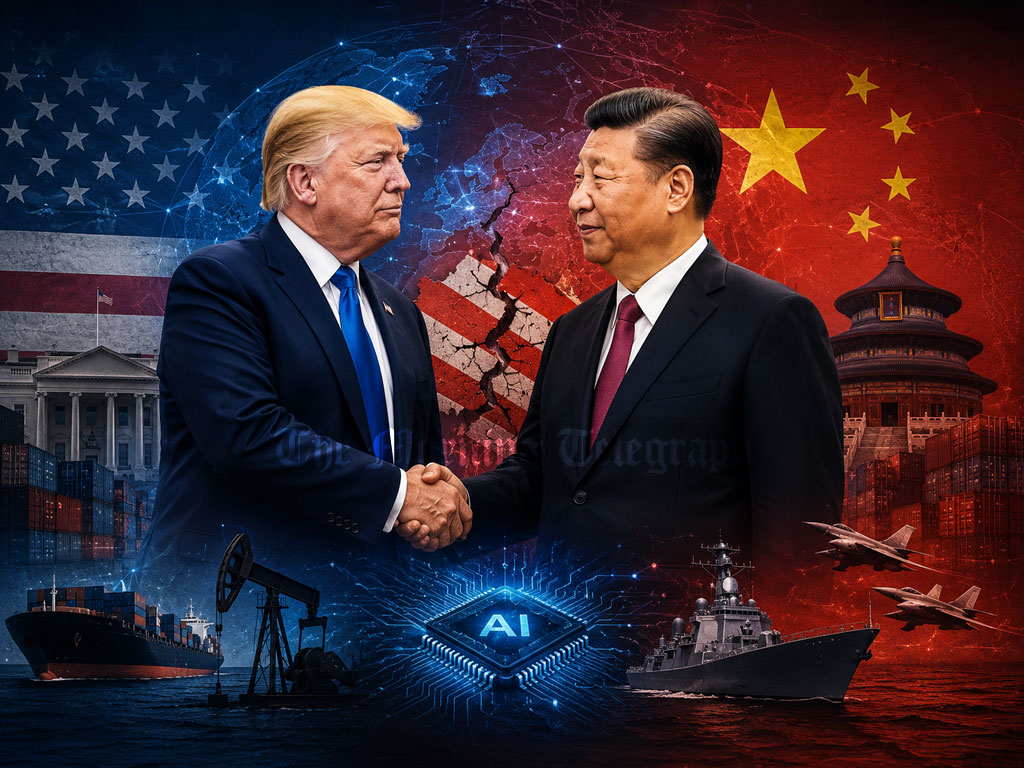
Trump–Xi summit talks in Beijing could become one of the most decisive meetings in years, with global trade, Taiwan tensions, Iran diplomacy and advanced technology competition all hanging over the visit.
As rumours spread about a grand state event and carefully staged ceremonial reception, security around Beijing’s historic Tiananmen Square has been tightened for days.
Although preparations began amid speculation, it now appears China is preparing a major welcome for United States President Donald Trump.

The visit is expected to include high-level discussions, state banquets and a tour of the historic Temple of Heaven, the imperial religious complex where emperors once prayed for good harvests.
Both Trump and Chinese President Xi Jinping are hoping the visit will be seen as a success. The summit between two of the world’s most powerful leaders could become one of the most consequential meetings in recent years.
For months, Trump had given relatively low priority to US-China relations, focusing instead on the Iran conflict, military operations in the Western Hemisphere and domestic political pressures. But this week, that focus is set to shift sharply.
The future of global trade, rising tensions over Taiwan and the competition for dominance in advanced technologies may all depend on the outcome of this meeting.
Economically, the trade war with the United States and instability linked to Iran may be troubling for Xi Jinping. Yet ideologically and politically, those same pressures could strengthen Beijing’s position and give Xi confidence at the negotiating table.
The visit may ultimately set the foundation for future cooperation or future confrontation between the two superpowers.
China’s Quiet Iran Peace Push
China has spent the past three months quietly trying to position itself as a mediator in the ongoing war. Alongside Pakistan, Beijing has emerged as a possible intermediary in the US-Israel conflict involving Iran.
In March, Chinese and Pakistani officials presented a five-point plan aimed at securing a ceasefire and reopening the Strait of Hormuz. Behind the scenes, Chinese officials have reportedly been encouraging Iranian officials to move towards negotiations.
Despite projecting strength, there is little doubt that China wants the war to end.
Its economy is already struggling with slowing growth and rising unemployment. Higher fuel prices have increased the cost of everything from petrochemical-based textiles to plastics, with manufacturing costs for some Chinese products reportedly rising by 20%.
China has fuel reserves, and its leadership in renewable energy and electric vehicles has helped protect it from the worst effects of the energy crisis. Still, the conflict is hurting China’s export-dependent economy.
If China steps in to help the United States diplomatically, Beijing is expected to demand something in return.
Last week’s visit to Beijing by Iranian Foreign Minister Abbas Araghchi appeared designed to showcase China’s influence in the Middle East.
Washington has been watching closely.
“I hope the Chinese tell him what needs to be said,” US Secretary of State Marco Rubio stated. “What Iran is doing in the Strait is isolating them globally. In this case, Iran is the bad actor.”
The United States has also reportedly tried to persuade China not to block a new UN Security Council resolution condemning Iranian attacks on ships attempting to pass through Hormuz. An earlier resolution had been vetoed by Russia.
Ali Wyne, senior adviser on US-China relations at the International Crisis Group, said Washington likely understands that China must play some role if Iran is to return to negotiations with a durable settlement.
Trump, meanwhile, has indicated that he is not deeply troubled by China’s close ties with Tehran. The United States recently approved a China-based refinery involved in transporting Iranian fuel, while Trump has suggested he is not overly concerned about Chinese assistance to Iran during the conflict.
“What’s the big deal?” Trump reportedly told an American journalist. “We do things against them too.”
Taiwan Remains A Dangerous Flashpoint
The Trump administration has also sent mixed signals on Taiwan.
Last December, the United States announced an US$11 billion arms deal with Taiwan, angering Beijing. Yet Trump has avoided clearly stating whether the United States would defend Taiwan, which China claims as its own territory.
“He sees it as part of China,” Trump said regarding Xi Jinping. “That’s his business. He’ll do what he does.”
Trump has also argued that Taiwan does not provide enough in return for American protection. He has accused the island of “stealing” semiconductor manufacturing from America and last year imposed 15% tariffs on Taiwanese goods.
Last week, Rubio said Taiwan would certainly be discussed during the summit, but added that Washington’s goal was to prevent the issue from escalating into a new crisis between the two superpowers.
“We do not want instability over Taiwan or anywhere in the Indo-Pacific,” Rubio said. “I think both the United States and China understand how important that is.”
China has made clear that Taiwan will be a major focus during discussions. Foreign Minister Wang Yi recently said he hoped the United States would make the “correct choices” on the issue.
Beijing has also intensified military pressure around Taiwan, sending warplanes and naval vessels near the island almost daily.
Some analysts believe Chinese officials may try to push for changes to the carefully worded Taiwan language established in 1982. Washington’s current policy says it does not support Taiwanese independence, but China may seek stronger wording explicitly opposing independence.
John Delury of the Asia Society’s Center on US-China Relations believes Xi is unlikely to push too aggressively on language changes.
“Even if Trump says something that sounds like a concession on Taiwan, the Chinese probably won’t treat it as permanent policy,” Delury said. “Trump’s language shifts constantly, and Beijing understands that.”
Trade Talks Carry Global Stakes
For much of 2025, the United States and China appeared dangerously close to a new trade war that could shake the foundations of the global economy.
Trump repeatedly raised tariffs on Chinese imports, in some cases pushing them above 100%.
China responded by restricting rare earth mineral exports to the United States and limiting purchases of American agricultural products, placing pressure on farmers in key US states that supported Trump politically.
Tensions have eased somewhat since Trump and Xi met face-to-face in South Korea last October. A February Supreme Court ruling limiting Trump’s unilateral tariff powers also helped calm fears over unpredictable trade policy.
Even so, both leaders still have major economic disputes to resolve.
Trump is expected to push China to buy more American agricultural products. Beijing, meanwhile, will likely pressure Washington to abandon recent investigations into alleged unfair Chinese business practices that could justify further tariffs.
Michael O’Hanlon of the Brookings Institution warned that it may be difficult for Washington to completely drop those investigations.
According to Reuters, Trump has invited executives from Nvidia, Apple, Exxon, Boeing and other major corporations to join the visit.
Unlike during Trump’s first presidency, China is no longer as dependent on the United States for trade. Beijing is now the leading trading partner for more than 120 countries. Still, Xi wants the summit to succeed because China depends heavily on global economic stability.
At the same time, Xi cannot afford to appear overly eager or weak.
“As long as Trump feels respected during the visit, the relationship will remain stable,” said Ryan Hass, director of the John L. Thornton China Center at Brookings. “But if Trump feels insulted or slighted, his mood could change quickly.”
The AI Race Becomes The Next Battlefield
China is increasingly focused on winning the race for the future.
The country is investing heavily in artificial intelligence and humanoid robotics, sectors Xi Jinping describes as “new productive forces” that will drive China’s next stage of economic growth.
Many US policymakers, however, believe Chinese industrial policy depends heavily on acquiring American technology, either through partnerships or outright theft.
That concern has already pushed Washington to restrict exports of advanced microprocessors to China, despite objections from American manufacturers.
The long-running dispute over TikTok’s Chinese ownership and operation became one of the rare technology disputes between the two countries that ended without total collapse.
Yet the wider battle over AI remains intense.
The United States has accused Chinese firms such as DeepSeek of copying American AI technologies, further escalating tensions.
“An AI Cold War is emerging,” said Yingyi Ma of the Brookings Institution’s John L. Thornton China Center.
“The White House has accused China of industrial-scale theft of American AI models, while reports suggest Beijing has acted to prevent Chinese-founded AI firms from relocating overseas. The deeper battle is not simply about who copies whom, but about who will control the next generation of AI talent and systems.”
China’s humanoid robots are already capable of running marathons, performing kung fu movements and carrying out complex physical tasks.
But while Chinese companies appear skilled at building robotic bodies, many are still working to design the advanced AI “brains” needed to power them.
To compete effectively, China still needs access to high-end computing chips, most of which come from the United States.
That gives Beijing leverage through its dominance of rare earth minerals, a sector Trump is clearly eager to secure.
China currently controls around 90% of the world’s rare earth supply. These materials are essential for everything from smartphones and wind farms to jet engines.
That could create room for negotiation. China may offer rare earth access in exchange for advanced US chips.
In many ways, rare earths are China’s version of the Strait of Hormuz, a strategic chokepoint Beijing could exploit at any moment.
With so many major policy issues on the table, Trump’s Beijing visit is likely to be packed with tense negotiations, ceremonies and strategic discussions over Thursday and Friday.
The two leaders may not have enough time to reach sweeping agreements. Yet even a short summit of this scale could shape the direction of US-China relations for many years to come.