By: Roshan Jayasinghe
The motorcycle never promised to explain life. It simply kept moving me through it, and slowly, mile by mile, I began to see life more honestly.
On weekend mornings, when the week’s weight has finally loosened its grip, I am already in the garage doing something that took me years to understand. I am not preparing the motorcycle. I am preparing myself.
The jacket goes on slowly now. Age has changed the body in quiet ways, and I notice it more honestly these days. Before climbing onto the motorcycle there is usually a small stretch of the hips, a moment of standing still beside the machine before movement begins. The small stumbles of a morning, gloves forgotten upstairs, wallet left on the counter, the mind briefly somewhere else entirely, these once irritated me. Now I almost welcome them. They tell me something truthful about where the mind is that morning. Whether it is sharp. Whether it is rested. Whether it is genuinely present.
Over time I began realizing the road does not allow much pretending.
And in a life filled with performance, obligation, pressure, and endless movement, that turns out to be a rare and valuable thing.

Most mornings people move directly into the demands of the day without ever quietly checking in with themselves. Coffee is poured. Phones are checked. Schedules begin. Conversations begin. Responsibilities begin. Yet inwardly many people have not paused long enough to notice how they are actually arriving into the day.
Riding slowly changed that in me.
Before I ride, I find myself quietly observing my own condition first. How is the body feeling today? How rested is the mind really? How much energy is honestly there? Is the lower back tighter this morning? How much is the hip stiffness limiting movement today? Which motorcycle feels right for the kind of ride ahead?
These may appear like riding questions, but over time I realized they are really life questions. Riding simply makes them more difficult to avoid.
The preparation ends with a quiet walk around the motorcycle itself. Tires. Chain. Brakes. Fuel. A glance beneath the engine. The familiar sound at first idle. And something in this small ritual, this deliberate and unhurried attention, settles the mind in a way difficult to fully explain. Modern life constantly pulls human attention outward in every direction. Riding asks for attention to return again.
Then I roll slowly out into the street and the neighborhood receives me without comment.
Many weekend rides begin with a few of my rider friends gathering at a fuel station before we head toward the mountains, canyon roads, coastlines, or simply toward wherever the road and the day gradually unfold. And before we even leave the parking lot, something quietly beautiful happens. Without discussion or instruction, we begin checking each other’s motorcycles once again. Someone notices something I missed on mine. I notice something small on another rider’s machine that may need attention before the ride continues.
I have always loved this moment, not only for what it says about riding, but for what it quietly reveals about people themselves.
At our best, human beings become extra sets of eyes for one another.
We look after each other not because we are required to, but because somewhere underneath all the noise of modern life, people still carry a natural desire for one another to arrive home safely.
That instinct, quiet and unannounced, is one of the most beautiful things I have witnessed through many years of riding.
And then eventually the ride begins.
Through streets still finding their weekend morning rhythm. Gardening crews already moving through front lawns, the smell of cut grass drifting softly across the road. Joggers and dog walkers finishing their morning routines. Families loading into cars for early errands. The first drive-through lines slowly forming at the corners. A church quietly filling somewhere in the distance. The city not fully awake yet, but no longer asleep either, existing in that soft space between the two.
The motorcycle moves through all of it differently than a car ever can.
Inside cars people become separated from much of the world around them, insulated behind glass, music, screens, conversations, climate control, and distraction. But on a motorcycle the rider remains directly exposed to life itself.
Cold is no longer a setting.
Wind is no longer background.
The air changes as the city changes. Heavier in some places. Lighter in others. The smell of the morning different near a park, near the ocean, near roads still carrying dampness from the night before.
You feel all of it, You cannot choose not to.
And perhaps this is why riding gradually became less about motorcycles themselves and more about what motorcycles quietly allow a person to observe.
As the city gives way to the freeway and the freeway gives way to canyon roads climbing toward the mountains, something changes inward too. The mind, which spent the early miles receiving the texture of the city, slowly begins quieting. Not because the world has changed, but because attention has changed.
On weekends the freeway carries a different atmosphere than during the working week. Lighter somehow. Families heading toward beaches. People moving toward hiking trails, breakfasts, gatherings, open space. And then eventually the canyon rises, the traffic thins, and the road becomes something else entirely.
At altitude, looking back down toward the city from a canyon ridge, something shifts in the eye.
The same place that felt layered with movement, pressure, errands, schedules, and human urgency from inside the city itself now appears softer from above. A slow murmur of movement through a valley.
And what rises unexpectedly is not superiority.
It is tenderness.
Small human beings in their small human vehicles, carrying their enormous human loads, trying to get somewhere.
All of us, the dog walker, the gardening crew, the family loading the car, the weekend traveler on the freeway, the rider in the canyon, moving through the same brief window of time beneath the same sky, doing our best with what we have been given.
The motorcycle never taught me this through instruction.
It revealed it quietly through repetition.
Mile after mile.
Year after year.
Somewhere in the canyon another rider approaches from the opposite direction. Just before we pass, a hand lowers briefly toward the road.
The low wave.
Every rider understands it immediately.
Ride safe.
Keep both wheels on the ground.
I see you out here.
No introduction needed. No shared background required. No politics. No status. No explanation.
Just two human beings acknowledging one another across an open road.
I never pass one of those moments without feeling something difficult to fully name. Perhaps recognition. Perhaps the quiet warmth of being seen by a stranger without agenda.
If more of human life carried that quality, I think many people would feel less alone.
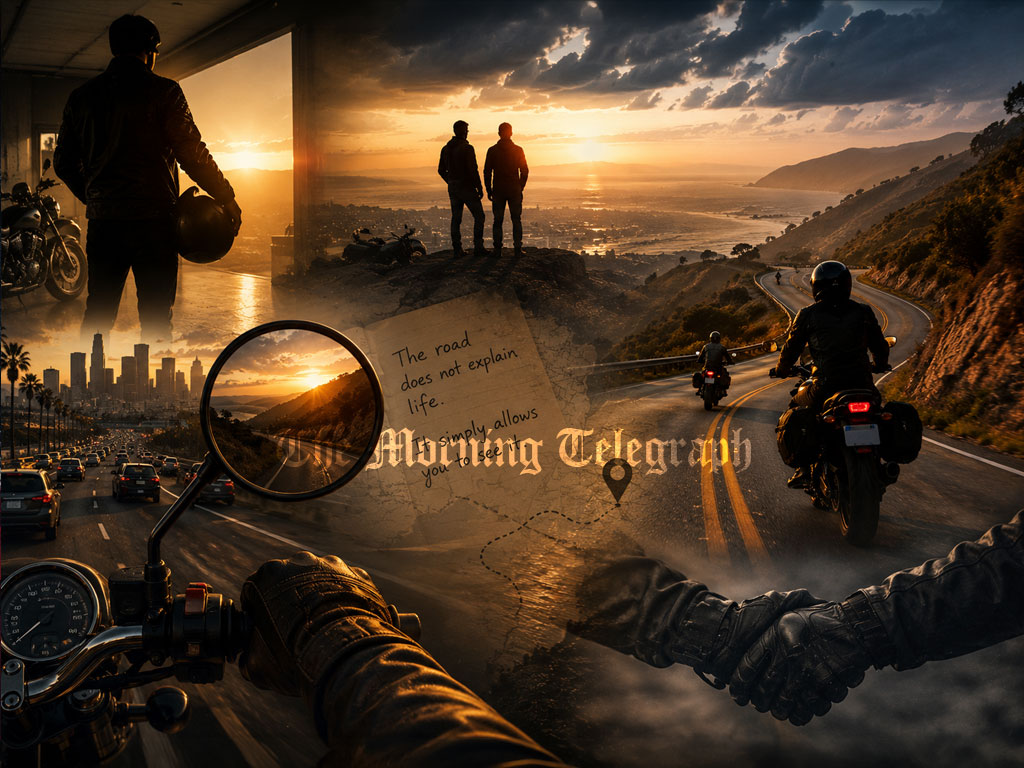
Hours later we stop along one of the canyon lookout ridges, the motorcycles ticking quietly beneath us as the engines cool. Gloves come off slower now than they once did years ago. The body notices longer rides differently these days. And standing there together looking back toward the distant city, much of the noise of modern life softens.
The competition, The pressure., The endless movement.
The constant feeling that everyone is trying to become something, prove something, reach something.
All of it grows quieter against the sound of wind moving through the hills behind us.
And standing there I think about something riding has been quietly showing me for many years now.
Human beings suffer most when we lose honest contact with the movement of life itself. When we become so sealed inside schedules, ambitions, distractions, grievances, screens, and endless urgency that the actual texture of being alive slowly fades beneath it all.
Perhaps this is why “Riders on the Storm” by The Doors continues reaching people across generations, riders and non-riders alike.
Because all human beings are moving through storms of different kinds.
Storms of ambition, Storms of grief, Storms of loneliness, Storms of confusion., Storms of becoming.
And somewhere between the machine, the movement, the open road, and the exposure to everything modern life tries to filter out, riding sometimes removes enough distraction for a person to simply see life again.
Clearly, Honestly, Without performance.
By early evening the light has turned into that long golden Southern California warmth that makes everything briefly feel softer. Descending back toward the city, I pass beach traffic slowly making its way home, families quiet and sun-tired in their cars, restaurant parking lots beginning to fill for early dinners, the city gradually shifting from afternoon into evening.
Traffic returns.
Noise returns.
The streets fill again.
But inwardly something remains quieter.
The ride has not solved life.
It has simply reminded me how to observe it again.
And perhaps that is enough.
Because none of us truly own the road.
We are all simply traveling through it together for a little while.
Author’s Note
This piece reflects many years of riding through highways, canyon roads, coastlines, desert crossings, and the quieter roads that run through a life. Over time, riding became inseparable from the way I observe humanity, nature, aging, awareness, and the movement of being human itself.
To fellow riders everywhere, and to anyone moving through their own kind of storm, may the road keep returning you to yourself.
About the Author
Roshan Jayasinghe is a writer and observer of human systems. His work explores the gap between man made constructs and lived humanity, with a focus on how economics, trade and everyday choices intersect with questions of fairness, responsibility and inner alignment. Through essays for publications in The Morning Telegraph, he aims to remind readers that they are not passengers in a fixed machine, but active custodians of a shared world.