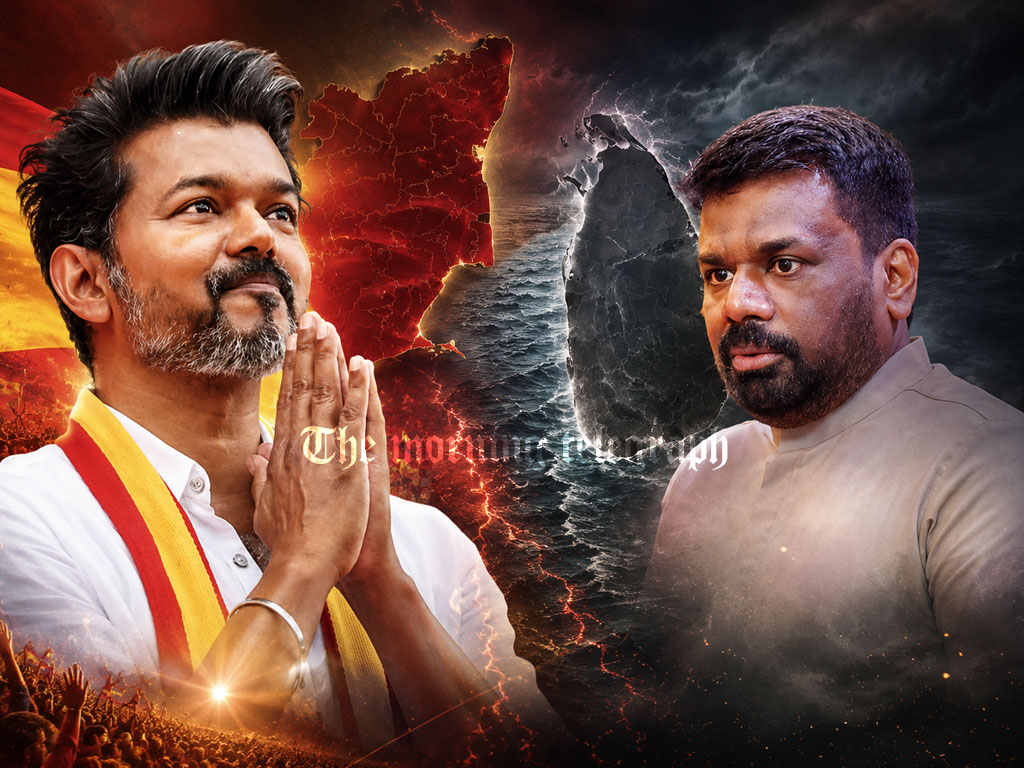
Vijay’s Tamil Nadu rise is reshaping pressure on Sri Lanka, reviving North-East politics, PC election demands, and Colombo’s old strategic fears.
Vijay’s Tamil Nadu rise has begun creating fresh political tremors for Sri Lanka, as Colombo faces renewed pressure from the North-East, Tamil Nadu, and opposition forces demanding long-delayed Provincial Council elections.
With Thalapathy Vijay now assuming office as Chief Minister of Tamil Nadu, a new political axis appears to be forming across the Palk Strait. For Sri Lanka, the implications are no longer distant or theoretical. They are unfolding in real time, through statements, alliances, fishermen’s issues, Tamil political rights, and renewed pressure over the Indo-Lanka Accord.

Uchi Uchi… Thol Thol
Last week, through our Inside Politics column, we revealed that Sri Lanka would not find matters easy once Thalapathy Vijay became Chief Minister of Tamil Nadu. We pointed out that Colombo’s next major political headache could emerge from a united front linking Tamil Nadu with Sri Lanka’s Northern and Eastern Provinces.
That warning now appears to be taking shape.
The political consequences of Vijay’s arrival in power are already being felt. His rise has revived old sentiments, reopened unresolved questions, and given fresh energy to Tamil political forces that had, until recently, seemed weakened and isolated within Sri Lanka’s North-East.
During the last presidential election, parliamentary election, and local government polls, President Anura Kumara Dissanayake and the National People’s Power alliance secured an unprecedented share of votes from the North and East.
For the first time, a Sinhala-majority southern party managed to move ahead of traditional Tamil and Muslim parties in those regions. It was a major political shift, and one that gave the government confidence that it could deal directly with the people of the North-East while paying less attention to the established Tamil and Muslim political leadership.
PC election promise
Perhaps because of that overwhelming mandate, neither the President nor the government paid serious attention during the past year and a half to the remaining Tamil and Muslim parties in the North and East.
Although those parties repeatedly demanded that the Provincial Council elections, promised by the President to the North, be held without further delay, the government showed little positive response.
Even requests for meetings with the President, which were once granted quickly, began facing delays of one or two months.
The reason was simple. The Tamil and Muslim parties in the North and East lacked real political strength.
But with Vijay’s political rise in Tamil Nadu, those parties now appear to have found the missing strength they had been searching for.
These observations are not based merely on newspaper reports, websites, or statements made by politicians. They come from closely watching the political forces, party leaders, and events that helped shape Vijay’s journey to the Chief Minister’s office.
The political battle begins
As we revealed last week, the political battle between Tamil Nadu and Sri Lanka has now begun.
The first sign came when Vijay needed eight additional seats to secure the Chief Ministership. His first major support came from the two seats held by the VCK party led by Thol. Thirumavalavan.
The VCK has long been known as one of Tamil Nadu’s strongest pro-LTTE political voices during the war years. It openly supported the LTTE and its leader Velupillai Prabhakaran. There is no shortage of photographic evidence showing that political relationship.
When Vijay sought VCK support, and when his supporters gathered outside Thirumavalavan’s party office calling on him to back Vijay, photographs published by Indian media showed large cut-outs of Prabhakaran still displayed outside the office.
Images of Prabhakaran standing alongside Thirumavalavan were also clearly visible.
Banned LTTE presence
This is politically significant because the LTTE remains a banned organisation in India.
If a party that still openly displays Prabhakaran’s cut-outs is now backing Vijay, the political implications are serious. They cannot be dismissed casually.
After taking office, Vijay made another unprecedented move. Soon after being sworn in, he personally visited the homes of prominent Tamil leaders who were known for their strong support of the LTTE cause.
Those leaders were Vaiko, Seeman, and S. Ramadoss.
All three were well known during the war for visiting Jaffna and openly supporting the Northern struggle.
But Vijay did not stop there.
After signing welfare gazettes for the people of Tamil Nadu, his second day of official work turned directly toward Sri Lanka.
As soon as possible
At that time, six Tamil Nadu fishermen and their boats had been detained by the Sri Lankan Navy in northern waters.
Vijay immediately wrote to Indian External Affairs Minister S. Jaishankar, demanding urgent intervention to secure their release.
He also pointed out that 54 fishermen and 264 boats were currently under Sri Lankan custody and insisted that all of them must be released.
One phrase in his letter stood out sharply. He demanded action “as soon as possible.”
In diplomatic language, that phrase carries weight.
This first official letter from Vijay confirmed many of the warnings we had already highlighted.
At the same time, while these developments were taking place in Tamil Nadu, several lesser-known but highly significant events were unfolding across Sri Lanka’s North and East.
Mullivaikkal returns to the front
One of the most important was the Mullivaikkal remembrance event centred around Mullivaikkal, the final battleground of the war.
While southern media focused on other political issues, major commemorative events were taking place across the North.
At the opening event in Valikamam, former LTTE leader Thileepan was commemorated with oil lamps. The chief guest was none other than M. A. Sumanthiran, General Secretary of the Tamil Arasu Kachchi.
Many Tamil local councillors also attended the event.
In Batticaloa, Tamil councillors attended council sessions wearing black bands in remembrance of those killed in the war.
Tamil political rights
Meanwhile, in Tamil Nadu, a newly elected VCK legislator made his maiden speech in the State Assembly and strongly argued that the Tamil Nadu government must support the political rights struggle of Tamils in Northern Sri Lanka.
He openly used the term “Tamil Eelam struggle.”
He also stated that while S. J. V. Chelvanayakam fought politically for 25 years, Prabhakaran fought militarily for 30 years.
He argued that although the Indo-Sri Lanka Accord was signed in 1987 with Indian intervention, it has never been properly implemented.
Therefore, he said, Tamil Nadu must press for its full implementation, especially to protect the rights of Tamils in the North and East.
This is where the next major conflict is likely to emerge.
PC elections return to centre stage
The Provincial Council system itself was introduced through the 1987 Indo-Lanka Accord.
Although elections were held regularly in the past, the Yahapalana government elected in 2015 effectively buried them through the delimitation issue.
More than ten years have now passed without Provincial Council elections.
Former Presidents Gotabaya Rajapaksa and Ranil Wickremesinghe also showed no serious interest in holding them.
Before coming to power, however, President Anura publicly promised in Jaffna that Provincial Council elections would be held within his first year in office.
Today, opposition voices accuse him of following the same path as Ranil, delaying rather than delivering.
Even though Minister Vijitha Herath has been tasked with a select committee on the matter, suspicion is growing that the government is more interested in postponing the elections than holding them.
Against this backdrop, another major political development took place last week.
Opposition media briefing
At the Opposition Leader’s Office, SJB General Secretary Ranjith Madduma Bandara, Tamil Arasu Kachchi MP Shanakiyan Rasamanickam, and SLMC General Secretary Nizam Kariapper held a joint media briefing.
This followed discussions between Sajith Premadasa, Sumanthiran, and Rauff Hakeem.
Their message was direct. The government must immediately hold the Provincial Council elections.
What they implied, but did not openly say, was even stronger.
If the government continues to delay, they may withdraw from the parliamentary select committee appointed for the purpose.
For the first time, political forces from the North, East, and South are beginning to align around this demand.
It is impossible to separate this new unity from the political arrival of Thalapathy Vijay.
The battle has begun with the demand for Provincial Council elections. But behind it lies something much larger, the revival of Tamil Nadu’s political influence over Sri Lanka’s North-East.
That is why it can now be said with certainty that further delays are no longer sustainable.
Provincial Council elections are becoming unavoidable, and the political tremors behind the curtain are only just beginning.
Anura’s bridge to Parliament
Last week, through our Inside Politics column, we revealed another important development.
For the first time, the President moved to appoint a Presidential Coordinating Secretary within Parliament, creating a direct bridge between the Presidential Secretariat and Parliament.
The aim was to reduce the growing distance between the President and Compass MPs.
We also reported last week on the several reasons behind this decision.
This week, Inside Politics focuses on what the President did after appointing Mr Kumarasinghe to that role.
The first thing the President did after making the appointment was to come to Parliament for three consecutive days and hold discussions with Compass MPs in the presence of the newly appointed official.
Avoiding the chamber
Usually, when the President visits Parliament, he is expected to enter the chamber and address the House.
However, after appointing this officer, although the President came to Parliament for three straight days, he did not enter the chamber or say a single word in the House on any of those occasions.
This drew considerable attention.
As Minister of Finance, the President carries major responsibility regarding the disappearance of US$2.5 million from the Finance Ministry.
Many were curious as to why he remained completely silent in Parliament on such a serious matter.
Nevertheless, during those three days, the President’s main focus was to meet Compass MPs representing each district separately, with the newly appointed coordinating officer present.
He held lengthy discussions with them.
MPs’ difficulties
During these meetings, MPs presented the problems they were facing in their districts, along with their proposals and concerns.
The President had to listen to a long list of grievances.
The MPs spoke openly about the difficulties they face in getting work done within the government.
They also raised concerns about obstacles placed before Compass MPs by the JVP’s internal political machinery.
They discussed the accusations they face from party supporters and the public when they return to their villages, as well as various personal issues.
One of the strongest complaints was the difficulty of directly reaching the President during urgent situations.
Dirty Dozen?
Some MPs also pointed out that 12 Compass MPs had already sent a letter to the JVP General Secretary expressing deep frustration over these injustices.
They had said they could no longer tolerate the situation.
In response, the President appeared to resolve some of these issues on the spot.
For certain other matters, he explained how they could be handled by speaking directly with the relevant ministers and officials.
He also told MPs that, in future, they could contact him at any time through his Parliamentary Coordinating Secretary and discuss their problems directly.
Why did the President suddenly appoint a Parliamentary Coordinating Officer and spend three consecutive days in Parliament meeting Compass MPs district by district?
Some say the reason is that, unlike during the early days of the Compass government, a group of around 20 to 30 Compass MPs has now developed a close relationship with the SJB and its leader, Sajith Premadasa.
According to that view, the President’s sudden move may have been triggered by this growing political closeness.
Was Tilvin assaulted?
While internal tensions within the Compass government were unfolding, another explosive claim surfaced on social media last week and shook the political stage.
The story was first revealed by Uvindu Kurukulasuriya, who lives in London and is widely seen as someone close to the President and the Compass movement.
In a Facebook post, he claimed that a physical altercation had taken place during a discussion at the JVP headquarters.
As soon as Uvindu shared this information, it spread rapidly across social media.
Many social media activists amplified the claim, alleging that Tilvin Silva, the General Secretary of the JVP, had been assaulted during a discussion at party headquarters.
Various posts began circulating online. Some even created AI-generated images showing Tilvin being attacked and shared them across social media platforms.
Before long, the story had grown into a major public talking point without anyone fully realising how quickly it had escalated.
Social media amplifies the claim
The matter gained more attention when social media activist Milinda Rajapaksha, during a political discussion involving the Pohottuwa camp, publicly commented on the incident while mentioning certain names.
This gave the story added credibility in the eyes of many.
Initially, the JVP had reportedly decided not to respond to the allegations at all.
However, as Uvindu’s post gained momentum and spread further, Tilvin Silva was eventually forced to respond in some form.
He suddenly appeared on a YouTube channel known to be friendly toward him. While discussing the current political situation, he also addressed the allegation.
When the interviewer asked him directly about the incident, Tilvin laughed it off and responded humorously, dismissing the claim.
Yet despite his response, many still believed that some kind of physical confrontation had taken place.
This was clear from the continued circulation of posts and discussions across social media.
Because of this, Compass MPs also began sharing Tilvin’s YouTube interview on their own social media accounts in an attempt to prove that no such assault had occurred.
Rumours refuse to fade
Even then, the rumours did not disappear.
As a result, last week Tilvin went a step further by appearing live on the state-owned Independent Television Network, where he once again rejected the story and said the allegation was false.
Still, the political “bomb” ignited by Uvindu did not cool down.
Some social media discussions then began linking K.D. Lalkantha to the alleged assault.
As attention shifted toward Lalkantha, he too addressed the media and strongly criticised social media for spreading such claims.
Despite the many versions circulating online, we were unable to find confirmed evidence proving whether the incident actually took place.
However, regardless of the denials, a significant section of society still believes that some kind of assault happened inside the JVP headquarters.
Political backlash grows
Following the alleged assault incident said to have taken place at JVP headquarters, the party was hit by another ideological setback.
This time, the issue was President Anura Kumara Dissanayake’s appointment of Eran Wickramaratne, an opposition seat organiser and office-bearer from another party, to a position in a government institution.
This marked the first time the JVP had given such a post to a senior figure from outside the party structure.
Many were surprised.
People questioned why, despite having so many educated professionals, intellectuals, scholars, doctors, and professors within the Compass movement and the JVP itself, the government had chosen a representative from the SJB for such an important appointment.
What made the matter even more surprising was that senior government figures such as Bimal Rathnayake, K.D. Lalkantha, and Wasantha Samarasinghe openly defended the appointment.
They said the government was prepared to bring more talented individuals from the opposition into its fold.
That only deepened public suspicion.
The 76-year curse
For years, the JVP built its political campaign around the idea of ending the “76-year curse.”
It accused all 225 MPs in Parliament of corruption.
It repeatedly claimed that every politician with wealth in hand was dishonest and corrupt.
It also strongly condemned the long-standing political practice of crossovers and defections in Parliament.
At the time, the JVP insisted that under a JVP-led government, this “head-count politics” would end, and no MP would be allowed to switch sides.
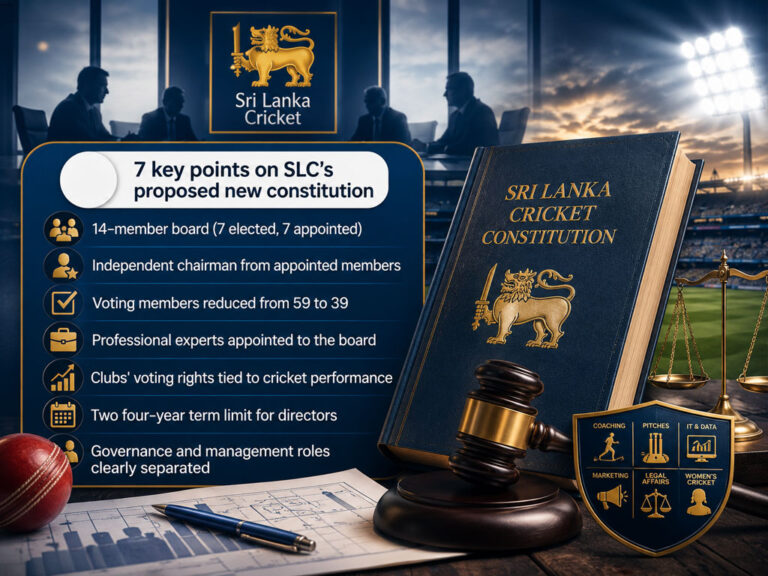
However, the same JVP that once branded all 225 MPs as corrupt and campaigned against the old political order has now handed the chairmanship of the Cricket Board to Eran Wickramaratne, someone who was himself part of the very Parliament they once condemned.
This move has caused serious damage to the ideological foundation the JVP carefully built in society over many years.
At the same time, reports began emerging that several more opposition MPs were preparing to join the government.
One of the names most frequently mentioned was Harsha de Silva.
Social media reports claimed that Harsha was preparing to join the government, possibly with the posts of Finance Minister and even Prime Minister on offer.
Harsha in the news
As a result, Harsha reportedly received continuous calls from various sides throughout last week.
Everyone was asking him the same question: Was the story true?
The pressure became so intense that he had to issue not one, but two public statements on Facebook denying the claim.
His second statement was released while he was in the United States.
In it, he said the government had already failed, that it was damaging the country’s economy, and that he had absolutely no intention of joining it.
He further stressed that he would continue to represent the right-of-centre political camp.
However, the final line of that statement created more confusion.
Harsha ended by saying that he was always ready to take responsibility if needed.
While the line was clearly intended as a rejection of the rumours, those few words were enough to keep the speculation alive.
The issue intensified further because of comments made by Tissa Attanayake, S. M. Marikkar, and Charith Abeysinghe during media briefings last week.
Tissa claimed that senior figures in the Compass government were carrying out a major operation to lure SJB MPs into the government.
According to him, they had even begun visiting the homes of opposition MPs for direct discussions.
He further alleged that senior Compass figures had visited the homes of SJB MPs in three different districts.
In one case, the wife and son of an MP had reportedly scolded and chased away a senior Compass figure from the house.
Public reaction turns against the move
Marikkar also said this matter had been discussed extensively within the SJB management committee.
He added that some MPs had shared their experiences humorously with fellow party members.
Charith Abeysinghe said that although he had joined the SJB only about a year and a half ago, he too had started receiving indirect messages from ministers and MPs in the Compass government through business intermediaries.
Although the President and the Compass government may have hoped to gain political advantage by appointing a former opposition MP to a government institution, public reaction appears to have turned it into a political disadvantage.
Especially for a party like the JVP, which once stood firmly against bringing in MPs from major opposition parties, this shift has created disappointment among those who voted for them on principle, as well as among neutral voters.
Perhaps sensing the growing public anger, Tilvin Silva attempted to distance himself from the decision during a political programme on ITN.
When asked about the appointment, he casually responded that it was a decision made by the President.
By placing responsibility on the President, Tilvin appeared to be trying to protect both the JVP and Pelawatte from the backlash.
Otherwise, as he usually does, he would have defended it as a collective party decision.
Internal divisions?
His refusal to do so suggests that even within the government, there may be internal divisions over Eran’s appointment.
Tilvin also stated that rather than bringing opposition MPs directly into Parliament, the government was willing to appoint talented individuals from other parties to positions such as chairmen and directors of institutions.
That too was seen as a clear signal.
Ministerial portfolios may remain closed, but institutional power positions are very much open.
Meanwhile, reports suggest that the second stage of the SJB’s allegations may emerge in the coming days.
According to sources, the SJB is preparing to release either recorded phone calls from JVP seniors to SJB MPs or CCTV footage showing senior JVP figures visiting the homes of opposition MPs.
If that happens, many believe the JVP could face the same political consequences once faced by leaders such as Chandrika Kumaratunga, Mahinda Rajapaksa, and Ranil Wickremesinghe.
This would be the very political culture the JVP once vowed to destroy.
Another crack in the wall
During the recent local government elections, one of the strongest political narratives built by the JVP was that it would secure control of the majority of local councils on its own.
It insisted that it would not join hands with any other party to seize power.
At one point during the campaign, even the Prime Minister publicly stated that the JVP would never form alliances with any other party.
She also said that apart from the Compass alliance, all other political parties were corrupt.
However, after the elections, the Compass alliance turned those very words upside down.
To establish power in several local government bodies, it ended up forming alliances with almost every party it had once labelled corrupt, except the SJB.
In some places, the Compass even joined hands with the Pohottuwa, a party it had fiercely attacked, and shared chairman and deputy chairman positions.
In other areas, it worked with the UNP, the SLFP, and the parties of Arumugam Thondaman, Rishad Bathiudeen, and Rauff Hakeem to capture power.
At that time, because of the victorious political atmosphere surrounding the government, there was little visible public resistance to these alliances.
But last week, one particular incident brought the JVP’s alliance politics back into sharp public focus.
Deputy Mayor arrested
This was the arrest of the Deputy Mayor of the Kurunegala Municipal Council, where the Compass holds power, while allegedly attempting to accept a Rs. 3 million bribe.
Media outlets widely reported that the Deputy Mayor of a Compass-controlled council had been caught accepting a bribe.
As the story gained major publicity, the JVP quickly issued statements clarifying that the person arrested was not a JVP or Compass representative.
Instead, he was a councillor from the All-Ceylon Makkal Congress, the party led by Rishad Bathiudeen.
This confirmed that when the Compass established power in the Kurunegala Municipal Council, it had done so through an alliance with Rishad’s party.
The Compass took the Mayor’s post for itself while handing the Deputy Mayor’s position to Rishad’s side.
What stood out most was that the same JVP, which built a massive public narrative around ending the “76-year curse,” was still operating within that same old political culture.
What was once seen only in national politics is now spreading into village-level politics.
By-election on the horizon?
At the same time, a recent order issued by the Supreme Court to the Election Commission has signalled that the political battlefield may become even hotter in the coming months.
The Court directed the Commission to immediately begin delimitation work related to the Sammanthurai Municipal Council and the Kalmunai Pradeshiya Sabha and proceed with holding elections for those institutions.
Before the proportional representation system was introduced, under the old first-past-the-post voting model, countries like the UK and the US regularly held by-elections.
Those by-elections often served as tests of a government’s popularity.
However, with the shift to proportional representation, Sri Lanka largely lost this by-election tradition.
Now, such elections usually happen only when court cases or legal complications delay polls in a specific local authority.
A good example was the Elpitiya Pradeshiya Sabha election.
Due to legal proceedings, that council alone did not hold elections alongside the 2023 local government elections.
Once the court case ended, the election was scheduled just before the 2024 Presidential Election.
At that time, with the final phase of the Gotabaya Rajapaksa government creating widespread dissatisfaction, both the Compass alliance and the SJB had gained strong popularity.
As a result, the Compass emerged first and the SJB came second in Elpitiya.
However, even though the Compass won, it failed to secure an outright majority.
Reflection of Elpitiya
Interestingly, the 2024 Presidential Election later reflected almost the same pattern seen in Elpitiya.
In that sense, the upcoming Sammanthurai and Kalmunai elections may function like mini by-elections.
They could offer an early reading of what future major national elections may look like.
During the last Presidential Election, Parliamentary Election, and Local Government Election, the Compass secured strong majorities across the North and East.
But over the past year and a half, its influence in the Eastern Province appears to have weakened.
Political analysts argue that its support in the South has also shown signs of strain.
That means the government is now placing heavy hopes on votes from the North, East, and plantation regions.
This makes victories in Sammanthurai and Kalmunai equally crucial for both the government and the opposition.
Before the PC elections
The person who seems to have understood this signal most clearly is Opposition Leader Sajith Premadasa.
As soon as the Supreme Court ruling was delivered, Sajith reportedly requested all voting pattern reports from previous elections in Sammanthurai and Kalmunai.
He quickly arranged several special Zoom discussions with SJB seat organisers in those areas.
He also held separate talks with Rauff Hakeem and Rishad Bathiudeen, leaders of the broader Samagi Jana Alliance.
Last week, the presence of Muslim Congress General Secretary Nizam Kariapper and Tamil Arasu Kachchi MP Shanakiyan Rasamanickam at a discussion held at the Opposition Leader’s Office reflected the outcome of those efforts.
Under the current situation, elections in Kalmunai and Sammanthurai may need to be completed before any future Provincial Council Election in the North-East.
Through those results, all major political parties may get an early preview of what lies ahead in the next Presidential Election, or even the next General Election.
The grand rally ended as a conference
After the success of the SJB May Day rally, Inside Politics spent the past few weeks exposing two “ghosts” within the UNP who were allegedly working behind the scenes to break the growing unity between the SJB and the UNP.
Last week, we even revealed the names of those two figures.
By now, readers should have a clear idea of who these “ghosts” are.
Following the strong SJB May rally, these two figures reportedly chose a new path to disrupt SJB-UNP unity.
This time, they brought former minister G. L. Peiris to the forefront.
They began gathering representatives of several defeated political parties at G.L. Peiris’s residence, trying to find a way to slow down the steady rise of the SJB.
The SJB had been strengthening its position among the public day by day.
Eventually, the decision was made to organise a massive rally in Matara under the banner of the so-called “Joint Opposition,” bringing together several non-parliamentary parties.
The responsibility of mobilising the crowd was handed to UNP National Organizer Sagala Ratnayaka.
Sagala then began contacting UNP organisers across the Matara District, promising transport facilities and buses to bring supporters to the Matara rally.
However, within a few days, he reportedly realised that the expected positive response from UNP supporters was not coming.
No leaders on stage
As a result, what had originally been planned as a massive public rally at the large Matara Sanath Jayasuriya Stadium was eventually downgraded into a conference at the Sanasa Hall in Nupe, Matara.
Even then, it became clear that the UNP alone could not fill even the hall.
At that point, Sagala reportedly turned to Duminda Dissanayake, a senior SLFP figure, and asked for help in bringing people to the event.
Duminda is said to have informed SLFP representatives in Matara to attend.
Along with the UNP, the conference included the SLFP, Patali Champika Ranawaka’s United Republic Front, the Sri Lanka People’s Party, former political factions linked to G.L. Peiris, and around 18 organisations.
Despite all of that, only around 600 people reportedly attended.
Many viewed that detail as highly significant.
At the conference, figures such as Sagala Ratnayaka, Chamara Sampath Dassanayake, Champika Ranawaka, and G.L. Peiris addressed the gathering.
But the most striking feature was this: although the event was organised under UNP leadership, none of the party’s young, electorally strong, high-profile MPs was seen on the Matara stage.
There was no sign of UNP Deputy Leader Ruwan Wijewardene, Deputy General Secretary Harin Fernando, Deputy Chairman Navin Dissanayake, or Akila Viraj Kariyawasam.
Even more notably, UNP General Secretary Talatha Athukorala, who had earlier mocked the SJB by publicly announcing through a press conference that the UNP would not attend the SJB May rally, was also absent.
Whether this was due to the heavy backlash she reportedly received from party supporters after that press conference remains unclear.
Reality surfaces
For some time now, senior UNP figures have been accusing SJB leader Sajith Premadasa of delaying and weakening SJB-UNP unity.
They have argued that Sajith keeps dragging the process without making a final move.
However, last week, a strong UNP activist posted a special letter on Facebook, one that very few had seen before.
The activist sharply criticised UNP leader Ranil Wickremesinghe over his refusal to attend the SJB May rally.
The letter showed that SJB General Secretary Ranjith Madduma Bandara had formally and respectfully invited Ranil to attend the rally.
Yet, according to the criticism, Ranil completely ignored the invitation and acted as if it carried no importance.
This became another point of frustration among those who believe opposition unity is essential.
The letter sent by Ranjith Madduma Bandara to the UNP leader was presented as clear evidence that the SJB had, in fact, made the effort for unity.
That contradicted claims that Sajith was the one blocking it.
Ranjith’s letter
Hon. Ranil Wickremesinghe,
“Enough Lies, Now the Thieves – May Day of the Alternative”
A Respectful Invitation
All arrangements have been made for the May Day celebration organised by the Samagi Jana Balawegaya under the theme “Enough Lies, Now the Thieves – May Day of the Alternative”, which will be held on May 1st at 2:00 PM at the P.D. Sirisena Grounds in Maligawatta.
It is no secret that the common hope of the supporters of both the Samagi Jana Balawegaya and the United National Party is to see our two parties move forward together on a united political journey.
At a time when leadership-level discussions regarding this matter are progressing very successfully, I strongly believe that the participation of either yourself, or a representative delegation representing the leadership of the United National Party, at the May Day programme organised by the Samagi Jana Balawegaya would greatly strengthen and bless this joint political path between our two parties.
I also respectfully remind you that, on the occasion of the recent anniversary of the United National Party, I, along with a delegation representing the Samagi Jana Balawegaya, took part in that event.
Therefore, I take this opportunity to respectfully invite you to join this May Day programme and kindly request that either you personally, or a representative or delegation representing the United National Party, participate in the event.
Furthermore, I would also respectfully request that you provide a goodwill message for this programme titled “Enough Lies, Now the Thieves – May Day of the Alternative.”
I especially pray for your speedy recovery and wish you good health and strength.
Thank you.
Yours sincerely,
Ranjith Madduma Bandara (MP)
General Secretary
Samagi Jana Balawegaya
Namal was called
Although the Matara conference turned out to be a failure, the UNP’s “news plant” group and its internal “ghosts” worked hard to project it as a success.
But Ranil Wickremesinghe himself wanted to know whether the event had truly been successful.
After quietly checking with various sources, Ranil reportedly learned that the gathering had been a complete failure and that none of the major UNP heavyweights had even attended.
With that in mind, and determined to somehow disrupt the forward momentum of the Samagi Jana Balawegaya, Ranil sent a message last week asking a special guest to come and meet him.
That guest was none other than Namal Rajapaksa, the National Organizer of the Pohottuwa.
Ranil had initially asked Namal to meet him on Tuesday.
Namal reportedly replied that he had an important engagement that day and would instead come on Wednesday.
Accordingly, after Namal arrived on Wednesday and the two exchanged pleasantries and general updates, Ranil moved to the real purpose of the meeting.
Pohottuwa enters the discussion
Ranil told Namal that the time had now come for the Pohottuwa to join the series of conferences being organised by the so-called Joint Opposition.
But Namal gave an immediate and sharp reply.
“Why don’t you bring the SJB into this first?” he asked Ranil directly.
Ranil responded by saying that the SJB was unwilling to join.
Namal then reportedly replied:
“Even if we don’t come to that conference, the best thing at this moment is for the SJB and the UNP to come together. That is the best way to strengthen the opposition.”
Ranil again responded by saying that discussions to reunite the SJB and the UNP were still ongoing.
Namal, however, repeated that while the Pohottuwa could work together with the Joint Opposition on certain specific matters, the best and most practical first step right now would be for the SJB and the UNP to unite.
Ranil’s rescue attempt
Through this discussion, it became clear that Ranil was trying to rescue the failed Joint Opposition conference in Matara by bringing the Pohottuwa into its next phase and giving it greater political weight.
But Namal’s answers showed that he clearly understood Ranil’s political calculations and tactical manoeuvring.
By now, Namal appears to have become experienced enough in politics to recognise such moves immediately.
Toward the end of the conversation, however, one particular statement made by Ranil reportedly caused Namal’s eyes to widen.
Ranil is said to have made a striking remark targeting a powerful opposition political figure.
Although Inside Politics has received details of that statement, we are not revealing it to the country at this moment.
But we note here that, at the right and decisive moment, we will expose the proposal Ranil made to Namal, with evidence and proof.
Meanwhile, another important message reportedly came last week from the highest levels of the UNP to both its “news plant” group and social media activists loyal to the party.
That message instructed them to prepare for a major political attack targeting the SJB and Sajith Premadasa in the coming days.
It is also said that they were specifically asked to ensure massive media coverage for that campaign through multiple media channels.
SOURCE:- MAWRATANEWS.LK