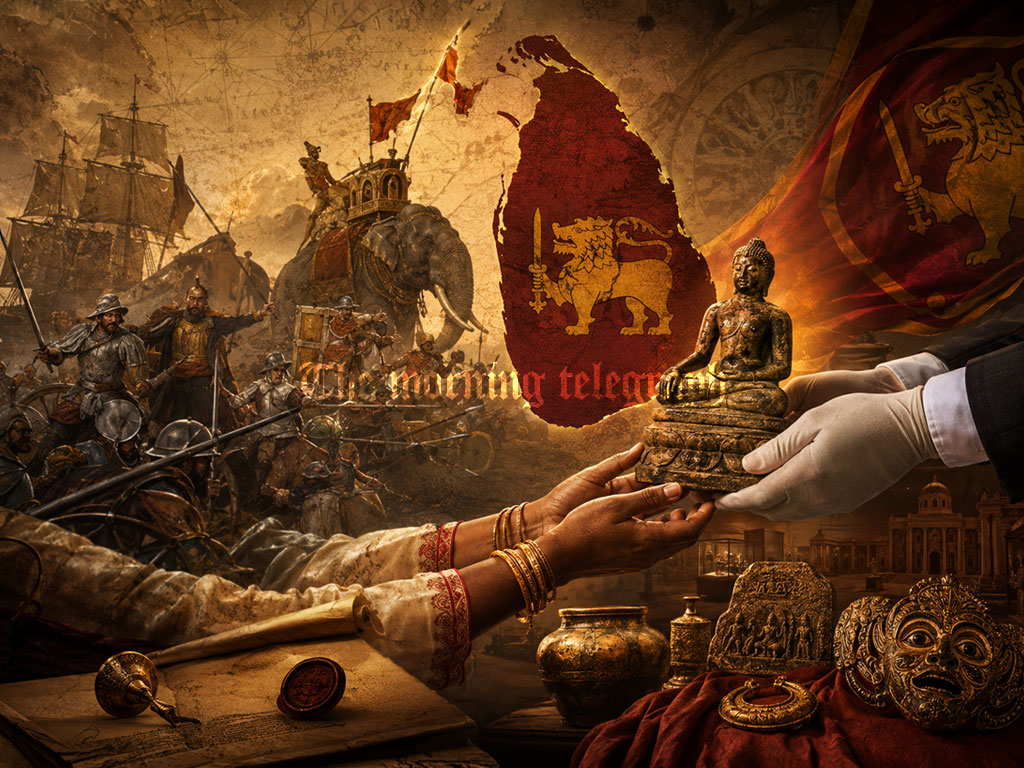
Sri Lanka demands return of cultural artifacts stolen by the Dutch during colonial era. Acting Minister Arun Hemachandra speaks at “Whose Law?” conference in Colombo.
The Acting Minister of Foreign Affairs, Foreign Employment and Tourism, Hon. Arun Hemachandra, addressed the inaugural session of the “Whose Law?” research conference held in Colombo.
This conference was an important platform bringing together legal experts, historians, researchers, museum professionals, policymakers, and international partners, focusing on the cultural heritage removed during the colonial period, specifically examining primary historical source research, legal and historical investigation, and cultural aspects.

The event was attended by the Deputy Ambassador of the Kingdom of the Netherlands to Sri Lanka, Mr. Evan Ruitjens, the Deputy Minister of Buddhasasana, Religious and Cultural Affairs, Hon. Muneer Mulafar, Hon. Yasantha Kodagoda, the Vice-Chancellor of the University of Colombo, Professor Indika Karunathilaka, and the Co-Chair of the conference, Dr. Darshi Thoradeniya, among other invitees.
In his remarks, Acting Minister Hemachandra stated that this conference was not a diplomatic or political event, but an important dialogue where law, history, culture, justice, and diplomacy converge.
He emphasized that cultural objects removed during the colonial period should be regarded not merely as museum artefacts, but as the living heritage, identity, and historical memory of nations and peoples.
He appreciated the collaboration between the University of Colombo, Vrije Universiteit Amsterdam, the Wereldmuseum in Leiden, the Netherlands Sri Lanka Foundation, and the Dutch Research Council, and also acknowledged the positive contribution of the Kingdom of the Netherlands.
The Acting Minister stated that Sri Lanka’s approach to reclaiming its cultural heritage should be policy-driven, evidence-based, and diplomatic. He further stated that such efforts should be seen not as confrontational, but as an opportunity to build relationships with history through mutual understanding and responsible international cooperation.
Mentioning Sri Lanka’s civilisational heritage and his personal connection to Trincomalee, he pointed out that heritage lives not only in museums but also in landscapes, coastlines, and the message carried by the people.
He also emphasized that primary source research, legal clarity, institutional coordination, public awareness, and international cooperation must be further strengthened to advance Sri Lanka’s national interests regarding its cultural heritage.
Concluding his speech, he stressed that the past must be transformed into a methodology, research into policy, and restitution into a partnership, and that Sri Lanka must stand as the custodian of its civilisation.
The Ministry of Foreign Affairs, Foreign Employment and Tourism is committed to advancing dialogue, research, cultural cooperation, and policy-driven diplomacy with international partners, academics, museums, and governments regarding matters related to Sri Lanka’s heritage.