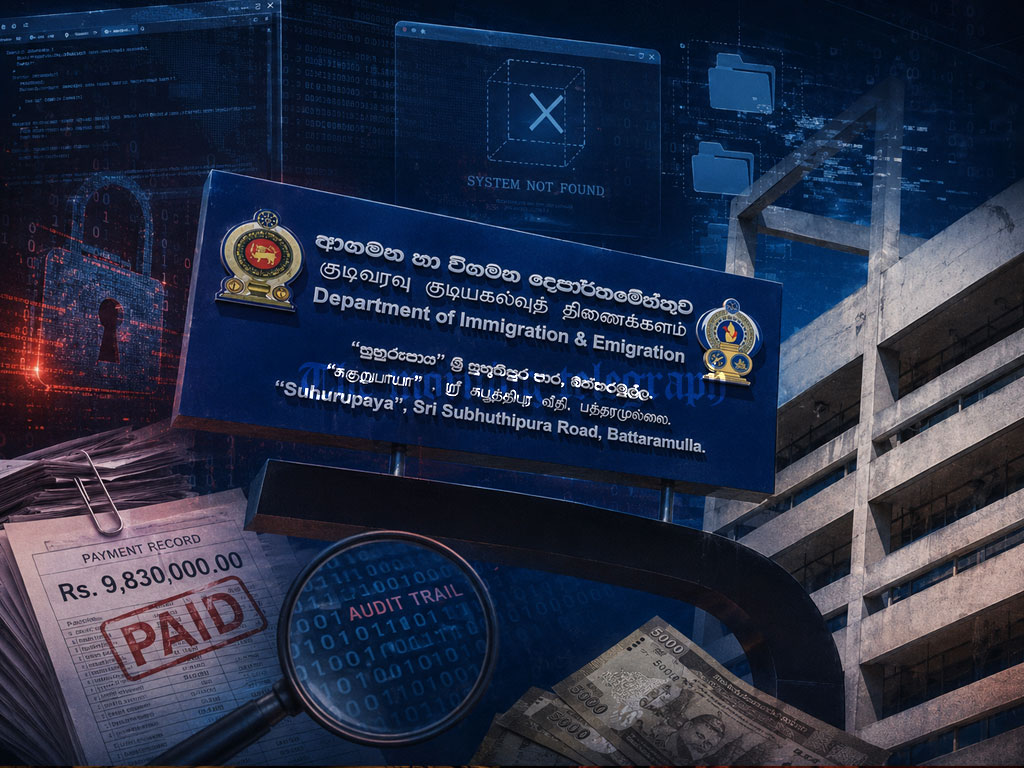
Immigration fraud probe exposes Rs.9.83 million payment for a digital system that never existed, with CID arresting an IT official.
Immigration fraud allegations have deepened after investigators uncovered that Rs. 9.83 million was paid for a digital system that was never developed.
Following extensive investigations into an alleged large-scale software procurement fraud within the Sri Lanka Department of Immigration and Emigration, authorities have uncovered a case where more than Rs. 9.83 million in public funds was released for a system that did not exist.

After a lengthy forensic audit conducted by the Financial Crimes Investigation Division of the Criminal Investigation Department, an official of the Department, K. Herath, the IT and Border Control Controller, was arrested on May 14, 2026.
According to investigating officers, the Department had planned to purchase a software platform known as a “User Management Module.”
The system was intended to regulate staff access to immigration data systems, which are considered important for national security, while also strengthening cybersecurity within the Department.
Investigators allege that the suspect official fraudulently certified that the software work had been successfully completed.
Based on that certification, approval was given to release government funds, even though no such digital system had been developed, installed, or made operational.
The software was reportedly meant to manage staff credentials, monitor internal audit activities, and improve security in border control operations.
However, when investigators examined the Department’s servers and procurement archives, they were unable to find records, deployment logs, or operational traces showing that the software had ever been installed.
This has raised serious questions over how technical documents were prepared to show that the project had been completed.
Investigators suspect that fraudulent documentation was used to obtain public funds without any independent verification of whether the system actually existed.
Investigations have revealed that Rs. 9,831,250 was paid to the relevant supplier based on written approvals signed by the suspect.
The arrest was made under provisions of the Prevention of Money Laundering Act and the Public Property Act.
Legal analysts point out that cases filed under the Public Property Act carry strict bail conditions and, if proven, can result in severe prison sentences.
The suspect has been produced before the Kaduwela Magistrate’s Court.
CID officers are now conducting further investigations into how the allegedly defrauded funds were circulated after being released.
According to ongoing investigations, procurement agreements, departmental correspondence, server activity logs, and payment documents are being collected.
Investigators are also examining whether other government officials, private contractors, or intermediaries were involved in the alleged fraud.
The case has once again exposed weaknesses in the state sector, particularly in high-value digital infrastructure projects involving sensitive national data.
Critics say the release of funds based only on internal certifications, without proper independent verification, creates a dangerous opening for corruption.
They argue that state agencies handling critical data must have a proper mechanism to verify whether software systems are actually implemented before payments are approved.
Security sources indicate that the forensic audit may now be expanded to cover other procurements carried out within the IT division of the Department of Immigration and Emigration.
There is growing belief that further frauds and corrupt activities involving the blatant misuse of public funds may be exposed as the investigation continues.