
Nuwara Eliya Golf Club faces serious allegations over tree destruction, illegal sawing, CCTV concerns and official silence.
Nuwara Eliya Golf Club is facing serious allegations over environmental destruction despite the President’s ban on tree felling above 5,000 feet.
Although the current government repeatedly claims that the law applies equally to everyone, serious information has now emerged regarding alleged misuse of state property and the destruction of a sensitive ecosystem in the heart of Nuwara Eliya city.
The controversy centres on land leased by the Nuwara Eliya Municipal Council to the Nuwara Eliya Golf Club.
The allegations come against the backdrop of a presidential order completely banning tree felling on lands located above 5,000 feet above sea level.

Despite that order, environmentalists allege that large-scale destruction is taking place inside the Golf Club premises.
The silence of responsible institutions, including the Nuwara Eliya Police, the Central Environmental Authority, and the Department of Forest Conservation, has now raised serious public concern.
Attempt To Kill Over 60 Trees Through Ring Barking?
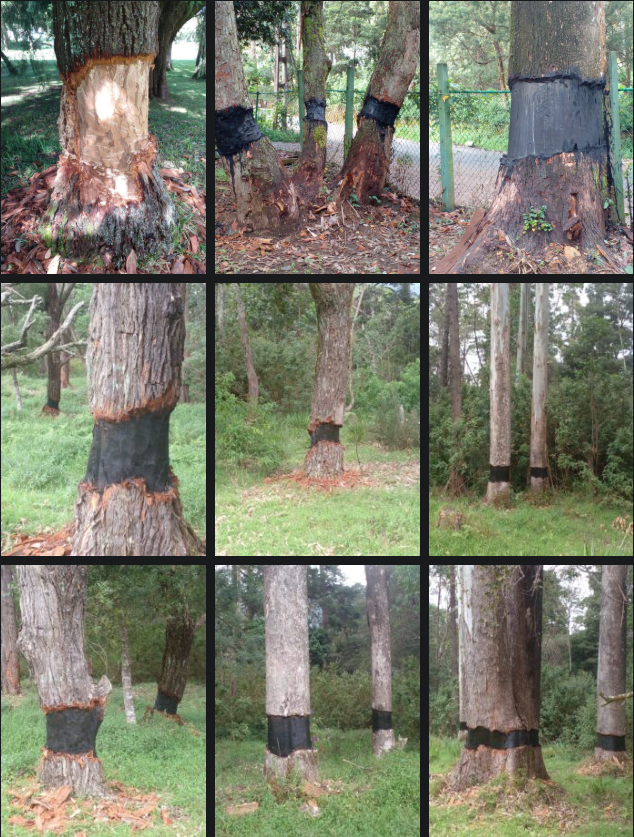
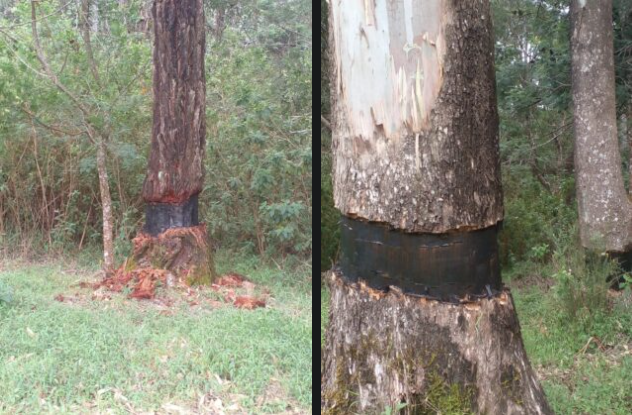
Environmentalist Tissa Seneviratne has lodged formal complaints with the Commission to Investigate Allegations of Bribery or Corruption and other relevant state institutions regarding the alleged environmental destruction.
According to those complaints and testimonies from local residents, five large trees of the valuable Grandis variety on the land have been completely cut down.
It is further alleged that the timber was used for private purposes, including furniture and roof construction.
The complaints also allege that the bark and cambium layer of more than 60 valuable trees, or 52 according to residents’ calculations, had been removed in a circular manner around the trunk.
Environmentalists say this method, known as ring barking, is a cruel technique used to slowly dry out and kill trees.
Although a district committee decision had reportedly required advice from the Haggala Botanical Garden before any changes were made inside this sensitive 5,000-foot zone, environmentalists allege that this requirement was ignored.
They further claim that a sawpit, or sawmill, had been operated illegally on the state land without official permission.
It is also alleged that the land has been gazetted as a protected area of archaeological value.
However, complaints state that no written permission or environmental impact report had been obtained from the Archaeological Department, the Nuwara Eliya Municipal Council, or the Divisional Secretary.
Was CCTV Footage Set To Disappear?
Environmentalists claim they have provided clear video evidence to the police showing illegal timber sawing and the operation of the alleged sawmill.
Despite this, they allege that the Nuwara Eliya Police have failed to seize the relevant machinery or produce suspects before the law.
A further concern has arisen over court case number B/2312/24, filed on November 20, 2024.
According to critics, police recorded and reported the alleged environmental crime merely as a “minor mischief” offence under the Penal Code.
There are also claims that CCTV footage at the location had been set to automatically delete within three days, raising fears that evidence may be lost.
View Complaint Document
Were Investigations Buried Under A Plate Of Biryani?
A separate incident reported on March 6, 2026, has intensified criticism over the response of state officials.
Serious allegations have been made that officials from the Archaeological Department who visited the site for inspection failed to conduct a proper inquiry.
Instead, critics allege that they ate lunch, described as biryani, provided by the accused party, including officials of the Golf Club, and left satisfied.
If state officials can be influenced through hospitality or other inducements to protect wrongdoers, the public is now asking what has happened to the government’s promise of “one law for all.”
Public Anger Grows Over Official Silence
The public gave power to the National People’s Power government expecting it to stop corruption, fraud, and environmental destruction that had taken place under previous regimes.
They also expected wrongdoers to be identified, investigated, and punished.
However, environmentalists and residents say the slow response of authorities has created deep disappointment.
They question whether the public has moved from one bad situation to another while powerful groups continue to bypass the law.
Local residents and environmental activists are now asking whether the country has ended up in a situation similar to “giving ginger and getting chillies” or “jumping from the frying pan into the fire.”
Environmentalist Tissa Seneviratne and civil organisations are urging the authorities to launch an immediate independent investigation.
They are also calling for action against corrupt state officials allegedly involved in protecting those responsible.
They further demand strict punishment under the Anti-Corruption Act against all senior officials connected to what they describe as a massive environmental massacre.