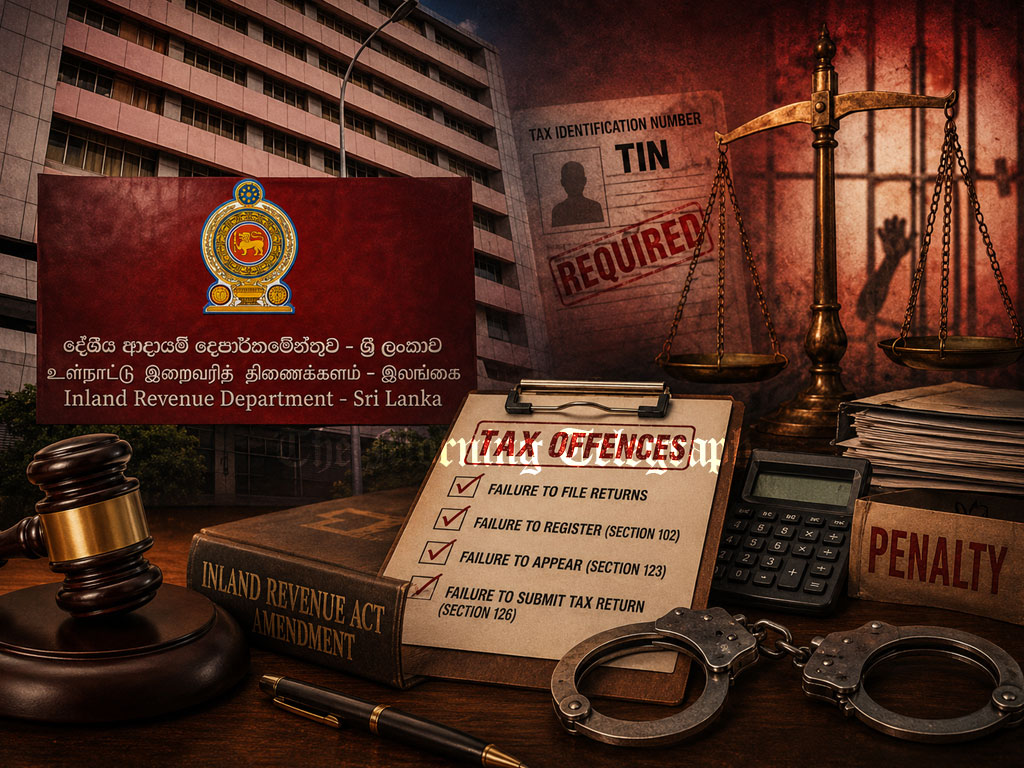
Inland Revenue Act amendments passed in Parliament trigger debate over TIN offences, tax returns, prosecutions, fines and jail terms.
Inland Revenue Act amendments passed in Parliament today have sparked a heated debate over tax offences, prosecutions, fines, and possible imprisonment.
The Bill presented by the government to amend the Inland Revenue Act No. 24 of 2017 was passed in Parliament today, May 19.
Deputy Minister of Economic Development Nishantha Jayawera, joining the second reading debate on the Bill, said the amendment was introduced to remove complications in the existing tax system and address uncertainties identified in tax administration.
The Minister also explained at length the methods introduced through the amendments to simplify tax administration and taxation.
The Deputy Minister further stated that amendments and recommendations given by the Supreme Court regarding the Bill would be incorporated into it.
However, the Opposition criticized the move, especially the naming of several matters, including failure to obtain a Tax Identification Number, or TIN, as criminal offences under the amendment.

What does the Bill say?
According to the Bill presented by the government, several failures can now become offences that may be prosecuted and punished by court.
These include failure to file annual returns, failure to file income returns, failure to register with the Commissioner General as required under Section 102, failure to appear before the Commissioner General of Inland Revenue after receiving notice under Section 123, and failure to submit a tax return under Section 126.
The Bill states that the Commissioner General must deliver written notice to such a person, warning that legal proceedings will be initiated if the required steps to comply with the Act are not taken within thirty days from the date of delivery of the notice.
It further states that any person who, without reasonable cause, fails to comply with a notice issued by the Commissioner General under subsection (1) will commit an offence under the Act.
On conviction after a summary trial before a Magistrate, such a person may face a fine not exceeding four hundred thousand rupees, imprisonment for a term not exceeding six months, or both.
Opposition warns of damage to development
Opposition Leader Sajith Premadasa, joining the debate, strongly criticized the government’s decision to criminalize shortcomings in the tax collection process.
He said the government’s step, which affects individuals, institutions, businesses, and entrepreneurs, further distorts democracy and is a very wrong move.
Premadasa said it would be reasonable to criminalize non-payment of taxes, failure to file a tax return, or failure to obtain a TIN number only if such actions were done intentionally.
He said people already facing immense pressure and inconvenience are now being subjected to further pressure by making delays in tax payment a criminal offence.
The Opposition Leader said this would blunt the country’s development by discouraging new businesses, new investors, foreign direct investment, industrial growth, and tourism sector expansion.
He requested that amendments proposed by the Samagi Jana Balawegaya be included in the Bill to make the process at least somewhat fair.
Namal says TIN failure could bring court action
MP Namal Rajapaksa, also joining the debate, alleged that the government was imposing taxes excessively and was now attempting to enforce repression when people failed to pay those taxes for any reason.
He said the government was now saying that people without a TIN number would face legal cases.
Rajapaksa claimed that if a person does not have a TIN number, that person could be jailed for six months.
He recalled that when the TIN number became a public discussion before the current government came to power, and when the previous government was preparing to implement it as policy, those now in power had opposed it.
He said they previously claimed that a TIN number was not needed to build the country, but after coming to power, they now warn that people without a TIN number could be jailed.
Government explains why the law was changed
Deputy Minister Chathuranga Abeysinghe, joining the debate, explained the reasons for strengthening legal action through the Inland Revenue Act amendment.
He said making certain failures criminal offences and giving the final decision to the Inland Revenue Department were necessary because past tax recovery efforts had faced serious implementation issues.
According to him, when tax assessments were issued earlier, there was no proper place to accept them, and even courts did not have the capacity to accept them effectively.
He said cases were falsely dragged on for ten or fifteen years as a result.
Abeysinghe said cases had already been filed against the individuals mentioned by the Opposition, and action had been taken, but there was no proper process to implement those actions.
He said the new amendment was introduced to fix that gap.
The Deputy Minister further stated that the Bill was presented as part of a broader method to reduce indirect taxes and increase the share of direct taxes.
Government MPs defend timely tax compliance
MP Lakmali Hemachandra, speaking during the debate, said the new amendment seeks to create responsibility around tax payment and build a mindset that non-payment of taxes is an offence.
She said the amendment also aims to create the idea that documents required under tax law must be submitted properly.
Hemachandra said encouraging tax payment, building awareness that tax evasion is wrong, and ensuring that required documents are submitted under tax law are not negative steps.
She added that law-abiding and responsible citizens in the country would not have a problem with acting on time regarding tax payments and the submission of relevant documents.
She said she did not believe that the important and taxpaying people of the country would object to timely compliance.