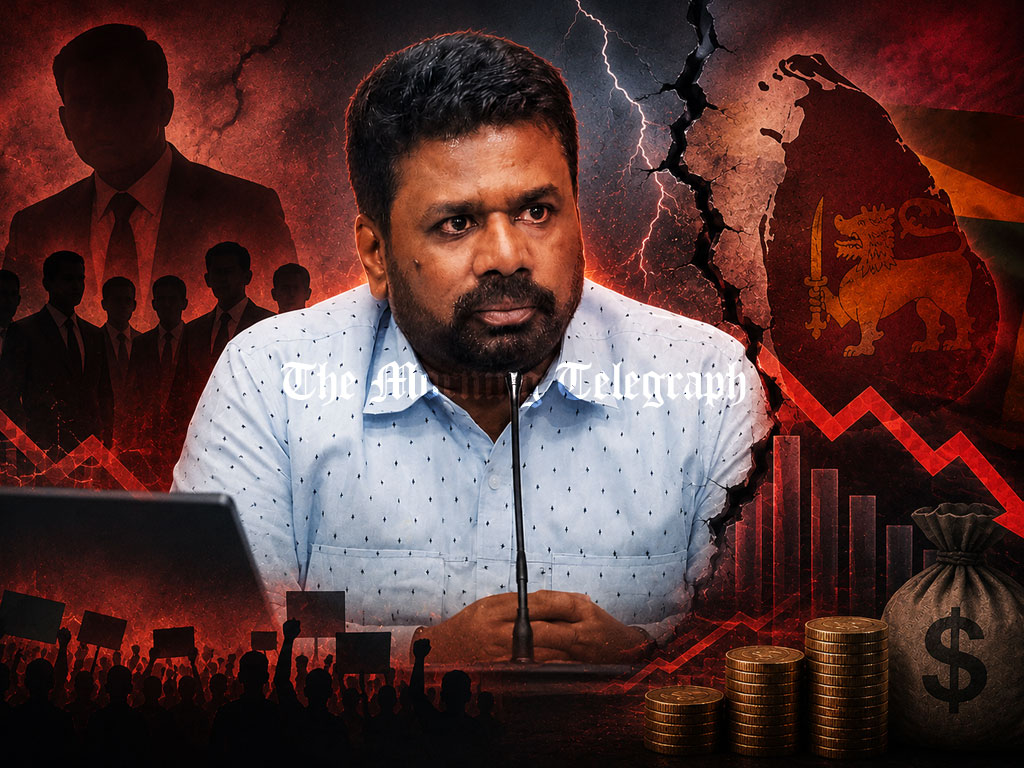
Anura government faces growing political and economic turmoil as resignations, dollar pressure, and internal power struggles deepen.
Anura government tensions are deepening as Sri Lanka faces fresh political and economic pressure, with senior figures reportedly preparing to step away.
For the first time under the Malima government, political circles now openly acknowledge that the country is facing a measure of economic strain.
That pressure is also beginning to create signs of a political crisis inside the government.
From 1994 onward, Sri Lanka experienced a long period of political continuity.
Chandrika Kumaratunga completed her presidency from 1994 to 2005.
Mahinda Rajapaksa then governed from 2005 to 2015, showing how powerful executives could maintain authority for nearly a decade.

Stability Gives Way To Crisis
That stability began to collapse after 2015.
Maithripala Sirisena served only around four years and did not contest again.
Gotabaya Rajapaksa, elected in 2019, was forced to resign after just three years following mass protests and national unrest.
Ranil Wickremesinghe, who completed the remainder of Gotabaya’s term, was then rejected at the next presidential election.
After three unstable administrations, the Malima alliance secured both the presidency and a two-thirds government.
But just 18 months later, President Anura Kumara Dissanayake’s government appears to be confronting serious political and economic turbulence.
Hanif Yusoof Resignation Blow
Political crises often begin when insiders and moderate supporters start distancing themselves from a government.
That is why the reported resignation move by Western Province Governor Hanif Yusoof has triggered major discussion.
Yusoof is widely considered one of President Dissanayake’s closest associates.
A prominent businessman, he had maintained close ties with the President even before the last election and had reportedly played a behind-the-scenes role in several political operations.
However, the question of whether Yusoof would remain as governor had reportedly existed for nearly a year.
Media reports last August had already suggested that he was considering stepping down.
Pelawatta Pressure Allegations
According to political sources, Yusoof had become unhappy over claims that informants connected to Pelawatta had been placed around him.
These individuals were reportedly interfering in his work and influencing decision-making.
Yusoof is said to have met the President directly and explained that he could not continue under such conditions.
At that stage, the President reportedly urged him not to resign, warning that such a move would damage him politically.
Yusoof agreed to remain in office at the time.
This time, however, Yusoof released a media statement announcing his resignation while saying he remained willing to serve as the President’s adviser on foreign investment.
Translation Dispute Deepens Controversy
Several interpretations are now circulating.
One theory is that pressure from Pelawatta-linked informants pushed Yusoof to leave.
Another is that, as an experienced businessman, he may have sensed a deeper economic crisis approaching and decided to step away early.
A further controversy has emerged over the Sinhala wording of the resignation statement.
Sources say the original statement was drafted in English, as Yusoof generally conducts official work in English and reportedly has difficulty reading Sinhala fluently.
However, the Sinhala version released to the media allegedly used stronger wording than the English draft.
Some inside the Governor’s Office now suspect that phrases may have been altered during translation.
Whatever the cause, Yusoof’s resignation has created a negative political impact on both the President and the government.
Mahinda Samarasinghe Exit Rumours
An even bigger development may now be approaching.
Sri Lanka’s Ambassador to the United States, Mahinda Samarasinghe, is reportedly preparing to resign from his current position.
Samarasinghe is widely respected across government and opposition circles as an experienced administrator and diplomat.
He has reportedly played a major role behind the scenes in helping Sri Lanka manage difficult international economic and political challenges.
His possible departure would send a far more serious message than Yusoof’s resignation.
According to information available to political sources, Samarasinghe is preparing to leave before completing his official term.
He is expected to return to Sri Lanka and spend time away from politics.
However, powerful political parties are reportedly already preparing to invite him back into active politics.
If he steps down, his exit could open the door to deeper political challenges for the government.
Presidential Secretariat Power Struggle
Another major discussion now surrounds possible changes inside the Presidential Secretariat.
Recent political reports claimed that Kumarasinghe had been appointed as a special parliamentary coordinating secretary to bridge the growing distance between the President and Parliament.
Following that appointment, the President reportedly attended Parliament for three consecutive days, meeting Malima MPs district by district.
Behind that coordination role, political sources point to Prabath Chandrakeerthi, the President’s Chief of Staff.
Chandrakeerthi is increasingly seen as one of the most powerful figures inside the Presidential Secretariat.
There is now talk that appointments linked to Bandarawela connections have gained influence under him.
Questions Over Nandika Kumanayake
Social media reports recently claimed that Presidential Secretary Nandika Sanath Kumanayake had been asked to step down.
The reports suggested that Prabath Chandrakeerthi could replace him.
President Dissanayake had appointed Kumanayake, a university contemporary, as Presidential Secretary to improve efficiency.
Although administrative shortcomings have been discussed, Kumanayake is still regarded inside the Secretariat as clean and respectable.
However, Chandrakeerthi’s administrative efficiency has reportedly allowed him to streamline several operations quickly.
Some reports claimed he has been consulted by the President even when appointing secretaries to state institutions.
Yet a highly reliable source has said the President has not made any final decision on removing Kumanayake.
Nandalal Also Under Scrutiny
Another powerful figure now facing speculation is Central Bank Governor Nandalal Weerasinghe.
The government’s biggest economic challenge is the rapid rise of the US dollar.
Responsibility for controlling dollar pressure largely falls on the Central Bank.
The disappearance of US$2.5 million from the Treasury has also raised questions about institutional responsibility.
Nandalal was absent from public view during the height of the controversy, reportedly while on 14 days’ leave in Australia.
After returning, he held a media briefing and said the Treasury was no longer under Central Bank authority.
He explained that it had been moved under the Ministry of Finance after the current government came to power.
His remarks appeared to shift responsibility toward Finance Ministry officials.
Dollar Crisis And COPF Tensions
The dollar crisis and missing Treasury funds were discussed at Parliament’s Committee on Public Finance.
Rauff Hakeem chaired the committee in the absence of Harsha de Silva.
Former Finance Minister Ravi Karunanayake requested that Nandalal be summoned before the committee.
During those proceedings, Nandalal reportedly warned that if the economic crisis worsened, the country could face uncertainty and instability.
After media coverage of those remarks, he held a press conference and said his comments had been misinterpreted.
However, he did not firmly deny making them.
Political circles are now speculating that Nandalal may also be preparing for a decisive move.
If Mahinda Samarasinghe resigns and Nandalal follows, the government could face an economic, political, and administrative crisis at once.
Ranil’s Move Against Sajith And Namal
Another political drama has emerged around former President Ranil Wickremesinghe.
Reports claim Ranil invited Namal Rajapaksa to his residence and urged him to attack Opposition Leader Sajith Premadasa.
Ranil had also allegedly encouraged Namal to participate in Joint Opposition conferences.
Namal reportedly suggested that the SJB and UNP should first work together before discussing wider opposition events.
Political sources now say Ranil was attempting to use Namal to weaken Sajith.
At the same time, there are claims that Ranil-aligned groups were trying to create tension between Sajith Premadasa and Harsha de Silva.
Namal reportedly told close associates that he was not ready to be used in Ranil’s political games.
Joint Opposition Strategy Exposed
Further reports claim that pro-Ranil factions attempted to trap Namal into appearing aligned with Joint Opposition events.
After a weak turnout at a Matara meeting, plans were made for further events in Negombo and Minuwangoda.
A strategy allegedly involved using video discussions with SLPP youth groups to create the impression that Namal supported the project.
However, WhatsApp discussions regarding the plan were reportedly leaked to Namal’s camp.
The leaked exchanges suggested an effort to make it appear that the Joint Opposition had momentum and that Namal could not distance himself from it.
Political observers now believe Ranil attempted to target both Sajith and Namal through the same operation.
Sajith Calls For All-Party Talks
Against the backdrop of the rising dollar and worsening economic conditions, Opposition Leader Sajith Premadasa addressed Parliament on Thursday.
He said opposition party leaders had been invited to an emergency meeting to discuss solutions to the crisis.
The meeting included southern opposition parties as well as Tamil and Muslim leaders from the North and East.
Sajith warned that Sri Lanka’s current IMF agreement ends in March next year.
He said the government must immediately begin talks with the IMF for a successor agreement.
He reminded Parliament that Sri Lanka had approached the IMF during Gotabaya Rajapaksa’s presidency from a position of extreme weakness.
Sajith said the government should not wait until conditions collapse again.
Opposition Leaders Meet
Before the opposition leaders’ meeting, Sajith reportedly held a three-hour discussion with three former IMF officials.
The discussion focused on the crisis, possible consequences, and measures needed to prevent collapse.
At the multi-party meeting, representatives from the SLPP, the Gas Cylinder faction, Tamil Arasu Kachchi, the Muslim Congress, and others were present.
After discussions, Sajith presented a set of proposals.
However, M.A. Sumanthiran argued that the responsibility for resolving the crisis lay with the ruling government.
He proposed that the President should immediately convene an all-party conference.
The group agreed and entrusted Sajith with informing the President.
Sajith later called President Dissanayake, who was touring the Eastern Province.
The President reportedly said he would respond after returning to Colombo.
Ranil-Anura Secret Meeting Claim
Another rumour emerged last week claiming that President Dissanayake and Ranil Wickremesinghe had held a secret meeting.
The claim spread through pro-UNP social media platforms.
Some accounts presented it as a major political development.
However, others recognized it as another planted political story and avoided publishing it.
The rumour eventually reached the President while he was in Batticaloa.
He reportedly dismissed it sarcastically, saying Ranil must have come to Batticaloa if such a meeting had happened.
He also reportedly said he had no obsession with meeting Ranil and asked what advice he would need from him.
With that response, the story quickly lost momentum.